
Outdoor quotes: 26 lines with the book, the chapter and the year
Thoreau at Walden, Muir in a Yosemite storm, Whitman in the open air and Stevenson asleep in a pine wood, every line read out of the complete text it came from. Plus the Muir line page one prints that is not in anything he wrote.

Search outdoor quotes and the line you meet first is credited to John Muir: of all the paths you take in life, make sure a few of them are dirt. It is a good line. It is on mugs, trail signs and a great many social posts. It is not in anything Muir wrote, and the people who keep the record of his writing say so in plain words.
The rest of the results page does not help much. Most of it is picture boards, and not one result tells you which book a line came from, which chapter, or what year. So you cannot tell whether you are quoting Muir, Thoreau or somebody doing an impression of them.
This page took the slow route. Every line below was read out of the complete text it came from and fenced to the chapter or section named on its card. The Muir line is shown too, marked, with the search that failed described so you can repeat it.
This page is about going outside at all: weather, air, the open field, the night spent out of doors. Trails have their own page in hiking quotes, the woods are in forest quotes and remote country is in wilderness quotes. The broad set lives on the nature travel quotes hub.
What are the best outdoor quotes? The short answer
The Muir line page one gets wrong
The circulating version first. It carries no book and no year, because it has neither.
Of all the paths you take in life, make sure a few of them are dirt.
What Muir actually wrote about the pull of the open air is less tidy and more interesting, and it is in the sections below. The misquote list itself is worth a look: the Sierra Club Muir misquotes page names this line alongside several others.
The same summary credits Muir with calling the forest the clearest pathway into the universe. The wording people actually cite, The clearest way into the Universe is through a forest wilderness, is not in any of the books Muir saw into print, nor in the three published after his death that were read for this page. Secondary sources place it in John of the Mountains, a selection from his journals edited by Linnie Marsh Wolfe and published in 1938. This page has not read that volume, so it prints no verdict on the exact wording, and no card: a line about the woods belongs on forest quotes in any case.
The summary also says Muir and Thoreau both described returning to the wilderness as going home. Only Muir did, and he was talking about mountains, in Our National Parks. That sentence already runs on the forest and wilderness pages, so it is not repeated here. Thoreau gets misquoted from the same territory: his line from the essay Walking is in Wildness is the preservation of the World, and it is carded on wilderness quotes with the real wording. Wildness, not wilderness.
Go out at all: Thoreau and Emerson
Concord in Massachusetts produced two of the writers outdoor quotes lean on most, and both were making the same case: the outdoors is not scenery you visit, it is a habit you keep. Emerson wrote it as an argument, Thoreau tried it for two years beside Walden Pond.
It would be well perhaps if we were to spend more of our days and nights without any obstruction between us and the celestial bodies, if the poet did not speak so much from under a roof, or the saint dwell there so long. Birds do not sing in caves, nor do doves cherish their innocence in dovecots.
From the opening chapter of Walden, where Thoreau is mostly talking about houses and what they cost. The argument slips out sideways: a roof is also a thing between you and the sky, and poets and saints spend too long under one.
Every morning was a cheerful invitation to make my life of equal simplicity, and I may say innocence, with Nature herself.
The outdoors as a daily habit rather than an event. Morning is the invitation, and the simplicity is what he accepts by going out to meet it.
This is a delicious evening, when the whole body is one sense, and imbibes delight through every pore.
The opening sentence of the chapter called Solitude. The whole body is one sense is as exact a description of a warm evening outside as you will find.
At the same time that we are earnest to explore and learn all things, we require that all things be mysterious and unexplorable, that land and sea be infinitely wild, unsurveyed and unfathomed by us because unfathomable. We can never have enough of Nature.
The last sentence is the famous one, and it is often printed alone. The sentence before it is the better argument: we want to learn everything and we want the world to stay unknowable, and only the outdoors lets us have both.
To speak truly, few adult persons can see nature. Most persons do not see the sun. At least they have a very superficial seeing. The sun illuminates only the eye of the man, but shines into the eye and the heart of the child. The lover of nature is he whose inward and outward senses are still truly adjusted to each other; who has retained the spirit of infancy even into the era of manhood.
Emerson’s claim is blunt: most grown adults do not really see the outdoors at all. The fix he offers is not a destination but a way of looking, which is why the lover of nature is defined by senses rather than by miles.
In the presence of nature, a wild delight runs through the man, in spite of real sorrows.
Note the last clause. Emerson does not promise the outdoors will cure anything, only that the delight arrives anyway, alongside the sorrow.
The health of the eye seems to demand a horizon. We are never tired, so long as we can see far enough.
A physical claim before it is a spiritual one, and a fair test of any time spent outside: did you see far enough?
Walden and Civil Disobedience (Penguin Classics)
Best for: The book behind this section, if you want Thoreau's case for the outdoors in full
Four of the lines on this page come from Walden. Two honest notes before you buy anything. The text is out of copyright and free in full at Project Gutenberg, which is exactly where we checked every Thoreau line here. The Penguin Classics paperback is worth paying for if you want a physical copy with an introduction and notes, and it binds in Civil Disobedience as well.
Check price
In any weather: Muir and the storm
John Muir is the name the AI summary leans on hardest. The real Muir is better than the posters: a man who treated a storm as a reason to go out. He has no profile on this site yet, which is the largest gap this collection has.
When the first heavy storms stopped work on the high mountains, I made haste down to my Yosemite den, not to “hole up” and sleep the white months away; I was out every day, and often all night, sleeping but little,
Muir on what a Yosemite winter was for. Other people waited for spring. He went out every day, often all night, and slept little. The card stops mid sentence; the list of what he was doing out there runs on.
I was awakened early in the morning by a wild storm-wind and of course I had to make haste to the middle of the Valley to enjoy it.
Of course is the whole card. Muir treats running out into a storm as the obvious response to one, and for him it was.
It is bad weather for exploring but delightful nevertheless, making all the strange, mysterious region yet stranger and more mysterious.
Written in camp at Glacier Bay in Alaska. The weather is bad for the work and good for the experience, and Muir sees no contradiction.
You cannot feel yourself out of doors; plain, sky, and mountains ray beauty which you feel.
From the California chapter of an early journal published after his death. The claim is that some country is so open the word outdoors stops meaning anything, because there is no inside left to compare it with.
When I was a boy in Scotland I was fond of everything that was wild, and all my life I’ve been growing fonder and fonder of wild places and wild creatures.
The first line of his memoir of growing up in Scotland. Everything else he wrote is already in this sentence: the taste came first and only got stronger.
Who ever breasted a snowstorm without being excited and exhilarated, as if this meteor had come charged with latent aurorae of the North, as doubtless it has? It is like being pelted with sparks from a battery.
John Burroughs making the case for winter weather. The battery simile is a Victorian idea of a thrill, and it still lands.
The open air as medicine
Long before anyone measured it, writers were reporting that time outside made them well. None of them had a study to cite. They had their own recoveries, and they wrote them down.
Shall I tell you, reader, to what I attribute my already much-restored health? That I have been almost two years, off and on, without drugs and medicines, and daily in the open air.
Walt Whitman, recovering from a stroke on a farm in New Jersey and keeping a diary of what helped. His answer is a prescription with nothing technical in it at all.
Now I see the secret of the making of the best persons, It is to grow in the open air and to eat and sleep with the earth.
The poem is about the road, but this line is about where people should be made: outside. Eat and sleep with the earth is as literal as it sounds.
How it all nourishes, lulls me, in the way most needed; the open air, the rye-fields, the apple orchards.
A diary entry written outdoors, just after sunrise by his own account. Lulls is the unexpected verb: the open air as something that calms rather than excites.
After you have exhausted what there is in business, politics, conviviality, love, and so on–have found that none of these finally satisfy, or permanently wear–what remains? Nature remains;
The question anyone who has chased a career eventually asks, and a very short answer. The doubled hyphens are the printed text’s, reproduced as it has them.
When I come back, I go to Nature to be soothed and healed, and to have my senses put in tune once more.
Burroughs describes the city first, which assaults every sense, and the outdoors second, which puts them back. Tune is the right word: nothing is added, something is adjusted.
Senses trained in the open air are in tune with open-air objects; they are quick, delicate, and discriminating.
The practical version of the same idea, from the same essay. Time outside sharpens the senses, and he treats that as a kind of knowledge rather than a mood.
Hence I say the way of knowledge of Nature is the way of love and enjoyment, and is more surely found in the open air than in the school-room or the laboratory.
A naturalist who made his name writing about birds, saying the classroom is the wrong place to learn about them. Hence closes an argument about how anyone comes to know nature at all.
The air up there in the clouds is very pure and fine, bracing and delicious. And why shouldn’t it be?—it is the same the angels breathe.
The air at Lake Tahoe, which Mark Twain rated above the view. He cannot resist the joke at the end, and the joke is also the compliment.
Three months of camp life on Lake Tahoe would restore an Egyptian mummy to his pristine vigor, and give him an appetite like an alligator.
Same chapter, same air, and Twain back in his usual register. It is still one of the better arguments for sleeping outside.

A night outside
Robert Louis Stevenson walked through the Cevennes in southern France with a donkey called Modestine and slept out in a pine wood on the way. The chapter he wrote about that night is as strong a case as there is for leaving the tent at home.
Night is a dead monotonous period under a roof; but in the open world it passes lightly, with its stars and dews and perfumes, and the hours are marked by changes in the face of Nature.
His report on why the night went quickly. Under a roof the hours are all the same; outside, the stars and the dew keep time.
The outer world, from which we cower into our houses, seemed after all a gentle habitable place; and night after night a man's bed, it seemed, was laid and waiting for him in the fields, where God keeps an open house.
The turn of the chapter: the world outside the house is not hostile after all. Where God keeps an open house is the phrase to remember.
Quit your books: Wordsworth
The oldest lines on the page are a poem that is an argument with a friend who reads too much. It was published in Lyrical Ballads, the book usually taken as the start of English Romanticism, and it still makes the case for getting up from the desk in a handful of lines.
Up! up! my friend, and clear your looks, Why all this toil and trouble? Up! up! my friend, and quit your books, Or surely you'll grow double.
The opening of the poem. Grow double means bent over from sitting, which is a complaint every desk worker will recognise.
And hark! how blithe the throstle sings! And he is no mean preacher; Come forth into the light of things, Let Nature be your teacher.
The throstle is a song thrush. Let Nature be your teacher is the line everyone knows; the stanza gives it its reason, a bird singing outside.

Short outdoor quotes
Many of the related searches on this term want something caption-length, so here are the shortest fully sourced lines on the page: card 3, card 6, card 7, card 11, card 16 and card 18. The shortest of the lot is card 6, at seventeen words, and it still carries a work and a year.
What this page will not do is hand you a wall of six-word lines with no author. If you need something short, cut from a sourced line and keep the name and the year with it. We can never have enough of Nature, from Walden, is about as short as a real quotation gets, and it still carries a book.
Why going outside keeps showing up in writing
Set the writers side by side and the same claim keeps arriving from different directions: something happens to people outside that does not happen indoors.
The same claim, six directions
| Writer | Where they went out | The claim | Work and year |
|---|---|---|---|
| Henry David Thoreau | Walden Pond, Massachusetts | Morning outside is an invitation to a simpler life | Walden, 1854 |
| Ralph Waldo Emerson | Concord, Massachusetts | Most adults do not really see nature; the child’s senses do | Nature, 1836 |
| John Muir | Yosemite Valley, in winter | A storm is a reason to go out, not to stay in | The Yosemite, 1912 |
| Walt Whitman | A farm in New Jersey | Daily open air did what medicine had not | Specimen Days, 1882 |
| John Burroughs | Home from the city | The outdoors puts back the senses the city blunts | The Gospel of Nature, 1912 |
| Robert Louis Stevenson | A pine wood in the Cevennes, France | A night outside passes lightly; a night indoors drags | Travels with a Donkey in the Cevennes, 1879 |
Notes on the selection
How this page was built. Thirteen complete primary texts were read as plain text and every line was matched against them word for word, with the extraction fenced inside the chapter, section or stanza the card names, so the locator is measured rather than remembered. Every one of the twenty-six lines comes from a work published before 1930, which is why the verification cost nothing. Eight writers are represented and John Muir carries the most, with five cards. Every line appears on this site for the first time. The Muir line was probed as the whole sentence and as separate fragments against all twenty-seven texts, including every Muir book read, and none of the probes appears in any of them. One distinction worth being exact about: the wording, the work and the locator on every card come from the text itself, while the year is the standard publication date of the work rather than something a plain text file can confirm. For Whitman’s Song of the Open Road the year is the poem’s first appearance and the wording is from the final edition of Leaves of Grass.
What was cut, and why. Every candidate was checked against the nature hub, the published nature pages, the site pillar and every draft in the same pipeline, 72 pages in all, so that no quote runs on two of them. Six verified lines failed that check and were cut, including some of the best known outdoor lines there are: Thoreau, four hours a day sauntering, from Walking; Thoreau, in Wildness is the preservation of the World, from Walking; Thoreau, we need the tonic of wildness, from Walden; Thoreau, no very black melancholy, from Walden; Emerson, crossing a bare common in snow puddles, from Nature; Muir, going to the mountains is going home, from Our National Parks. They are live on the hiking, forest and wilderness pages, with their sources.
Chief Seattle appears in the AI summary for this search and has no card here. The speech credited to him survives only in a journalist’s recollection published decades later, and the popular wording about the earth was written for a film in the early 1970s, so no line can carry an author, a work and a year honestly. His profile on this site sets out the whole problem.
Outdoor quotes: the questions people actually ask
Did John Muir say make sure a few of your paths are dirt?
No. Of all the paths you take in life, make sure a few of them are dirt is not in any Muir book read for this page, and the Sierra Club John Muir Exhibit, which maintains the standard list of Muir misquotes, says he never said it. This page could not trace who first wrote it. It is a fine line for a trail sign; it just is not Muir.
What is the most famous quote about the outdoors?
Probably Thoreau’s in Wildness is the preservation of the World, from the essay Walking, published in The Atlantic Monthly in 1862. It is usually printed with wilderness in place of Wildness, which changes the meaning: Thoreau meant a quality, not a place. The full line is carded on the wilderness quotes page on this site.
What is a good short outdoor caption?
Cut from a real line and keep the name with it. Three that work: “We can never have enough of Nature.” Henry David Thoreau, Walden, 1854; “Let Nature be your teacher.” William Wordsworth, The Tables Turned, 1798; and “It is like being pelted with sparks from a battery.” John Burroughs, Winter Sunshine, 1875. Each is a fragment of a card on this page, so you can see the full line before you use it.
Did Chief Seattle say the earth does not belong to us?
Not in any form that can be sourced. The speech survives only in a journalist’s recollection published decades after it was given, and the popular wording about the earth was written for a film in the early 1970s. The Chief Seattle profile on this site sets out what is known and what is not.

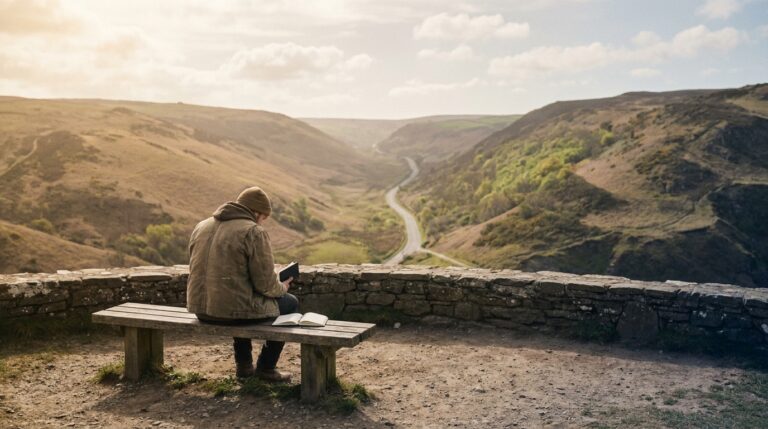




This is the line the AI summary on this search credits to Muir. Every Muir book read for this page was searched for the whole sentence and separately for each distinctive fragment, and none of them appears. The Sierra Club John Muir Exhibit, which keeps the standard list of Muir misquotes, goes further: it says he never said it, and that a search of his published and unpublished writing finds nothing like it.