
Forest quotes: 30 lines with the book and the year
Every line below was read out of the text it came from, with the chapter, the poem or the letter named. Thoreau, Emerson, Muir, Frost, Gibran, Stevenson and a twelfth-century abbot, plus four of the most shared forest lines anywhere, none of which appear in any book John Muir published.
Search forest quotes and the first page of Google hands you two quote aggregators, a Pinterest board, an eco-hospitality blog, a tree-conservation charity, an ecology society and a couple of travel blogs. Between them they print hundreds of lines about trees. Almost none of them tell you which book a line came from, or what year it was written, or whether the person credited with it ever wrote it at all.
That last question turns out to matter more than it should. The single most repeated forest sentence on the internet is credited to John Muir on page one, in the AI summary above page one, and on the forum thread that summary cites. It is not in any book Muir published. Neither are three of the other lines his name is attached to.
So this page took the slow route. Every line below was read out of the text it came from, with the chapter, the poem or the letter named, and the year attached. Thoreau, Emerson, Muir, Frost, Gibran, Stevenson and a twelfth-century abbot who told a friend to put the books down and go outside. Where the popular version of a line differs from the printed one, the card says so.
Then the part that is actually useful, and it sits first because it is the reason most people arrive here. Four of the most shared forest lines anywhere are credited to a man who did not write them in any book he published, and the section immediately below shows what he did write instead.
This page is the woods and the trees. The wider outdoors collection lives on the nature travel quotes hub, falling water has its own page, and every attribution this site has traced sits on the travel quotes fact check hub.
What are the best forest quotes? The short answer
The forest line everyone quotes and nobody can source
Four lines below are credited to John Muir across page one of this search and in the AI summary above it. None of them appear in the four books Muir published that this page draws on: The Mountains of California (1894), Our National Parks (1901), My First Summer in the Sierra (1911) and The Yosemite (1912). Each one was searched whole, as plain text, for several separate fragments of the line, so a stray apostrophe or a reworded clause could not hide a real match.
That is a narrow claim and it is worth stating precisely. It does not say Muir never wrote anything like these lines. Three of the four are normally traced to John of the Mountains, a selection from his journals edited by Linnie Marsh Wolfe and published in 1938, twenty-four years after he died. A journal Muir kept for himself is a different kind of source from a book he wrote, revised and put his name to, and a page that prints one as the other is not telling you the truth about it. This site has not been able to check the 1938 journals against a copy of the text, so where that is the likely origin the card says so rather than pretending to a verdict it has not earned.
And into the forest I go, to lose my mind and find my soul
Between every two pines there is a doorway to a new world
Not in the four books. Normally traced to the 1938 journals, which means it is Muir talking to himself in a notebook rather than Muir publishing a sentence. Worth quoting, worth labelling honestly.
I never saw a discontented tree
Same class as the line above. Not in the four books; traced to the 1938 journals. The rest of the journal passage is better than the fragment everybody prints, which is usually what happens when a line gets cut down for a caption.
The clearest way into the Universe is through a forest wilderness
Not in the four books. Traced to the 1938 journals. It is the most quoted sentence in modern forest writing and it comes from a notebook, which is a fact about it that no page on the current first results mentions.
So what did Muir actually publish about going into the woods? These two, both from books he wrote and released himself.
Going to the woods is going home; for I suppose we came from the woods originally.
This is the sentence the unsourced lines are reaching for, and Muir did write it, in a book, in his own lifetime. It sits in the chapter on the forests of the Yosemite park rather than in anything mystical, which is the Muir worth reading: the claim about coming from the woods arrives in the middle of a working description of trees.
Climb the mountains and get their good tidings. Nature’s peace will flow into you as sunshine flows into trees.
Almost always cited to the opening chapter. It is not there. It is in the Yellowstone chapter, a few sentences after Muir complains that the standard tourist trip through the park is too short to see anything. The advice to climb the mountains is the second half of a grumble about itineraries, and knowing that makes it land harder, not softer.
Forest quotes from the naturalists
The three writers who did the most to make the American woods worth writing about, quoted from the books rather than from each other. All of this is out of copyright and free to read, which is why the whole verification pass for this page cost nothing at all.
Our village life would stagnate if it were not for the unexplored forests and meadows which surround it.
The whole argument for keeping land wild, in one sentence, written by a man whose village was Concord. It comes from the Spring chapter, near the end of the book, once the year has turned.
It is a surprising and memorable, as well as valuable experience, to be lost in the woods any time.
Thoreau means this literally and warmly. The passage around it is about how strange a familiar wood becomes at night, and how useful that is.
in Wildness is the preservation of the World.
Read the spelling carefully, because almost every page that prints this line gets it wrong. Thoreau wrote Wildness with a capital W, not wilderness, and the difference is the argument: he is talking about a quality, not a place you drive to. The mangled version, in wilderness is the preservation of the world, is the one on the posters.
Every tree sends its fibers forth in search of the Wild.
The sentence immediately after the famous one, and it explains it. Wildness is not scenery, it is the thing the tree is actively reaching for.
A town is saved, not more by the righteous men in it than by the woods and swamps that surround it.
A claim about municipal planning disguised as a line about trees, and the better half of the essay it comes from.
In the woods, we return to reason and faith.
Nine words, and the most quoted thing Emerson wrote about woods. From the first chapter of the little book that started American nature writing.
In the woods, is perpetual youth.
Same chapter, a few lines earlier, and note the comma after woods. Emerson punctuated it that way and the popular version tidies it out.
It is this which distinguishes the stick of timber of the wood-cutter, from the tree of the poet.
The best sentence about why any of this matters. Same tree, two men, two entirely different objects, and Emerson is not sneering at the wood-cutter.
The forests of America, however slighted by man, must have been a great delight to God; for they were the best he ever planted.
The opening of the chapter that became the founding document of American forest protection. Muir is being funny and deadly serious in the same breath.
Any fool can destroy trees.
Five words. The shortest genuinely sourced forest line worth knowing, and the start of a paragraph that gets angrier.
God has cared for these trees, saved them from drought, disease, avalanches, and a thousand straining, leveling tempests and floods; but he cannot save them from fools,—only Uncle Sam can do that.
The end of that paragraph, and the reason Muir is on stamps. The turn at the end, from the theological to Uncle Sam, is the whole of his method: the argument is spiritual and the ask is legislative.
When we try to pick out anything by itself, we find it hitched to everything else in the universe.
Written in a notebook on a mountain in 1869 and published by Muir himself in 1911, which is exactly the distinction the section above is about. Ecology in one sentence, decades before the word was in common use.
Forest quotes from the poets
Two poets carry most of the forest lines in English, and one of them is routinely read backwards. Both are quoted here from the books the poems were first collected in.
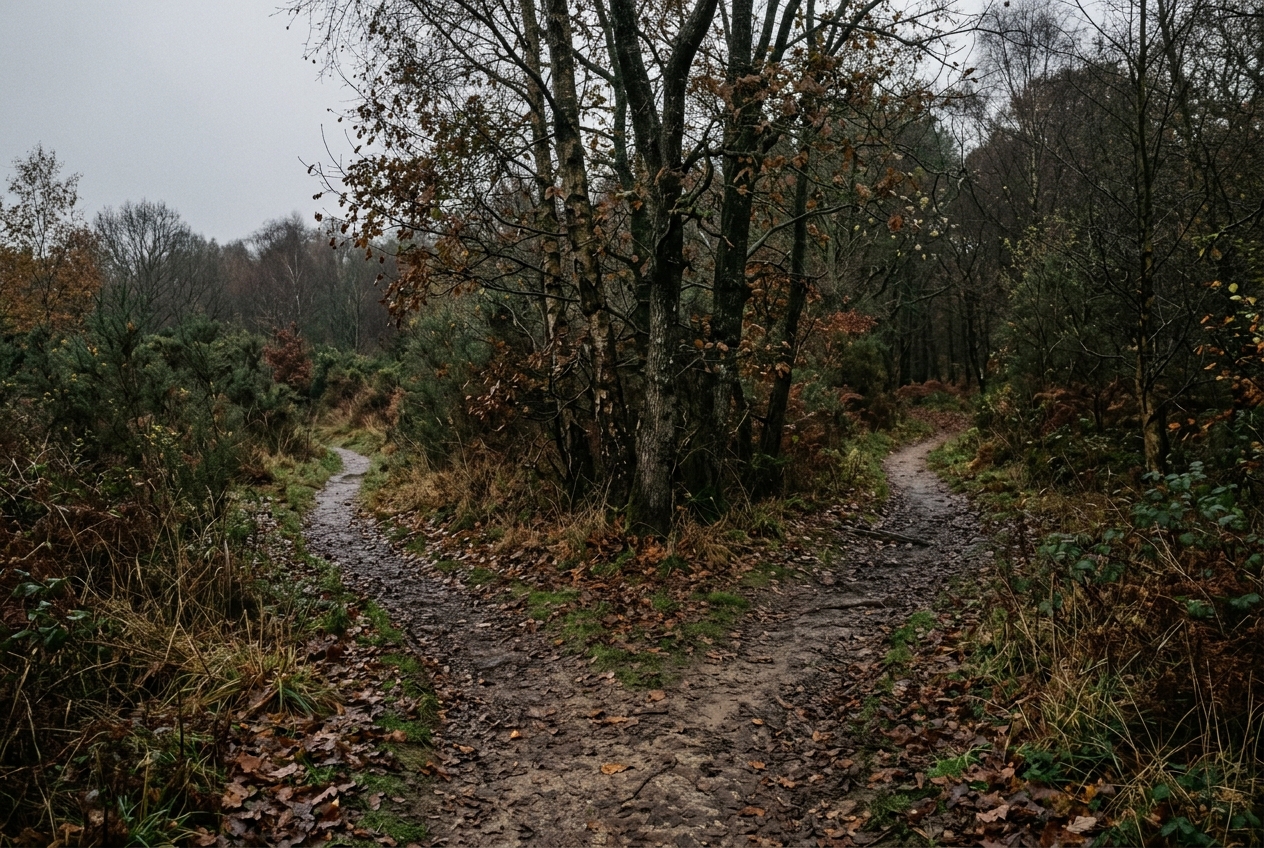
Two roads diverged in a yellow wood, And sorry I could not travel both And be one traveler, long I stood And looked down one as far as I could To where it bent in the undergrowth
The opening of the most misread poem in the language, from the collection it first appeared in. Read it with the next card before deciding what it means.
I shall be telling this with a sigh Somewhere ages and ages hence: Two roads diverged in a wood, and I— I took the one less traveled by, And that has made all the difference.
Here is the problem. The last stanza says the speaker will tell it this way later, with a sigh, and it quietly drops the word yellow: two roads diverged in a wood. Earlier in the poem the two paths are worn about the same. So the poem is not advice to take the road less travelled. It is about the story we will tell ourselves afterwards, and the sigh is the tell. Almost every page that quotes card 15 as encouragement stops before this bit.
The woods are lovely, dark and deep, But I have promises to keep, And miles to go before I sleep,
The other most quoted forest lines in English, and this time the popular reading is fair. From the title poem collection of 1923, which won Frost his first Pulitzer.
One could do worse than be a swinger of birches.
The last line of Birches, and a better piece of advice than anything in The Road Not Taken.
Earth's the right place for love: I don't know where it's likely to go better.
From the middle of the same poem, where Frost talks himself out of wanting to leave. The plainest sentence he ever wrote and the one most worth keeping.
I wonder about the trees. Why do we wish to bear Forever the noise of these More than another noise So close to our dwelling place?
A forest poem about noise and irritation rather than peace, which is why nobody puts it on a print. Frost is asking why we put up with the racket of trees near a house, and the answer turns out to be about wanting to leave and never going.
Trees are poems that the earth writes upon the sky. We fell them down and turn them into paper that we may record our emptiness.
Page one prints the first sentence of this and stops, which turns an indictment into a greeting card. Gibran wrote a second sentence, and it is the reason the first one exists. From his book of aphorisms, checked against a scan of the first edition.
And the oak tree and the cypress grow not in each other’s shadow.
Strictly a line about marriage, and it has been a line about trees for a hundred years because the image does the work. From the chapter on marriage in the book everyone owns and few finish.
Forest quotes about solitude and being alone in the woods
The reason most people search for this in the first place. Every line here is about being on your own under trees, and every one of them was written by somebody who actually did it for long enough to have an opinion.
There can be no very black melancholy to him who lives in the midst of Nature and has his senses still.
The sentence to keep from the Solitude chapter. Thoreau is arguing with the idea that living alone in a wood is sad, and he is not being sentimental about it: the condition he names is having your senses still.
We need the tonic of wildness,—to wade sometimes in marshes where the bittern and the meadow-hen lurk, and hear the booming of the snipe
Not tranquillity. A tonic, something medicinal you go and take, and the list that follows is deliberately unlovely: marshes, bitterns, the smell of sedge. Thoreau’s wild is not pretty and that is the point of it.
Yet it is far safer to wander in God’s woods than to travel on black highways or to stay at home.
Muir being practical, in the chapter that argues for public forest reserves. He had spent more nights out alone than any of his readers and he is comparing the woods to the road and to the sofa, both of which he thinks will kill you sooner.
Fears vanish as soon as one is fairly free in the wilderness.
Nine words from the Yellowstone chapter. The claim is about how quickly it happens, not whether it happens.
Thousands of tired, nerve-shaken, over-civilized people are beginning to find out that going to the mountains is going home; that wildness is a necessity; and that mountain parks and reservations are useful not only as fountains of timber and irrigating rivers, but as fountains of life.
The opening of Our National Parks, and the most modern thing on this page. Written in 1901 about tired, over-civilised people who need the woods, which is roughly the whole readership of every forest quote page ever built, including this one.
Everybody needs beauty as well as bread, places to play in and pray in, where Nature may heal and cheer and give strength to body and soul alike.
Usually printed as a gentle line about beauty. It is not. It is from the Hetch Hetchy chapter, the last in the book, where Muir is fighting to stop a valley being flooded for a reservoir. He lost, the dam was built, and the sentence is an argument he made under pressure rather than a thought he had on a walk.
The oldest forest quote still in use
Long before anybody wrote a nature essay, a Cistercian abbot wrote to a friend who was stuck in a library and told him to go outside. The line has been circulating for nine centuries and page one attributes it to Saint Bernard with no work attached, which for a letter with a number is a strange thing to leave out.
Believe one who has tried: you shall find a fuller satisfaction in the woods than in books. The trees and the rocks will teach you that which you cannot hear from masters.
Bernard of Clairvaux wrote this to Henry Murdach, then a scholar and later Archbishop of York, in the letter numbered 106. The English here is Samuel Eales’ 1889 translation, read out of a scan of his edition; the short form that circulates, you will find something more in woods than in books, is a looser rendering of the same Latin. Either way it is the oldest line on this page by seven hundred years and the only one written to talk somebody out of reading.
it is not so much for its beauty that the forest makes a claim upon men’s hearts, as for that subtle something, that quality of the air, that emanation from the old trees, that so wonderfully changes and renews a weary spirit.
The AI summary of this search credits the first clause of this to Stevenson and stops at hearts, which loses the answer. Stevenson wrote it as an essay for a magazine at twenty-four, about the forest at Fontainebleau, and the sentence keeps going until it explains itself: not the beauty, the air, and what the air does to a tired person.
Short forest quotes, with the source still attached
Roughly a third of the related searches on this term are asking for something caption-length. The shortest fully sourced lines on this page are card 5, card 6, card 8, card 9, card 12 and card 18. The shortest of the lot is card 12, at five words, and it still carries a book and a year.
If you want one for a caption, take the whole thing. A line with a book and a year on it is more interesting than a line without one, and it is the part nobody else in the results can give you.
Notes on the selection
How this page was built. Twelve complete primary texts were read as plain text and every candidate line was matched against them word for word, with the chapter, poem or letter recorded. Thirty of the thirty lines come from a work published before 1930, which is why the whole verification pass cost nothing: those texts are out of copyright and free to read in full. The oldest line here was written in the twelfth century and the newest in 1926. Twenty-three of the thirty lines are appearing on this site for the first time; the rest were verified for earlier pages and are reused here because the page would look broken without them.
What was cut, and why. The most famous woods sentence in English, Thoreau’s reason for going to Walden in the first place, is not on this page: it is already on the nature travel quotes hub, and this site does not run the same line on two pages that compete for the same reader. Chief Seattle has no card either, although he has a profile here. The speech he is famous for survives only in a newspaperman’s recollection published thirty years later, and the version most people quote was written for a film script in 1971. That deserves its own investigation rather than a card on a listicle. Pablo Neruda and Thomas Carlyle were both considered and both dropped: Neruda is in copyright, and no Carlyle forest line survived the check.
Nothing here came from a quote aggregator. Aggregators were used to find out which lines are circulating, which is a real question, and then every line was checked somewhere else. Where a popular wording differs from the printed one, the card carries the printed one and says what the difference is. The wider outdoors set is on the nature travel quotes hub, the travel quotes pillar is the way into the rest of it, and the travel quotes fact check hub collects every attribution traced so far.
Forest quotes: the questions people actually ask
Did John Muir say “and into the forest I go, to lose my mind and find my soul”?
There is no evidence that he did. The line does not appear in any of the four books Muir published that this page draws on: The Mountains of California (1894), Our National Parks (1901), My First Summer in the Sierra (1911) or The Yosemite (1912), each searched whole as plain text. Unlike several other lines credited to him, it is not in the 1938 journal selection either, and nobody quoting it has produced a page reference. What Muir did write, in a book, is: Going to the woods is going home; for I suppose we came from the woods originally, from the chapter on the forests of the Yosemite park in Our National Parks.
What is the oldest forest quote still in use?
Bernard of Clairvaux, writing in the twelfth century to Henry Murdach in the letter numbered 106. In Samuel Eales’ 1889 translation it reads: Believe one who has tried: you shall find a fuller satisfaction in the woods than in books. The trees and the rocks will teach you that which you cannot hear from masters. The shorter form that circulates online, you will find something more in woods than in books, is a looser rendering of the same Latin sentence. It predates every other line on this page by about seven centuries.
What did Thoreau actually say about the woods?
Three things worth keeping, all checkable. From Walden (1854): our village life would stagnate if it were not for the unexplored forests and meadows which surround it, in the Spring chapter. From the same book, in Solitude: there can be no very black melancholy to him who lives in the midst of Nature and has his senses still. And from Walking, the lecture published in the Atlantic Monthly in June 1862: in Wildness is the preservation of the World. Note the capital W on Wildness. The version on most posters says wilderness, which changes it from a quality into a destination.
Is “The Road Not Taken” a forest quote about choosing your own path?
Almost certainly not, and the poem says so itself. Frost published it in Mountain Interval in 1916. Early on, the two roads are described as worn about the same. The last stanza then begins I shall be telling this with a sigh somewhere ages and ages hence, and when it repeats the opening image it drops a word: two roads diverged in a wood, not a yellow wood. The poem is about the story the speaker expects to tell later, and the sigh is the signal. It is still a fine forest quote. It is just not the motivational one.


This is the most shared forest line on the internet and the one with the weakest paper trail. It is not in the four books, and unlike the other three below it is not in the 1938 journals either, in any wording anybody has ever produced. The likeliest explanation is that somebody compressed a longer journal sentiment into something that scans, and the short version travelled. Nobody has produced a page reference, which after this many years of the line being quoted is itself the finding.