
The Little Prince quotes, with the translation named: what Saint-Exupéry actually wrote
Seven lines from The Little Prince, each with its chapter and English translation, read as the journey it is, plus the famous love line the book never contained.
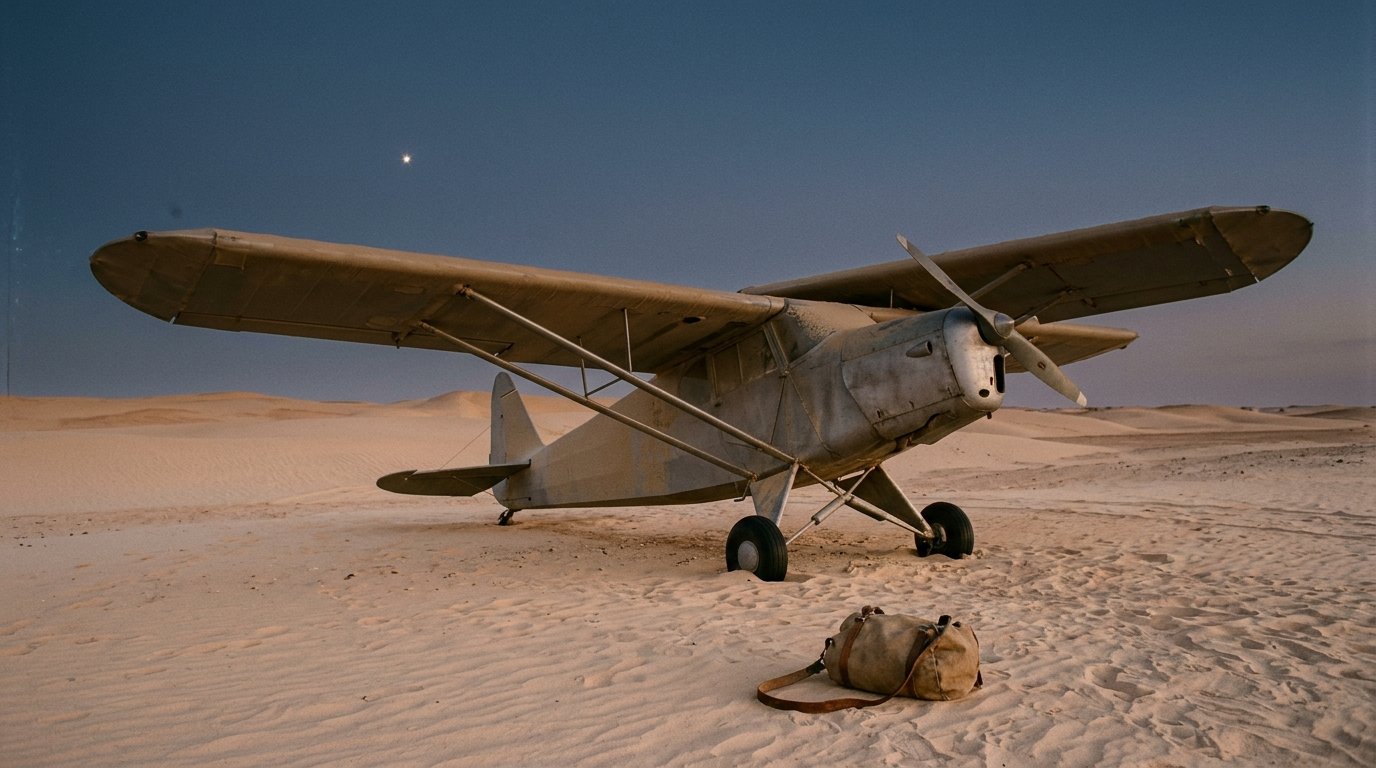
Most lists of Little Prince quotes are long, unsourced and quietly mixed: a line from one English translation, the next from another, and every so often a line the book never contained. This page is the opposite. It is commentary on a short set of lines, not a reproduction of the book, and every line carries its chapter and the translation it comes from.
The reading here is a traveller’s one. Antoine de Saint-Exupéry was a mail pilot who crashed in the desert and walked out of it, and the narrator of The Little Prince is a pilot stranded in the Sahara listening to a boy who has crossed the stars to get there. Read that way, it is a book about journeys: why people leave, what they are looking for, and what they carry home.
The English lines are from Katherine Woods’s translation, the one published alongside the French original in New York in 1943 and the one most people grew up with. If you are here for the romantic lines, our travel love quotes collection has more, and the whole site starts at the 100 best travel quotes.
What are the best Little Prince quotes? The 60 second answer

The Little Prince quotes, with chapter and translation
The heart of the book is one conversation. In chapter XXI the little prince meets a fox in a field on Earth, learns what it means to tame something, and is sent away with a secret. Three of the most quoted lines in the book come from that single page, so we start there and then follow the prince on through the railway, the desert and the stars.
It is only with the heart that one can see rightly; what is essential is invisible to the eye.
It is the time you have wasted for your rose that makes your rose so important.
The fox again, a breath later. It reframes the whole relationship: the rose is precious not because of what it is but because of the attention spent on it. Anyone who has gone back to a place they once worked hard to reach will recognise the idea. Woods chose wasted here, which sounds harsher in English than the French perdu, which can simply mean lost. The point is generous, not rueful.
You become responsible, forever, for what you have tamed.
The last of the fox’s lessons, and the one that sends the prince home. Taming, in the fox’s sense, means creating ties: once you have done it, you cannot pretend the bond is not yours. It is quoted on wedding cards and in leadership books, but in the story it is advice to a homesick traveller about the one thing waiting for him at the end of the road.
No one is ever satisfied where he is.
The next chapter, and the best travel line in the book. The prince meets a railway switchman sorting travellers into bundles and watches lit express trains roar past in both directions. When he asks whether the passengers were unhappy where they were, this is the answer. It is short, a little funny, and true of every departure board you have ever stood under.
What makes the desert beautiful … is that somewhere it hides a well…
The narrator and the prince are walking the Sahara at night looking for water, and the pilot suddenly understands why the sand seems to glow. It is the line the book is built around: the value of a place lies partly in what it hides. It already sits on our desert quotes page, and it belongs here too, because this is the chapter where it was said.
Men … set out on their way in express trains, but they do not know what they are looking for.
Spoken by the prince himself, beside the well, looking back on the trains. The cut in the card is a dialogue tag, nothing more. It is his verdict on restless travel: motion is not the same as purpose, and people who rush about often have no idea what they set out to find. He adds, drily, that it is not worth the trouble. A useful line to carry on any trip that has become a checklist.
And so it will be as if all the stars were laughing, when you look at the sky at night…
The farewell, near the end of the book. The prince is going home and gives the pilot a parting present: since he will be laughing on one of the stars, every star will seem to laugh whenever the pilot looks up. The card stops before the prince repeats the idea. It is the gentlest way anyone has described missing someone who lives far away.
Those lines carry the book’s argument in miniature. More writing about the desert is collected on our desert quotes page, and for another great journey told in fewer words than it deserves, see the not all those who wander are lost story.
The pilot who wrote it: Saint-Exupéry’s Sahara crash
Saint-Exupéry did not invent the stranded pilot. Before he was a famous writer he flew mail routes for the French airline Aéropostale across the Sahara and down the coast of Africa, and later in South America. On 30 December 1935, trying to break the speed record from Paris to Saigon, he and his mechanic André Prévot crashed their plane into the Libyan Desert at night. They survived the impact with almost no water, walked for days in the heat, began to hallucinate, and were found by a Bedouin travelling by camel who gave them water and saved their lives.
He told that story in Wind, Sand and Stars, published in French as Terre des hommes in 1939 and translated into English by Lewis Galantière the same year. It is one of the great travel books of the century, and it is the key to The Little Prince. The thirst, the mirage, the well found at daybreak and the stranger who appears out of the sand all reappear, softened, in the children’s book he wrote in New York in 1942.
The ending has a travel story of its own. In July 1944 Saint-Exupéry took off from Corsica on a reconnaissance flight over southern France and never came back. The book’s last pages, in which the prince vanishes and the pilot asks readers to tell him if they ever see a small boy in the desert, read very differently once you know that.

Is “love does not consist in gazing at each other” from The Little Prince?
No. It is Saint-Exupéry, but it is from Wind, Sand and Stars, not The Little Prince. The line is all over page one of the search results for Little Prince quotes, including on one book summary service that presents it as coming from the same book. In the English of Lewis Galantière’s 1939 translation it reads:
“Life has taught us that love does not consist in gazing at each other but in looking outward together in the same direction.”
We checked this two ways. First, we searched the complete text of The Little Prince, both Woods’s English and the French original, for the phrase and for the idea of looking in the same direction. It is not there. Second, the line is credited to Wind, Sand and Stars by the quotation archives that name a translator for it, which place it in the book’s closing pages on comradeship. We have not checked the chapter against a printed copy, so treat the chapter as reported rather than confirmed.
The mix up is easy to understand: same author, the same tenderness, and a sentence about love that sounds as if the fox could have said it. But the fox’s idea is close to the opposite. The fox says the rose matters because of the time spent looking after her; the pilot of Wind, Sand and Stars says love is a shared direction, not a gaze. Both are worth keeping, with the right label. It is the same standard we apply across our travel quote fact-checks.
Why the same line reads differently: Woods and Howard
There is no single English Little Prince. Katherine Woods made the first translation in 1943, and for nearly sixty years it was the only one most readers knew. In 2000 Harcourt published a new translation by the poet Richard Howard, who aimed for plainer, more modern English. Many famous lines now circulate in both versions, often mixed together on the same list, and sometimes blended into wording neither translator wrote.
The fox’s secret shows why. In the French original, chapter XXI, it is just “On ne voit bien qu’avec le cœur. L’essentiel est invisible pour les yeux.” Literally, one only sees well with the heart; the essential is invisible to the eyes. Woods turned that into an elegant sentence about seeing rightly and what is essential. Howard set out to stay closer to the plain French. Neither is wrong. They are different choices, and a quote without a named translation cannot tell you which one you are reading.
Our advice if you are buying a copy: read Woods if you want the book as it was first read in English, and Howard if you want it closer to the French. If you read French at all, read the original. It is short, simple, and the full text is free to read at Project Gutenberg Australia, where it is in the public domain.
If you want the book itself, the edition in print in English is the Richard Howard translation, a Clarion paperback that restores the original drawings to colour. The Katherine Woods version quoted on this page is out of print in the United States and turns up secondhand.
The Little Prince (Richard Howard translation)
Best for: Readers who want the current English text with the drawings in colour
The 2000 Clarion paperback, 96 pages, in the Richard Howard translation. Howard keeps closer to the French than Woods did, so the fox and the rose read a little plainer and a little truer, and the original artwork is printed in full colour. It is the copy to buy if you want to check the lines on this page against the book.
Pros
- The translation closest to the French now in print
- Original drawings restored to colour
- Short enough to read on one flight
Cons
- Not the Woods wording most English readers grew up with, so familiar lines read differently
- Paperback only in this listing; the hardback is a separate edition
Notes on the selection
How this page was built. The English lines were matched word for word against a complete text of Katherine Woods’s 1943 translation, and each chapter number was then checked against the French original, so the locator is measured rather than remembered. Where the prince or the fox is interrupted by a dialogue tag such as said the little prince, the tag is cut and the cut is shown with an ellipsis. Woods’s spaced dots are set as a single ellipsis, and the switchman’s line, which runs into said the switchman, is closed with a full stop. No wording was changed.
What was left out, and why. The book and every English translation are still in copyright in the United States, so this page quotes seven English lines and one French line, keeps each one short, and lets the commentary carry the page. That ruled out the long passages people love, including the opening about the drawing of a boa constrictor and the lamplighter’s speech. The famous dedication line about grown ups who were once children was cut to keep the set on the journey. Nothing comes from the 2015 film or the stage musical, and none of Saint-Exupéry’s illustrations are reproduced: the images on this page are our own desert scenes.
The Little Prince quotes: the questions people actually ask
What is the most famous line in The Little Prince?
The fox’s secret in chapter XXI. In Katherine Woods’s 1943 translation it reads: “It is only with the heart that one can see rightly; what is essential is invisible to the eye.” Richard Howard’s 2000 translation words it more plainly, closer to the French.
What is The Little Prince about?
A pilot stranded in the Sahara meets a small boy who has travelled from a tiny asteroid, by way of several other planets, to Earth. Through the boy’s stories of a rose, a fox and the strange adults he met, it becomes a book about friendship, loss and what makes a journey worth taking. Saint-Exupéry, a pilot himself, published it in 1943.
Who said “love does not consist in gazing at each other”?
Antoine de Saint-Exupéry, but in Wind, Sand and Stars (Terre des hommes, 1939), translated by Lewis Galantière, not in The Little Prince. The line does not appear anywhere in the text of The Little Prince.
Which English translation of The Little Prince should I read?
Katherine Woods (1943) if you want the version most English readers grew up with; Richard Howard (2000) if you want plainer English closer to the French. If you read any French, the original is short and simple enough to try.




The fox’s secret, given as a parting gift. The prince has just learned that his rose, which he thought unique in all the universe, looks exactly like thousands of roses in a garden. The fox’s answer is that what made his rose matter was never visible in the first place. The prince repeats the second half aloud so that he will remember it, which is why many lists quote only that half. It is also the line where the translations differ most, which we come back to below.