
Hiking quotes: 32 trail lines with the book and the year
Every line below was read out of the book it came from, with the chapter or the essay named. Thoreau, Hazlitt, Stevenson, Burroughs, Leslie Stephen and Muir, plus five famous hiking lines that are not in the books they are credited to.
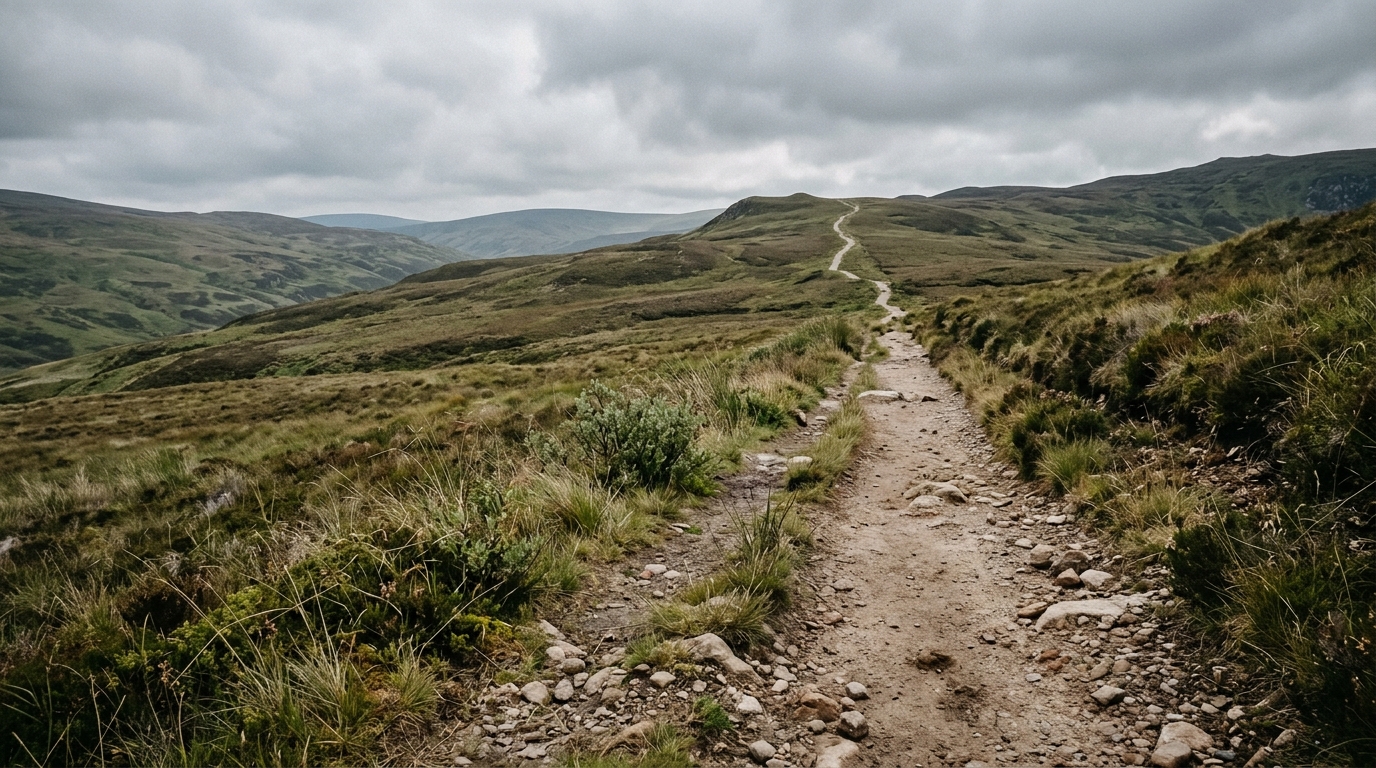
Search hiking quotes and you get caption walls. Page one is four travel blogs, a caption generator, a free blog and two aggregators, and the titles say what they are: 250+ best hiking captions, 72 hiking captions that go the distance. Not one page attaches a book and a year to a line. The AI Overview leans on Hillary, Muir, Thoreau and Emerson and sources none of them.
That gap is odd, because walking has one of the best specialist literatures in English and almost all of it is out of copyright. William Hazlitt wrote an essay about going for a walk in 1822. Thoreau wrote one in 1862. John Burroughs wrote one in 1875, Robert Louis Stevenson in 1876, and Leslie Stephen, an Alpine Club president who happened to be Virginia Woolf’s father, wrote one in 1902. By 1911 a London publisher had collected them into an anthology for walkers. Every one of those texts is readable in full, for nothing, today.
So this page took the slow route. Thirty-two lines, each matched word for word against a complete text, each carrying the author, the work, the year and where inside the work to find it. Twenty-eight of the thirty-two come from those five essays and, as far as page one of this search is concerned, none of those writers exists.
Then the useful part. Five of the most reproduced hiking lines on the internet do not survive a search of the books they are credited to, including the one about coming out of the woods taller than trees. The counts are at the bottom, and you can re-run them.
For the wider collection, the nature travel quotes hub gathers the whole outdoor set, and the nearest published neighbour is sunset quotes. This page owns the act of walking: the pace, the pack, the distance, and the part where you decide whether to keep going.
What are the best hiking quotes? The short answer
Hiking quotes about setting out
Six lines about the first hour. Two are Hazlitt in 1822, two are Robert Louis Stevenson in 1881, one is Henry David Thoreau explaining where the word saunter comes from, and one is Leslie Stephen, who ran the Alpine Club and still thought the best walking was the kind with an inn at the end of it.
One of the pleasantest things in the world is going a journey; but I like to go by myself. I can enjoy society in a room; but out of doors, nature is company enough for me.
Give me the clear blue sky over my head, and the green turf beneath my feet, a winding road before me, and a three hours' march to dinner–and then to thinking! It is hard if I cannot start some game on these lone heaths. I laugh, I run, I leap, I sing for joy.
The most quoted sentence Hazlitt ever wrote, and the version that circulates usually stops at the winding road. The three hours’ march to dinner is the part worth keeping, because it tells you what he thought the right distance was. Stevenson noticed the same thing fifty years later and called him an epicure for it. Note also that Hazlitt admits, in print, to laughing and singing on his own in a field.
And surely, of all possible moods, this, in which a man takes the road, is the best.
Stevenson on the mood at the trailhead, and he is precise about what he is claiming. Not the best mood available on a walk, and not the best mood in life: the best of all moods, ranked against every other, is the one in which a person takes the road. He is writing about the first mile, before anything has happened yet.
And no sooner have you passed the straps over your shoulder than the lees of sleep are cleared from you, you pull yourself together with a shake, and fall at once into your stride.
The pack. Stevenson has just described wanting to throw it over a hedge on the first day, and this is the turn: a few days in, the straps go on and the body simply starts. Anyone who has walked with a load for more than a weekend recognises the sentence, and it was written about a knapsack in 1876.
I have met with but one or two persons in the course of my life who understood the art of Walking, that is, of taking walks—who had a genius, so to speak, for sauntering, which word is beautifully derived “from idle people who roved about the country, in the Middle Ages, and asked charity, under pretense of going à la Sainte Terre,” to the Holy Land, till the children exclaimed, “There goes a Sainte-Terrer,” a Saunterer, a Holy-Lander.
Where the word saunter comes from, and Thoreau gives two derivations rather than one. This is the first: idle people in the Middle Ages who begged their way across Europe saying they were bound for the Holy Land, until children called them Sainte-Terrers. A few lines later he offers the alternative, sans terre, without land or a home, and says that in the good sense it means having no particular home but being equally at home everywhere. He does not pick one. Most pages that quote this line pick one for him.
Free from all bothers of railway time-tables and extraneous machinery, you trust to your own legs, stop when you please, diverge into any track that takes your fancy, and drop in upon some quaint variety of human life at every inn where you put up for the night.
Leslie Stephen was a serious mountaineer, president of the Alpine Club and the first man up several Alpine peaks, and his essay in praise of walking is about none of that. It is about a knapsack, the Odenwald, and the freedom to turn down a track because you felt like it. Worth remembering when a hiking page implies you need an objective.
Hiking quotes about pace, effort and distance
Ten lines about the middle of the day. This is the register the caption pages cannot reach, because it takes somebody who has actually walked a long way to write about why the fifth hour is different from the first. Five of these are John Burroughs, an American naturalist whose 1875 essay on the road is the single best thing on this page and who appears nowhere in this search.
But the walking of which I speak has nothing in it akin to taking exercise, as it is called, as the sick take medicine at stated hours—as the swinging of dumb-bells or chairs; but is itself the enterprise and adventure of the day.
The distinction the whole essay turns on. Thoreau is not against exertion; he is against the idea that a walk is a dose, taken at a set hour for a health benefit, like swinging dumb-bells. His alternative is that the walk is the day’s adventure, the thing itself rather than preparation for the thing. Anyone who has ever closed a step ring and felt nothing will know what he means.
I think that I cannot preserve my health and spirits, unless I spend four hours a day at least—and it is commonly more than that—sauntering through the woods and over the hills and fields, absolutely free from all worldly engagements.
Four hours a day, and commonly more. It reads like a boast until you notice he is describing a minimum for staying sane rather than a training target, and that the condition attached is not distance but freedom from all worldly engagements. The number is the famous part. The clause about engagements is the part that is hard.
Moreover, you must walk like a camel, which is said to be the only beast which ruminates when walking.
The best piece of pace advice on this page and it is a hundred and sixty years old. Walk so that you can think while you walk, which means slowly enough to chew. Note that Thoreau hedges the zoology himself, with which is said to be: he is repeating a claim about camels, not making one.
The human body is a steed that goes freest and longest under a light rider, and the lightest of all riders is a cheerful heart.
Burroughs on why two people of the same fitness finish the same walk differently. The body is the horse, the mood is the rider, and a light rider makes a horse that goes further. He means it literally as advice: sort out your head before you sort out your boots.
Indeed, the heaviest thing in the world is a heavy heart.
The follow-up sentence, and the one worth carrying. Everybody obsesses over base weight. Burroughs points out that the heaviest item nobody weighs is the one you brought in your chest, and that it is the one that breaks people in the first mile.
It is for this reason that an unknown road is always a long road. We cannot cast the mental eye along it and see the end from the beginning. We are fighting in the dark, and cannot take the measure of our foe.
Why a new trail feels longer than a familiar trail of the same length, explained in three sentences in 1875. The mind cannot measure what it has not seen, so it cannot ration the effort. Every thru-hiker who has ever said the second half went faster is describing this.
Hence also the fact that to vanquish one mile in the woods seems equal to compassing three in the open country. The furlongs are ambushed, and we magnify them.
The same idea at a smaller scale, and the phrasing is the reason to keep it. Woodland miles feel like three because there is no horizon to check your progress against, so the furlongs are ambushed. That is the correct word for it and nobody has improved on it since.
Your heart must furnish such music that in keeping time to it your feet will carry you around the globe without knowing it.
Burroughs on rhythm. The moment you start counting steps, the walking has become work; the cure is to have something in your head that keeps time for you. He is rewriting a line from the Sermon on the Mount, which is a joke his readers would have caught instantly.
He will not believe that to walk this unconscionable distance is merely to stupefy and brutalise himself, and come to his inn, at night, with a sort of frost on his five wits, and a starless night of darkness in his spirit.
Stevenson on the case against big days, and he is blunt. The man who walks an unreasonable distance arrives with a frost on his five wits and a starless night in his spirit, which is an exact description of the far end of a fifty kilometre day. His argument is not that it is hard. It is that you stop noticing anything, so you have paid for the walk and not received it.
I have no objection to argue a point with any one for twenty miles of measured road, but not for pleasure.
Hazlitt drawing the line. He will argue a case for twenty miles if there is something at stake, but not for entertainment, because a debate makes the walk into something else. Two hundred years before anyone had to invent a phrase for the right kind of trail silence.
Short hiking quotes and captions, still sourced
Seven lines short enough for a caption, every one with the book and the year still attached. This is the whole argument of the page in miniature: a short quote does not have to be an anonymous one. If you use any of these, the source fits in the same caption.
Some do not walk at all; others walk in the highways; a few walk across lots.
Nine words and a complete social theory. Most people never walk; some walk where they are told to; a few cut across country. Thoreau means it about land access and he also means it about everything else, which is why it is the most portable line in the essay.
But in every walk with Nature one receives far more than he seeks.
The Muir line that the AI Overview for this search quotes without a source, and here is the source: Steep Trails, chapter IX, in a walk up the Oquirrh range above the Great Salt Lake. He had gone looking for rock and trees and got a mile of flowers instead. The quote walls print it without the opening But, which is the word that connects it to the modest list of things he actually set out for.
You should be as a pipe for any wind to play upon.
Stevenson’s instruction for what to do with your attention once you are moving. Stop steering, let the day play through you. It is the oldest version of the advice every mindfulness app now sells, and it is eight words long.
The soul of a journey is liberty, perfect liberty, to think, feel, do, just as one pleases.
Hazlitt’s definition, and note that it is liberty rather than scenery, solitude or distance. The next sentence spells out what he wants liberty from: impediments, inconveniences, and other people. Not a caption about beauty. A caption about being left alone.
The devil never yet asked his victims to take a walk with him.
Burroughs, and he is only half joking. The surrounding passage argues that walking strips a person of pretence and that you find out quickly who you are walking with. The devil, being a creature of disguises, would not risk it.
Walking tours thus rescue a bit of one's life from oblivion.
Leslie Stephen on why walks are the memories that survive. His argument just before this is that friendships blur into a general impression while walks stay pinned to a date and a place, so they end up being the thread the rest of a life hangs on.
I am a good horse to travel, but not from choice a roadster.
Thoreau on what kind of animal he is. A good horse for travel, not by choice a roadster, meaning built for country rather than for the made road. Keep this one in mind for the selection notes below, because it is the line that gets misquoted by a man who admired him.
Trekking and long-distance walking quotes
Six lines about what a walk does over days rather than hours. Trekking quotes and hiking quotes are searched as separate terms and they are the same subject, so they live on one page here. The best material on the long form is Victorian, because until quite recently a long walk was simply how people got anywhere.
Now, to be properly enjoyed, a walking tour should be gone upon alone. If you go in a company, or even in pairs, it is no longer a walking tour in anything but name; it is something else and more in the nature of a picnic. A walking tour should be gone upon alone, because freedom is of the essence; because you should be able to stop and go on, and follow this way or that, as the freak takes you; and because you must have your own pace, and neither trot alongside a champion walker, nor mince in time with a girl.
The most useful paragraph Stevenson wrote, and the reason is the last clause. Alone is not about solitude for its own sake; it is about pace. The moment there is a second person, the pace is negotiated, and a negotiated pace is somebody else’s walk. Anyone who has trailed a faster friend up a hill for six hours has lived the sentence.
Walking is among recreations what ploughing and fishing are among industrial labours: it is primitive and simple; it brings us into contact with mother earth and unsophisticated nature; it requires no elaborate apparatus and no extraneous excitement.
Leslie Stephen’s case for walking over every other recreation, and the clause that matters commercially is the last one: no elaborate apparatus and no extraneous excitement. Written in 1902, by a man who could afford any apparatus he liked, and it is still the honest answer to the question of what gear you need to start.
The memories of walks, on the other hand, are all localised and dated; they are hitched on to particular times and places; they spontaneously form a kind of calendar or connecting thread upon which other memories may be strung.
Why the walks are the bits you remember. Stephen is making a specific claim, not a sentimental one: walk memories come with a date and a place already attached, so they work as an index to everything else that was happening at the time.
Man takes root at his feet, and at best he is no more than a potted plant in his house or carriage till he has established communication with the soil by the loving and magnetic touch of his soles to it.
Burroughs at his least restrained and most quotable. The potted plant is the person who travels enclosed, and the cure is contact through the soles of the feet. It is the same thought that the whole grounding fad rediscovered a century later, written by somebody who walked to work.
They would walk away from their ennui, their worldly cares, their uncharitableness, their pride of dress; for these devils always want to ride, while the simple virtues are never so happy as when on foot.
The end of his argument about walking to church, and the line lands as a rule of thumb. The things you want to leave behind all want a lift; the things worth keeping are happy on foot. It is also, incidentally, a good description of what happens to a bad mood in the first hour.
I am alarmed when it happens that I have walked a mile into the woods bodily, without getting there in spirit.
The failure mode, named by the person who wrote the book on walking. You can put in the distance and never arrive. Thoreau’s test is not mileage, it is whether your attention came with you, and he admits in the next line that he sometimes cannot shake the village.
The summit, and what Thoreau found at the top
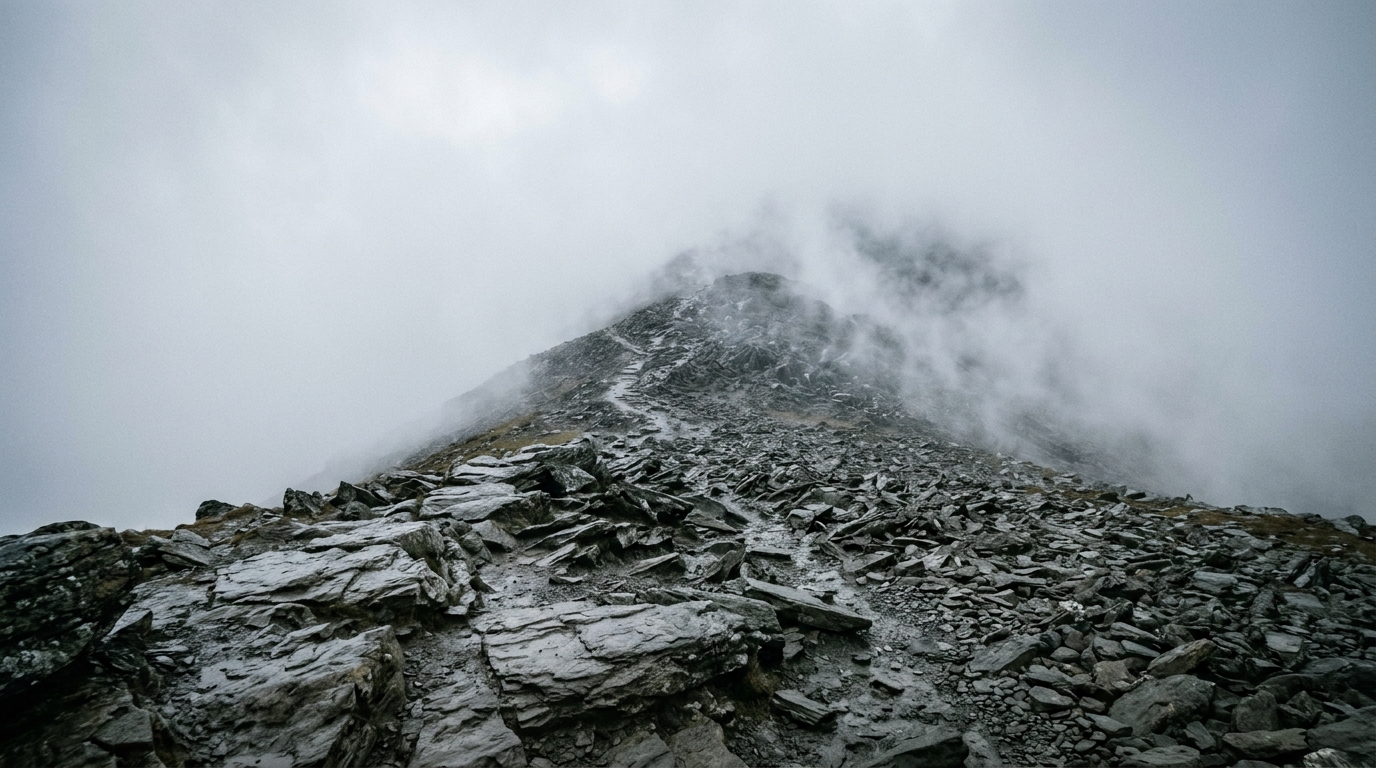
Three lines from the far end of a walk. Two are from Thoreau’s ascent of Katahdin in 1846, published as Ktaadn, and they are worth knowing because the most famous American essay about climbing a mountain is written by a man who did not enjoy it and did not reach the true summit. The third is Ralph Waldo Emerson, ten years earlier, having the opposite experience in a wet field.
The tops of mountains are among the unfinished parts of the globe, whither it is a slight insult to the gods to climb and pry into their secrets, and try their effect on our humanity.
Not a celebration of summits. Thoreau is saying that the tops of mountains are unfinished ground, that climbing them is a small impertinence toward whatever made them, and that only daring and insolent people go up. The passage continues into Pomola, the Penobscot spirit who is angry with anyone who climbs Katahdin. This is the counterweight to every conquer-the-peak caption in this search.
Talk of mysteries! Think of our life in nature,–daily to be shown matter, to come in contact with it,–rocks, trees, wind on our cheeks!
Written on the descent, and it is the most physical thing in the essay. The mountain has frightened him; what he reaches for is not the view but the plain fact of matter, rock and trees and wind on the face. Hikers who come down from a hard day slightly rearranged, and cannot say why, are describing this paragraph.
Crossing a bare common, in snow puddles, at twilight, under a clouded sky, without having in my thoughts any occurrence of special good fortune, I have enjoyed a perfect exhilaration. I am glad to the brink of fear.
The counter-example, and it is deliberately unspectacular. No mountain, no summit, no good news: a bare common, snow puddles, twilight, a clouded sky. Emerson gets the full charge anyway. Useful the next time a hiking page implies the feeling requires an alpine backdrop and a fortnight off.
Five hiking lines that are not where they say they are
These five are on page one of this search, on the AI Overview, or on both. None of them carries a source there, and none of them is in the books it is credited to. Each card names exactly which complete texts were searched, because an absence proof is only as wide as the shelf it was run against. Nothing below says the person never wrote it. It says it is not in these books.
“Of all the paths you take in life, make sure a few of them are dirt.”
The most reproduced hiking caption in English, and it is not in The Mountains of California (1894), Our National Parks (1901), My First Summer in the Sierra (1911), The Yosemite (1912) or Steep Trails (1918). Zero matches for the full line, zero for paths you take in life, zero for a few of them are dirt. The register is wrong for him as well: Muir does not write in bumper stickers. If you want a real Muir line about walking, card 18 above is one, and it has a chapter.
“I took a walk in the woods and came out taller than trees.”
Searched in full: Walden (1854), Walking (1862), The Maine Woods (1864) and A Week on the Concord and Merrimack Rivers (1849). Zero matches for the line, zero for taller than trees, zero for came out taller. The phrasing is modern and the earliest circulation anyone can point to is a greetings-card register rather than a printed page. Thoreau has a genuine line about coming back from a walk changed, and it is card 29.
“Adopt the pace of nature: her secret is patience.”
Searched in full: Nature (1836), Essays: First Series (1841) and Essays: Second Series (1844). Zero matches for the line, zero for adopt the pace of nature, zero for her secret is patience. It is one of the most shared lines on this search and it reads like Emerson, which is exactly why it travels. A real Emerson sentence about being out on foot is card 32.
“An early-morning walk is a blessing for the whole day.”
Same four complete texts as above, and the same result: zero matches for the line, for early-morning walk is a blessing, and for blessing for the whole day. Thoreau did write about the morning at length, in Walden, and those passages are about waking rather than about walking. This is a case of a real habit being given a sentence he never wrote.
“It is not the mountain we conquer, but ourselves.”
This one has a real author. Hillary published it in High Adventure in 1955, and it is graded secondary here because we did not read the 1955 page ourselves this run. What we can show is where it is not: zero matches across all four Thoreau books and all five Muir books listed on this page. The names it gets re-credited to on caption walls are both provably wrong.
Notes on the selection and the sources
The order is not a preference ranking. The sections run in the order a walk happens, setting out, then the long middle, then the top and the way down, and inside each section the lines run by how directly they answer the register. The short-lines section exists because half the demand behind this search is for a caption, and the position taken here is that a caption can carry a source.
Method. Twenty complete texts were downloaded and every candidate line was matched against them by string search, with the chapter or essay read off the position of the match in the same file. Thirty-two of thirty-two matched. The locator column was itself checked against fifteen known-answer probes before a single card was built, and two of those probes failed on the first pass: the section finder was landing in each book’s contents list rather than in its body, which would have labelled the Burroughs and Leslie Stephen cards with the wrong essay. That was fixed before anything was written.
One card is here because two of the sources disagree, and both are in front of you. Card 23 is Thoreau in 1862: a good horse to travel, but not from choice a roadster. Thirteen years later Burroughs quotes him in Winter Sunshine as saying he was a good horse but a poor roadster, and builds a paragraph on it in praise of gravel. Not from choice is a preference. A poor roadster is an incapacity. A naturalist who revered Thoreau misquoted him in print in 1875, which is a useful reminder that this problem is older than the internet.
What was left out, and why. Aldo Leopold, Edward Abbey, Colin Fletcher and Cheryl Strayed all belong on a hiking page and none of them appears, because all four are in copyright, none could be searched in full, and the rule here is to cut rather than to reword a line that cannot be checked. John Muir carries only one card despite being the most quoted name in this search, because he has no author profile on this site yet and because the Muir lines that fit a hiking page best are already carried elsewhere in this collection. Two sibling pages, on wilderness and on mountains, are built and not yet live; they will be cross-linked from here when they publish.
Aggregators, named rather than hidden. Goodreads, BrainyQuote and Pinterest were used to find out which lines people are actually searching for, which is all they are good for. Not one of them was used as evidence for a single card. The primary texts came from Project Gutenberg, and The Footpath Way (Sidgwick and Jackson, 1911), the anthology that first put Hazlitt, Thoreau, Stevenson, Leslie Stephen and Burroughs between the same covers, supplied the two essays that are not otherwise easy to find whole.
If you want one line to start with
Take card 11, the heaviest thing in the world is a heavy heart, and carry it on the next walk where the pack feels wrong in the first twenty minutes. Burroughs is making a practical claim, not a poetic one, and it is testable: check your head before you check your straps. If it holds, read the rest of his 1875 essay, which is nine pages long and better than most modern books on the subject.
After that, the useful move is to check one line you already believe. Pick a hiking quote you have shared, find the book it is credited to, and search the text. That is exactly what the five cards above are, and four of the five turned out to be nobody’s. For the wider collection, the travel quotes pillar is the way in.
Hiking quotes: the questions people actually ask
Did Thoreau say “I took a walk in the woods and came out taller than trees”?
There is no evidence he did. The line returns zero matches across the complete texts of Walden (1854), Walking (1862), The Maine Woods (1864) and A Week on the Concord and Merrimack Rivers (1849), and so do the fragments taller than trees and came out taller. The closest genuine sentiment in his work is the opposite in tone: “I am alarmed when it happens that I have walked a mile into the woods bodily, without getting there in spirit.”
What is a good short hiking quote for Instagram?
Three that are short and fully sourced. “Some do not walk at all; others walk in the highways; a few walk across lots.” Henry David Thoreau, Walking, 1862. “You should be as a pipe for any wind to play upon.” Robert Louis Stevenson, Virginibus Puerisque, 1881. “Indeed, the heaviest thing in the world is a heavy heart.” John Burroughs, Winter Sunshine, 1875. Each fits a caption with the book and the year still attached, which is more than any of the caption lists on this search can offer.
Who said “It is not the mountain we conquer, but ourselves”?
Edmund Hillary, in High Adventure (1955). It is routinely re-credited to Henry David Thoreau or John Muir on caption walls, and neither wrote it: the line returns zero matches across four complete Thoreau books and five complete Muir books. We grade the Hillary attribution secondary rather than primary here for one honest reason, which is that we did not read the 1955 page ourselves.
What did Emerson actually write about walking in nature?
The passage people are reaching for is in Nature (1836), chapter one: “Crossing a bare common, in snow puddles, at twilight, under a clouded sky, without having in my thoughts any occurrence of special good fortune, I have enjoyed a perfect exhilaration. I am glad to the brink of fear.” The line usually attached to his name on hiking pages, “Adopt the pace of nature: her secret is patience”, is not in Nature, Essays: First Series or Essays: Second Series.
Are trekking quotes and hiking quotes different things?
Not for the purposes of a page like this one. Google buckets the two terms together with near-identical demand curves, and the literature does not separate them either: Stevenson’s walking tour, Leslie Stephen’s knapsack trip through the Odenwald and a modern multi-day trek are the same activity at different distances. The long-distance section above carries the lines that are specifically about days rather than hours.



The opening sentence of the essay that started this whole literature, and everything after it is an argument for going alone. Hazlitt is not antisocial: he says plainly that he enjoys company in a room. His point is that a walk is one of the few activities where another person changes the activity itself rather than just adding to it.