
Island quotes: lines from the writers who actually lived on them
Twenty-five island quotes from Stevenson, Melville, Defoe, Darwin, Donne and more, each read out of the original text and labelled with its book, year and chapter.
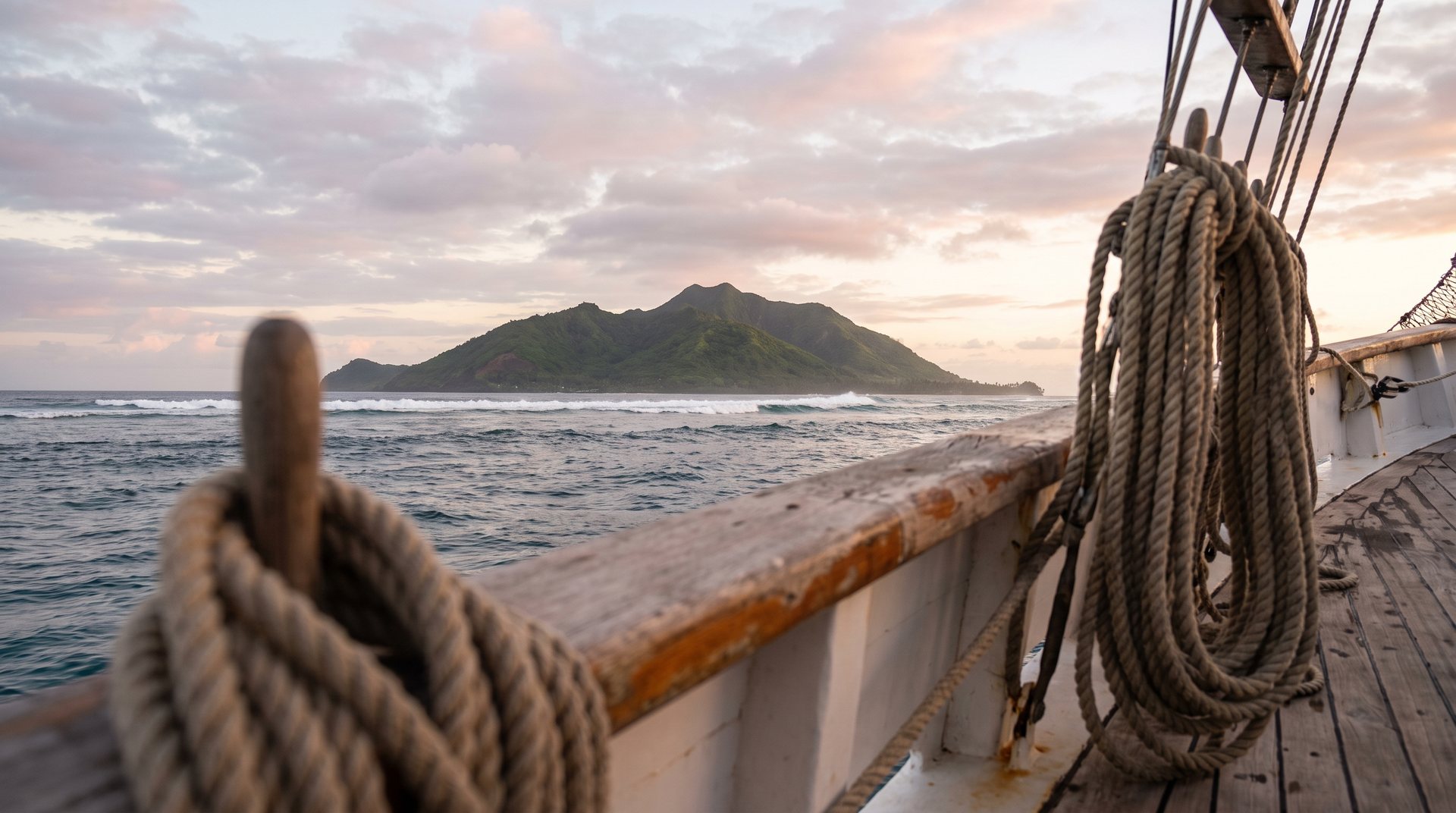
Search island quotes and page one is captions: short lines over a beach photo, almost never with a name you can check, and never with a book. That is a shame, because some of the best writing in English about islands was done by people who actually landed on them and wrote it down.
So every numbered line on this page carries its writer, its book, the year and the chapter, act or section it came from, and every one was read word for word out of the original text. Robert Louis Stevenson lived his island years in the Pacific and died on Samoa; Herman Melville jumped ship in the Marquesas; Charles Darwin worked out something enormous on the Galapagos. Their words are here, along with the island lines from fiction that everyone half remembers.
This page is about land in the sea. For the water itself, see sea quotes and sailing quotes; for the whole shoreline, the ocean and coast quotes hub. The full collection starts at travel quotes.
What are the best island quotes? The 60 second answer
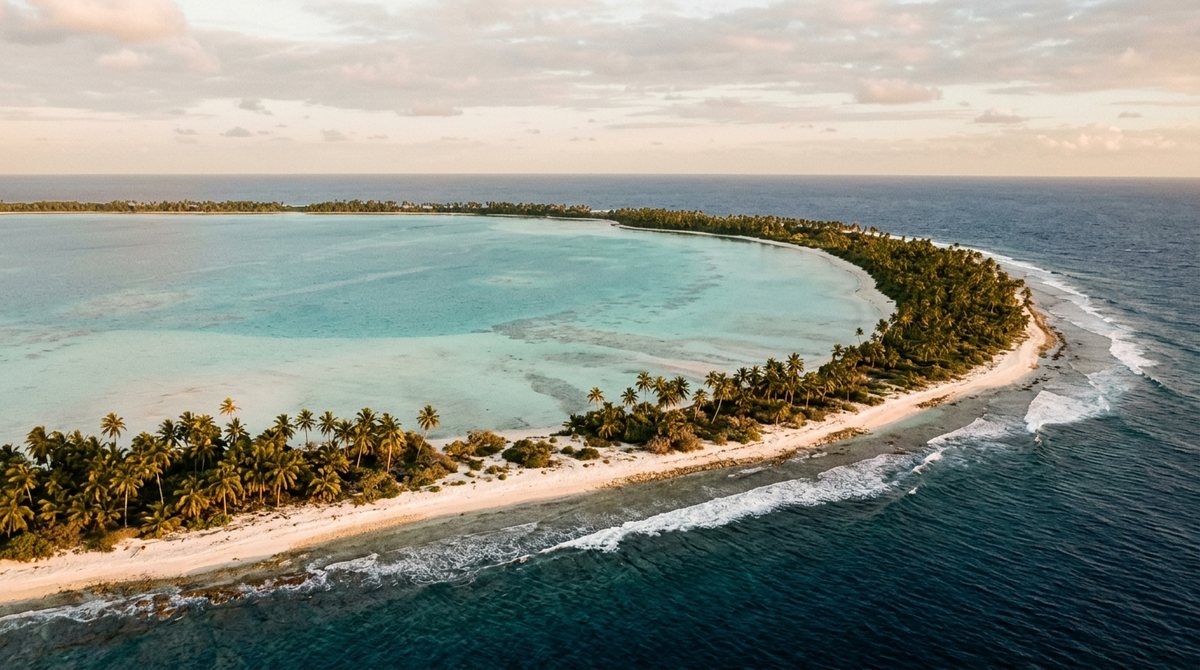
Island quotes with the book and the year: the landfall lines
Start with Stevenson, because he was there. In 1888 he sailed from San Francisco in the yacht Casco to the Marquesas, and his account of the voyages, In the South Seas, was published in 1896, after his death. It is free to read in full at Project Gutenberg, and it is the best book about arriving somewhere that most people have never heard of. More of his lines live on the Stevenson in the South Seas profile.
The first experience can never be repeated. The first love, the first sunrise, the first South Sea island, are memories apart and touched a virginity of sense.
Land ho! Aye, there it was. A hardly perceptible blue irregular outline, indicating the bold contour of the lofty heights of Nukuheva.
Melville in Typee, sighting the same island nearly half a century before Stevenson. He had shipped as a whaleman, and this is his narrator’s first look at Nukuheva.
Twenty-seven days out from San Francisco we arrived at the island of Oahu, Territory of Hawaii. In the early morning we drifted around Diamond Head into full view of Honolulu; and then the ocean burst suddenly into life.
Jack London arriving in Hawaii in his own small boat, the Snark, after the crossing from San Francisco. The flying fish arrive in the next sentence.
And it was so we saw it; lost in blue sea and sky: a ring of white beach, green underwood, and tossing palms, gem-like in colour; of a fairy, of a heavenly prettiness.
Stevenson passing an atoll in the Paumotus, now French Polynesia. He notes that the name may mean Lost in the Sea.
Very often when lost in admiration at its beauty, I have experienced a pang of regret that a scene so enchanting should be hidden from the world in these remote seas, and seldom meet the eyes of devoted lovers of nature.
Melville on the bay of Nukuheva, seen from his ship at anchor in the middle of the harbour.
Few men who come to the islands leave them; they grow grey where they alighted; the palm shades and the trade-wind fans them till they die…
Stevenson explaining why he never went home. The sentence runs on about the visit home that is rarely made, and the card shows the cut.
For the cocoa-tree and the island man are both lovers and neighbours of the surf.
Stevenson sailing into the bay of Anaho, his first anchorage, as the village comes into view.
The cocoa-palm, that giraffe of vegetables, so graceful, so ungainly, to the European eye so foreign…
The same bay, and the best description of a palm tree in the language.
…offering to the eye, even when perfect, only a ring of glittering beach and verdant foliage, enclosing and enclosed by the blue sea.
Stevenson defining the low island, the ring of coral around a lagoon. The card picks up mid sentence; the start of it is a long list of what an atoll lacks.
I have spent since then long months upon low islands; I know the tedium of their undistinguished days; I know the burden of their diet.
The honest follow-up to the heavenly prettiness above: what an atoll is like once you have lived on one.
Islands in fiction: Crusoe, Treasure Island and The Tempest
Three books invented the island most of us carry in our heads. Daniel Defoe’s Robinson Crusoe (1719) gave it the castaway, Stevenson’s Treasure Island (1883) gave it the map and the dread, and Shakespeare’s The Tempest gave it magic. One thing worth knowing about Crusoe: Defoe’s text has no chapters. The chapter numbers here follow the Project Gutenberg edition we read it in, so you can find the line.
I, poor miserable Robinson Crusoe, being shipwrecked during a dreadful storm in the offing, came on shore on this dismal, unfortunate island, which I called “The Island of Despair”; all the rest of the ship’s company being drowned, and myself almost dead.
The first entry in Crusoe’s journal, dated the day he came ashore. He names the island before he has explored it.
…how I was a prisoner, locked up with the eternal bars and bolts of the ocean, in an uninhabited wilderness, without redemption.
Crusoe on the fits of despair that still caught him years in. The card starts mid sentence, after the woods, the mountains and the deserts he was in.
I had nothing to covet, for I had all that I was now capable of enjoying; I was lord of the whole manor; or, if I pleased, I might call myself king or emperor over the whole country which I had possession of…
The same man, a chapter later, deciding the island is a kingdom after all. The sentence carries on to say he had no rivals.
…my heart sank, as the saying is, into my boots; and from the first look onward, I hated the very thought of Treasure Island.
Jim Hawkins on his first sight of the island, grey woods and stone spires, with the ship rolling at anchor. The cut is marked.
I have never seen the sea quiet round Treasure Island. The sun might blaze overhead, the air be without a breath, the surface smooth and blue, but still these great rollers would be running along all the external coast, thundering and thundering by day and night; and I scarce believe there is one spot in the island where a man would be out of earshot of their noise.
Jim again, before he slips away in the coracle. The surf on the outer coast is the sound of the whole book.
Oxen and wain-ropes would not bring me back again to that accursed island; and the worst dreams that ever I have are when I hear the surf booming about its coasts…
From the last chapter. The sentence ends with Captain Flint the parrot screeching in Jim’s dreams, which is where we leave it.
This island’s mine by Sycorax, my mother, / Which thou tak’st from me.
Caliban to Prospero, in the play’s second scene. The whole argument of The Tempest is in it.
Be not afeard. The isle is full of noises, / Sounds and sweet airs that give delight and hurt not.
Caliban again, to Stephano and Trinculo. The speech carries on about dreaming, and it is the most beautiful thing anyone says on the island.
For as this appalling ocean surrounds the verdant land, so in the soul of man there lies one insular Tahiti, full of peace and joy, but encompassed by all the horrors of the half known life. God keep thee! Push not off from that isle, thou canst never return!
Melville in Moby-Dick, chapter “Brit”, turning the island into a picture of the mind. It is the reason this page exists.
The writers who actually lived on islands
Stevenson stayed. After the Casco voyage of 1888 he kept sailing, through the Paumotus, Hawaii and the Gilberts, and in 1890 he bought land above Apia on Upolu, in Samoa. He built a house there called Vailima, and died there in December 1894. In the South Seas came out after his death, from the letters and chapters he wrote on the voyages.
Melville jumped ship. In 1842 he deserted the whaler Acushnet at Nuku Hiva and spent some weeks in the Taipi valley before leaving on another ship. Typee (1846), his first book, is the story of that stay, stretched and embroidered, and it is free to read. The same Marquesan valley shows up in Stevenson, who visited it in 1888.
London sailed his own. Jack London built the Snark and sailed it from San Francisco in 1907, through Hawaii, the Marquesas, Tahiti and on to the Solomon Islands, where illness ended the voyage. The Cruise of the Snark (1911) is his account, and it is free to read. For the Stevenson family’s other trade, building the lights that kept ships off islands like these, see lighthouse quotes.
No man is an island was never a poem
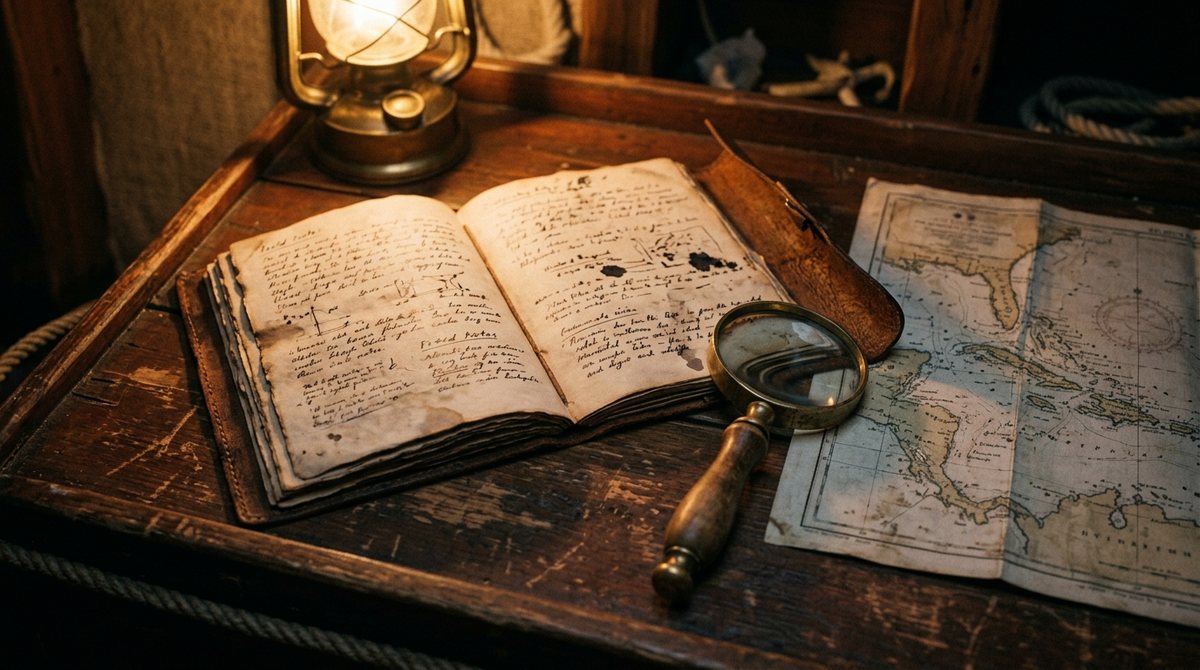
The most famous island line in English is usually printed as a poem, with line breaks. It is prose. John Donne wrote it in 1623 while recovering from a serious illness, and it is part of Meditation XVII of Devotions upon Emergent Occasions, published in 1624. It is the same passage that ends with for whom the bell tolls, which is where Hemingway found his title. The full text is free to read.
No man is an island, entire of itself; every man is a piece of the continent, a part of the main. If a clod be washed away by the sea, Europe is the less, as well as if a promontory were, as well as if a manor of thy friend’s or of thine own were: any man’s death diminishes me, because I am involved in mankind…
Donne in modern spelling, as most editions print him. The 1624 text reads “No man is an Iland, intire of it selfe”, which is the spelling scholarly editions reproduce. The sentence goes on to the bell.
The Mauritius line Twain did not say
There is a line about Mauritius that travels everywhere as Mark Twain’s own verdict on the island: that it was made first, and heaven was copied from it. Twain did write the words, in Following the Equator (1897), his account of a lecture tour round the world. But he is reporting what a local told him, and the very next sentence says another local called it an exaggeration. The book is free to read; more of his travel lines are on our Twain on Mauritius and everywhere else profile.
From one citizen you gather the idea that Mauritius was made first, and then heaven; and that heaven was copied after Mauritius.
What Twain actually wrote, in a diary entry in his Mauritius chapter. It is a joke about how proud the islanders were, not a recommendation.
Mauritius was made first, and then heaven; and heaven was copied after Mauritius.
Shared as Twain’s own opinion, usually on travel posters for the island. In the book he attributes it to a citizen, then gives the opposite view straight away. Quote it, by all means, but say who said it.
We check attributions like these on our fact-check page.
Darwin’s islands: the Galapagos
Darwin spent five weeks in the Galapagos in 1835 on the Beagle. The lines below are from the second edition of his journal, published in 1845, which he revised after he had begun to think seriously about how species arise. The first edition of 1839 is less outspoken. Both are public domain, and the 1845 text is free to read.
The archipelago is a little world within itself, or rather a satellite attached to America, whence it has derived a few stray colonists, and has received the general character of its indigenous productions.
The opening of Darwin’s summing up of the archipelago. Later in the chapter he corrects himself: not one satellite but a group of them.
Hence, both in space and time, we seem to be brought somewhat near to that great fact—that mystery of mysteries—the first appearance of new beings on this earth.
The same paragraph. The mystery of mysteries was a phrase of the astronomer John Herschel, and Darwin uses it here, years before On the Origin of Species.
…one is astonished at the amount of creative force, if such an expression may be used, displayed on these small, barren, and rocky islands; and still more so, at its diverse yet analogous action on points so near each other.
Darwin near the end of the chapter, on finding different species on islands within sight of each other. The card picks up mid sentence.
Short island quotes
If you want something short enough for a caption, these are the tightest lines on the page, and each one still carries a name and a book: card 7, card 8, card 14, card 17, card 18 and card 25. The last of them is below.
The Solomon Islands are on the fringe of things.
Jack London arriving in the Solomon Islands, at the far end of the voyage. The paragraph goes on about sailing reefs at night without a single lighthouse.
1. Treasure Island (Penguin Classics)
Best for: Readers who want the full text of the Stevenson novel quoted on this page.
A Penguin Classics paperback of Stevenson’s 1883 novel, with an introduction by John Seelye. A good way to read the island chapters quoted above in context.
Pros
- Complete text from a long established classics list
- Introduction and notes included
- Low priced paperback
Cons
- Paperback, so it is not a gift edition
- Illustrations are limited compared with collector editions
Notes on the selection
How this page was built. Every source was read in full as plain text: In the South Seas, Treasure Island, Moby-Dick, Typee, Robinson Crusoe, The Voyage of the Beagle (1845 edition), Donne’s Devotions, Following the Equator and The Cruise of the Snark from Project Gutenberg, and The Tempest from the Folger Shakespeare text. Twenty-five lines from eight writers were matched against them word for word. The chapter, act or section on each card is the nearest heading above the line in that text, so the locator is measured rather than remembered. Page numbers are left out on purpose: they change with every edition. Where a card starts or stops mid sentence, the cut is shown. Shakespeare’s verse lines are separated by a slash.
What was left out, and why. Song lyrics, of which page one is full, are not quoted. Modern island books still in copyright, such as Hemingway’s Islands in the Stream and Aldous Huxley’s Island, are named here rather than quoted. Two widely shared lines about the island of knowledge, credited online to the physicist John Archibald Wheeler and to the minister Ralph W. Sockman, could not be placed in a primary source, so they are left out rather than guessed at. Matsuo Basho’s Matsushima passage needs a named translation we have not yet sourced, so it waits for a later update. Three lines we would otherwise have used already run on other pages of this site, so they are not repeated here.
Island quotes: the questions people actually ask
Who said “No man is an island”?
John Donne, in Meditation XVII of Devotions upon Emergent Occasions, published in 1624. It is prose, not a poem, and the original spelling is “No man is an Iland, intire of it selfe”. The same passage ends with for whom the bell tolls.
What did Robert Louis Stevenson write about islands?
His South Seas voyages from 1888 became In the South Seas (1896), which opens with his first landfall in the Marquesas. He settled at Vailima on Samoa in 1890 and died there in 1894. His island novel, Treasure Island (1883), was written before he had sailed the Pacific at all.
What are the best quotes from Storm on the Island?
Storm on the Island is a poem by Seamus Heaney, from his first collection, Death of a Naturalist (1966). It is in copyright, so we do not reproduce it here. It describes a community on a bare island bracing for a storm, and it is widely studied in schools, so your anthology or the collection itself is the place to read it.
What is a good short island caption?
Stevenson’s “For the cocoa-tree and the island man are both lovers and neighbours of the surf.” Or Jack London’s “The Solomon Islands are on the fringe of things.” Both are real, both are short, and both come with a book you can name.

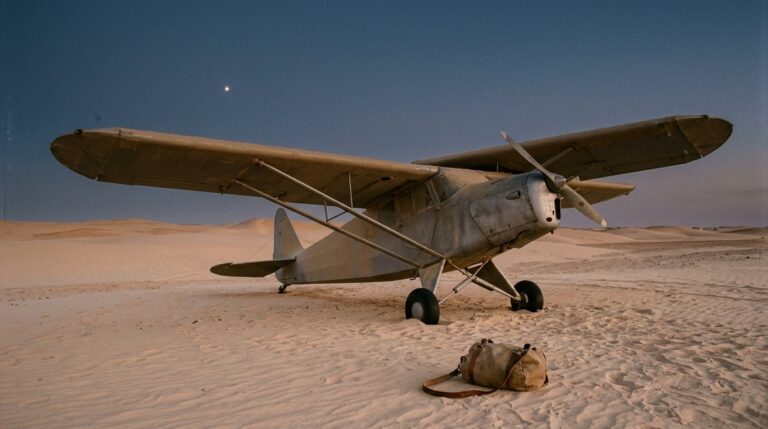


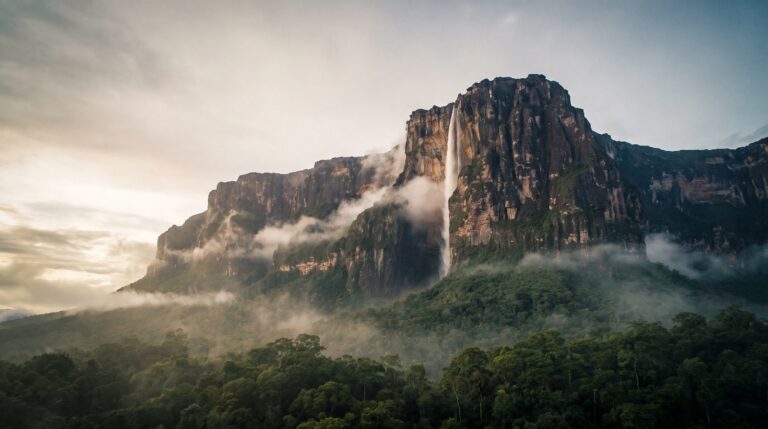

The sentence that opens Stevenson’s account of his first landfall, at Nuku Hiva in the Marquesas. If this page could keep one line, it would be this one.