
Waterfall quotes: 31 lines with the work and the year
Wordsworth, Byron, Shelley, Coleridge, Tennyson, Longfellow, Dickens at Niagara, Thoreau and Muir, every line read out of the complete text it came from. Plus three of the most shared waterfall lines on the internet, none of which can be sourced at all.
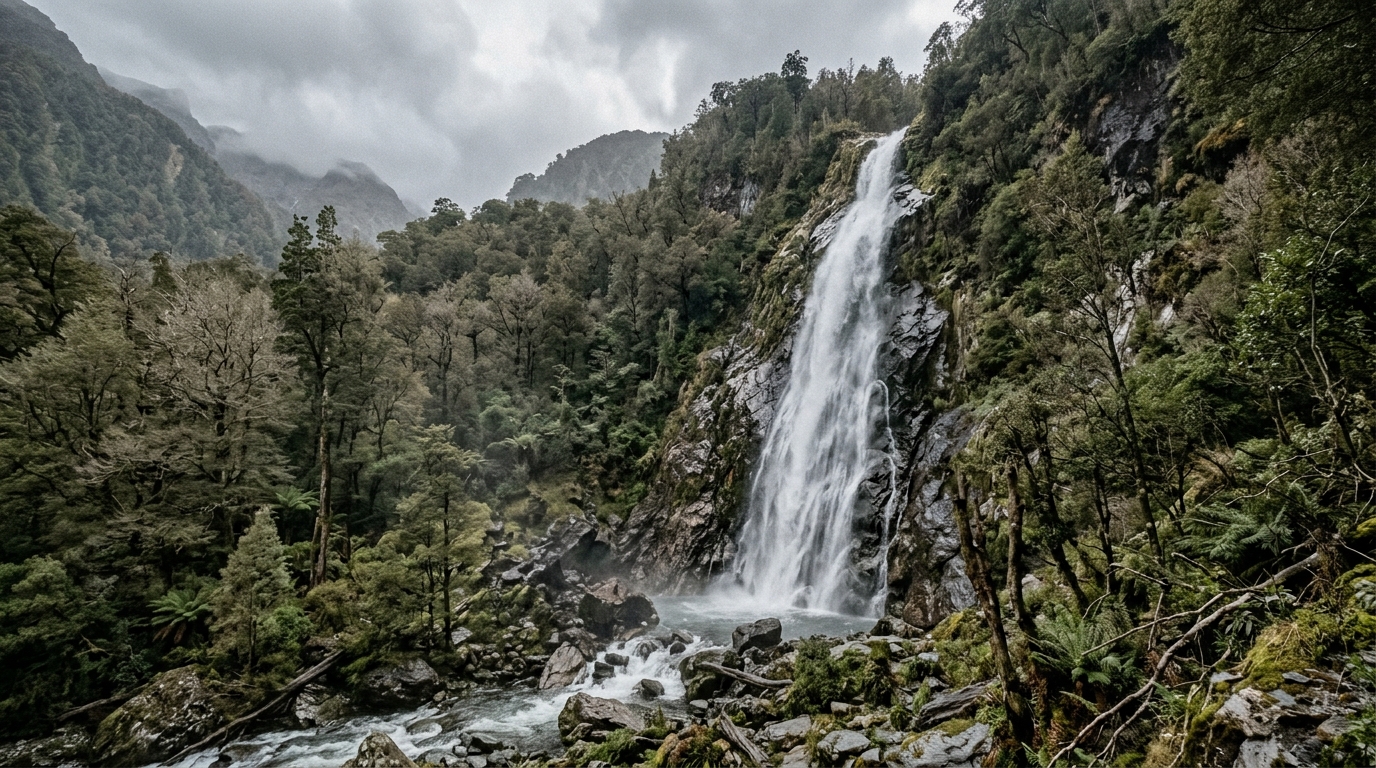
Search waterfall quotes and page one hands you three Pinterest results, a picture-quotes site, one real travel blog, and two Goodreads pages for novels that happen to be called Waterfall. The AI summary above all of it serves eight lines. Their credits, in order, are a painter, Unknown, a contemporary aphorist, Unknown, three more living writers, and Anonymous. Not one of them carries a work or a year.
That is odd, because falling water has been written about beautifully for two hundred years by people whose books are free to read in full. Wordsworth put a waterfall at the centre of the most famous nature poem in English. Byron gave a cataract in Italy several stanzas. Dickens spent ten days at Niagara and wrote the best paragraph anybody has written about standing in front of a great fall. Muir wrote about Yosemite Falls for thirty years. None of them appear on page one.
So this page took the slow route. Every line below was read out of the complete text it came from, as plain text, with the chapter, the poem or the stanza named and the year attached. Where a line is famous and cannot be sourced, it sits in its own section at the top, marked, with the search that failed described so you can repeat it.
One thing this page will not do is serve you a caption. Short lines are here, and there is a section pointing at the shortest of them, but every one still arrives with a book attached. The broader outdoors set lives on the nature travel quotes hub, salt water is on the ocean and coast quotes page, and every attribution this site has traced is collected on the travel quotes fact check hub.
What are the best waterfall quotes? The short answer
The waterfall lines nobody can source
These lines circulate constantly and none of them survives a search of the texts. Each one was probed as several independent fragments against thirteen complete books and collected poetical works, so a stray apostrophe or a reworded clause could not hide a real match. What follows is what the search returned, not an opinion about the lines.
Waterfalls are nature's way of showing off
A waterfall is the voice of the mountain
Same class. The phrase voice of the mountain does turn up in Longfellow, but not in this sentence and not about a waterfall, which is how these things usually form: a real phrase from a real poem drifts loose and reassembles into something tidier.
The rivers flow not past, but through us
The best known water line attached to Muir’s name, and it is not in any of the four books he published that this page draws on. It is normally traced to John of the Mountains, a selection from his journals edited by Linnie Marsh Wolfe and published in 1938, twenty-four years after he died. A notebook he kept for himself is a different kind of source from a book he wrote and put his name to. This site has not checked the 1938 journals against a copy of the text, so the honest verdict is absent from the published books rather than never written.
One measured finding in the other direction, and it is the kind of thing this exercise turns up when you actually read the books. Muir’s most quoted sentence of all is usually sourced to a letter he wrote to his sister in 1873. The phrase is also in a book he published. In Our National Parks (1901), in the chapter where he tries to talk Ralph Waldo Emerson into camping, Muir writes: Never mind. The mountains are calling; run away, and let plans and parties and dragging lowland duties all gang tapsal-teerie. It is not the poster wording, and it is not a waterfall line, so it does not get a card here. It is logged for the fact check hub, because a published source for that phrase is news.
And one line this page deliberately does not print as a quotation. The most shared waterfall line in the AI summary above these results is credited to a painter, and it is widely described as something he said while teaching a brush technique on television rather than as a thought about life. That is very likely right and it is exactly the kind of promotion this site exists to catch. It is left out of the list because this site has not been able to name the episode, and the rule on this page is that a line whose only traceable source is a captions site does not go in the list at all. Stated rather than quietly dropped.
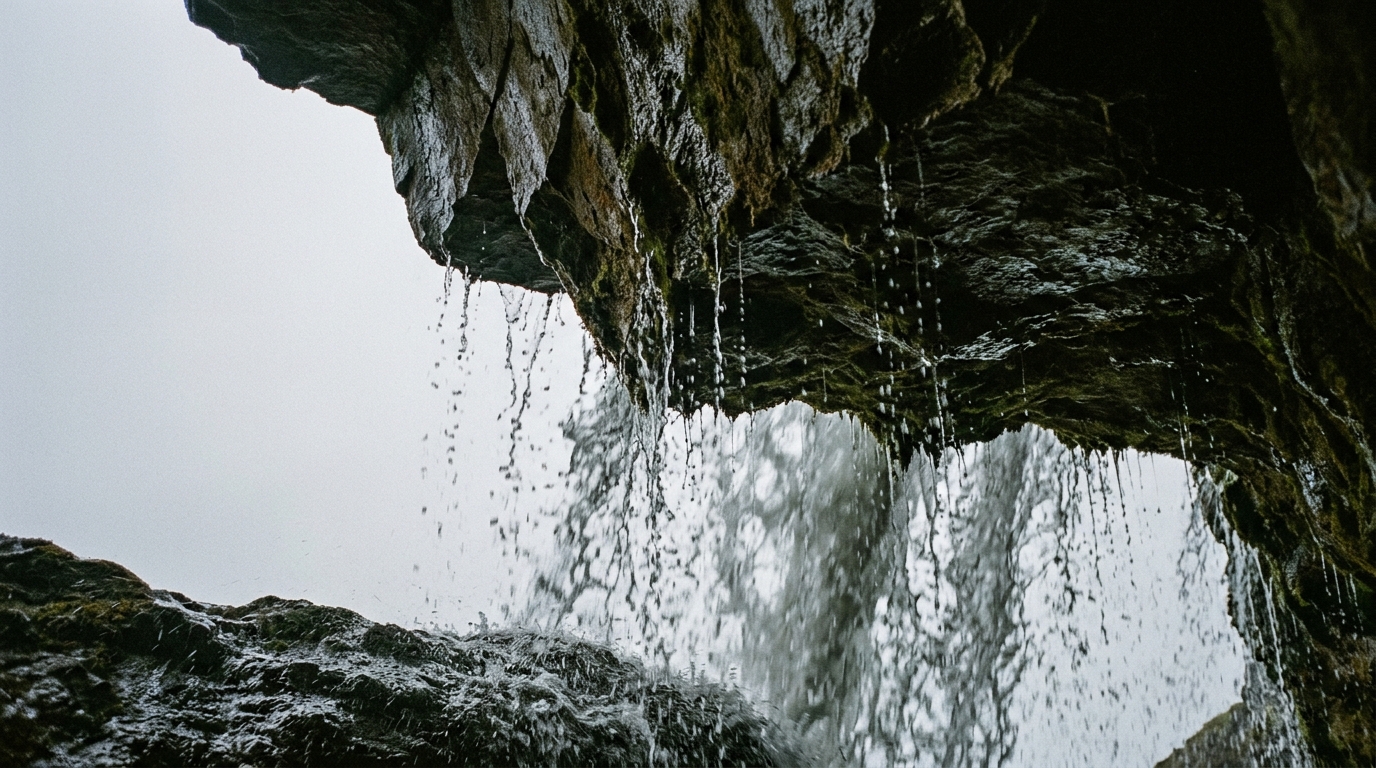
Waterfall quotes from the naturalists
Muir wrote more good sentences about falling water than anybody, and he wrote them in books he published himself, which means they can be checked. Thoreau is here for the opposite reason: he is the only writer in this collection who is rude about waterfalls, and he is right.
This was the most sublime waterfall flood I ever saw—clouds, winds, rocks, waters, throbbing together as one.
Yosemite in the flood of 1907, when every wall in the valley was running at once. Note what he does not say: no adjective about the water itself. The whole force of it is in putting clouds, wind, rock and water in one list and then calling the list one thing.
Here most of the new falls were in sight, probably the most glorious assemblage of waterfalls ever displayed from any one standpoint.
The same flood, a few sentences earlier. Muir had waited decades to see the valley like this and the sentence is careful to say probably. He is estimating, in public, about the thing he knew better than anyone alive.
As if celebrating some great event, falls and cascades in Yosemite costume were coming down everywhere from fountain basins, far and near; and, though newcomers, they behaved and sang as if they had lived here always.
The best line on this page about temporary waterfalls, the ones that exist for a week after heavy rain and then are gone. They behaved and sang as if they had lived here always is a joke, and it is also an argument about how quickly a landscape can absorb something new.
As soon as the stream is fairly over the lake-lip it breaks into cascades, never for a moment halting, and scarce abating one jot of its glad energy, until it reaches the next filled-up basin, a mile below.
A description of a stream stepping down a chain of glacial basins, and the phrase to keep is scarce abating one jot of its glad energy. The Victorian construction sounds ornate until you watch water do it.
The thousand falls, however, and the cascades in the cañons are then in full bloom, and sing songs from one end of the range to the other.
Falls in full bloom. Muir routinely wrote about water using the vocabulary of plants, which is not decoration: he is claiming that a waterfall has a season, appears, peaks and dies back, exactly like the meadow it waters.
Never shall I forget these glad cascade songs, the low booming, the roaring, the keen, silvery clashing of the cool water rushing exulting from form to form beneath irised spray
Cascade Creek, and one of the few passages anywhere that tries to separate the sounds a cascade makes instead of calling the whole thing a roar. Low booming, roaring, and a keen silvery clashing are three different noises made by one stream.
The noble walls—sculptured into endless variety of domes and gables, spires and battlements and plain mural precipices—all a-tremble with the thunder tones of the falling water.
The valley walls a-tremble with the thunder tones of the falling water. The claim is physical rather than poetic: he means the rock is moving.
The actual height and breadth of a mountain or a waterfall are always ridiculously small; they are the imagined only that content us.
The corrective, and the most useful sentence on this page. Thoreau is saying the waterfall in your memory is bigger than the one you stood in front of, and that the imagined version is the one that satisfies. Anybody who has gone back to a fall they loved as a child knows he is right.
Most men have no inclination, no rapids, no cascades, but marshes, and alligators, and miasma instead.
From the Sunday chapter, and it is a joke about people, not about rivers. He has just been describing a river’s drop and turns it into a complaint about characters with no gradient to them.
Waterfall quotes about sound, and about silence
A fall is mostly a noise. These are the lines that treat the sound as the subject rather than as scenery, including the strangest and best idea in the whole collection.
No wonder he sings well, since all the air about him is music; every breath he draws is part of a song, and he gets his first music lessons before he is born; for the eggs vibrate in time with the tones of the waterfalls.
The best sentence on this page, and it is about a bird. The water ouzel nests in the spray beside waterfalls, and Muir’s claim is that it learns music before hatching because the eggs vibrate with the fall. Whether or not that is good ornithology, it is a complete theory of where a song comes from in one clause.
No moving thing is seen as we climb the peaks, and only the low, mellow murmur of falling water is heard, which seems to thicken the silence.
The inversion that makes it work: the murmur of falling water does not break the silence, it thickens it. Written about Yellowstone, and true of every quiet place with water in it.
The waterfall sang in chorus, filling the old ice-fountain with its solemn roar, and seeming to increase in power as the night advanced—fit voice for such a landscape.
A night camped above the Tuolumne with a fall across the lake. Fit voice for such a landscape is Muir at his most matter-of-fact about the thing he was most sentimental about.
Then every bower in the groves is a bridal bower, the winds murmur softly overhead, the streams sing with the birds, while from far-off waterfalls and thunder-clouds come deep rolling organ notes.
Waterfalls and thunder-clouds producing the same deep rolling organ notes. The comparison is doing real work: he is telling you that at distance you cannot tell falling water from weather.
And hark, the noise of a near waterfall!
A single exclamation, and the reason it is here is the word near. The poem is about a man walking away from being in love, and the waterfall arrives as an interruption he welcomes. A sound can be a rescue.
And you, ye five wild torrents fiercely glad!
Coleridge counting the torrents at Chamonix and addressing them directly. Fiercely glad is the best two-word description of a mountain torrent anybody has managed.
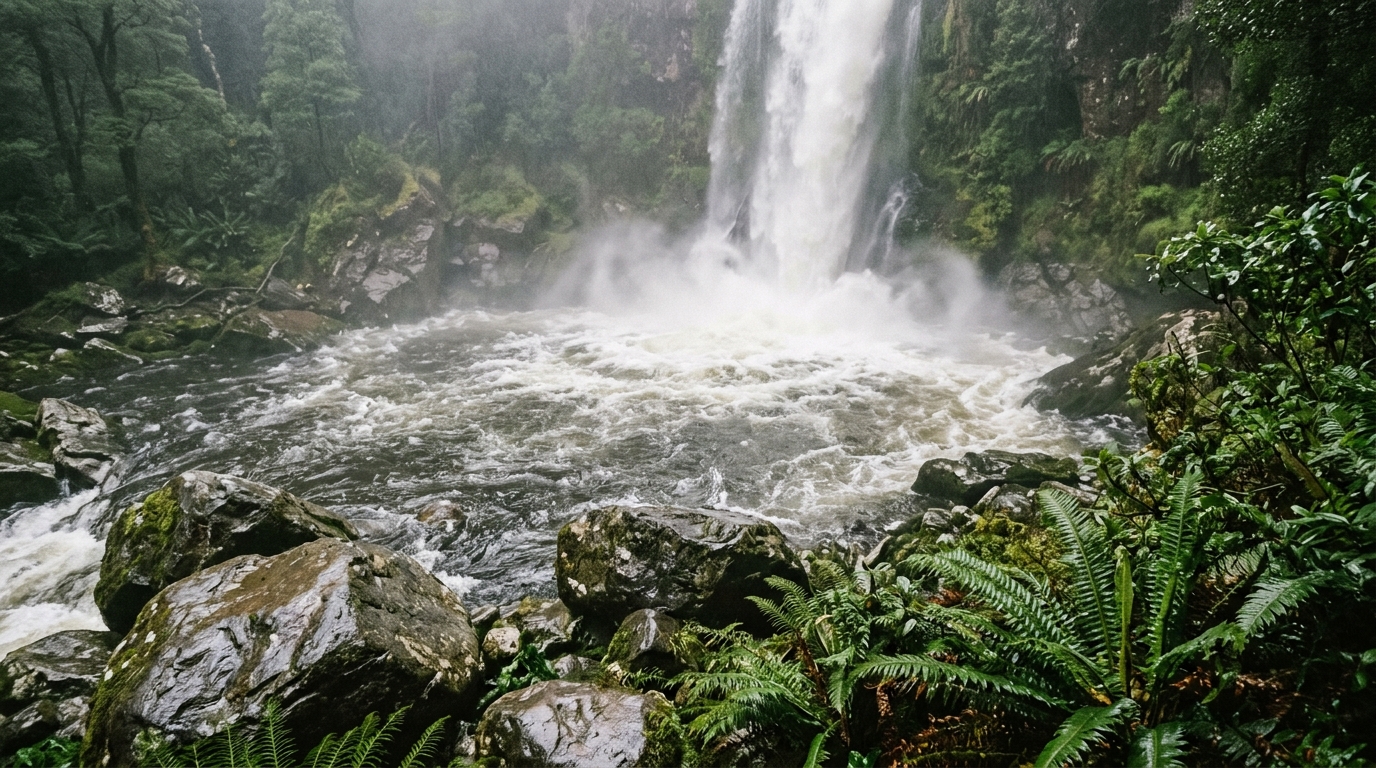
Niagara, and what a great fall does to a traveller
Dickens went to Niagara in 1842, stayed ten days, never crossed back to the American side, and wrote the passage that everybody writing about waterfalls since has been competing with without knowing it. It is quoted here at some length because cutting it is what the caption sites do to it.
Then, when I felt how near to my Creator I was standing, the first effect, and the enduring one—instant and lasting—of the tremendous spectacle, was Peace. Peace of Mind, tranquillity, calm recollections of the Dead, great thoughts of Eternal Rest and Happiness: nothing of gloom or terror.
The whole point, and it is not the one you expect. A man standing in front of the loudest thing in North America reports peace, and then lists what the peace consisted of: the dead, rest, happiness, and specifically nothing of gloom or terror. Every modern waterfall caption reaches for awe. Dickens got something quieter and more useful.
Niagara was at once stamped upon my heart, an Image of Beauty; to remain there, changeless and indelible, until its pulses cease to beat, for ever.
Stamped upon my heart, an Image of Beauty, to remain there until its pulses cease to beat. He was thirty years old and had been in America four months, and he meant it: he wrote about Niagara again for the rest of his life.
I think in every quiet season now, still do those waters roll and leap, and roar and tumble, all day long; still are the rainbows spanning them, a hundred feet below.
The tense is what makes this great. Back in England, he says that in every quiet season now the water is still falling, still rainbowed, still going. It is the most accurate thing anybody has written about what a waterfall leaves behind in a person who has left it.
But always does the mighty stream appear to die as it comes down, and always from its unfathomable grave arises that tremendous ghost of spray and mist which is never laid
The mighty stream appears to die as it comes down, and from its grave rises the spray. The image is doing something precise: the cloud above a great fall is made of the river that has just ended.
we saw a laced and ruffled cataract of limpid water leaping from a sheer precipice fifteen hundred feet high
Twain in Hawaii, refusing to be impressed in the usual way and then producing laced and ruffled, which is exactly what a high thin fall looks like. Laced and ruffled is haberdashery, and it beats a paragraph of grandeur.
Waterfall quotes from the poets
The poets got to falling water first and they have not been improved on. Every line here names its poem, and where the edition read for this page disagrees with the date usually printed, the card follows the edition: its own note dates The Lotos Eaters to 1833, not the 1832 that circulates.
The sounding cataract Haunted me like a passion
The line that should be at the top of every waterfall list and is on none of them. From Tintern Abbey, in the first Lyrical Ballads of 1798. He is describing what nature was to him as a young man, before thought got involved: not a view, an appetite. Haunted me like a passion is the whole argument.
The roar of waters!–from the headlong height Velino cleaves the wave-worn precipice; The fall of waters! rapid as the light
Byron at the Cascata delle Marmore near Terni, where the river Velino drops off a cliff. He opens the stanza with the roar, not the sight, then says it twice: the roar of waters, the fall of waters. Most waterfall writing is visual. This is a soundtrack with a picture attached.
Charming the eye with dread,–a matchless cataract
Three stanzas later, and charming the eye with dread is the phrase that earns the whole passage. He is naming the specific pleasure of standing safely next to something that would kill you.
Beneath, the distant torrent's rushing sound Tells where the volumed cataract doth roll Between those hanging rocks, that shock yet please the soul.
The approach rather than the arrival: you hear the cataract before you see it and the rocks that shock yet please the soul are the ones hiding it. Good writing about a fall is often writing about what is in the way.
Thine earthly rainbows stretched across the sweep Of the ethereal waterfall, whose veil Robes some unsculptured image
Shelley in the vale of Chamouni, published in 1817, and the strangest image in the collection: the rainbow in the spray is an earthly rainbow, the fall itself is ethereal, and the veil of water robes an unsculptured image. He is describing a statue that was never made, behind water.
The vale is girdled with their walls, a howl Of cataracts from their thaw-cloven ravines, Satiates the listening wind, continuous, vast, Awful as silence.
From Prometheus Unbound, and the phrase to take away is awful as silence. A howl of cataracts so continuous and so vast that it stops registering as noise is a real acoustic effect and almost nobody has named it.
And like a downward smoke, the slender stream Along the cliff to fall and pause and fall did seem.
A fall seen from very far away, which is the one view nobody writes about. Like a downward smoke, and then to fall and pause and fall, which is what distance does to falling water: it turns continuous motion into something that seems to hesitate.
Till he heard the cataract's laughter, Heard the Falls of Minnehaha Calling to him through the silence.
The cataract’s laughter, and then the falls calling through the silence. Longfellow’s meter is easy to mock and this is what it is for: the line arrives at the same speed as a man walking toward a sound.
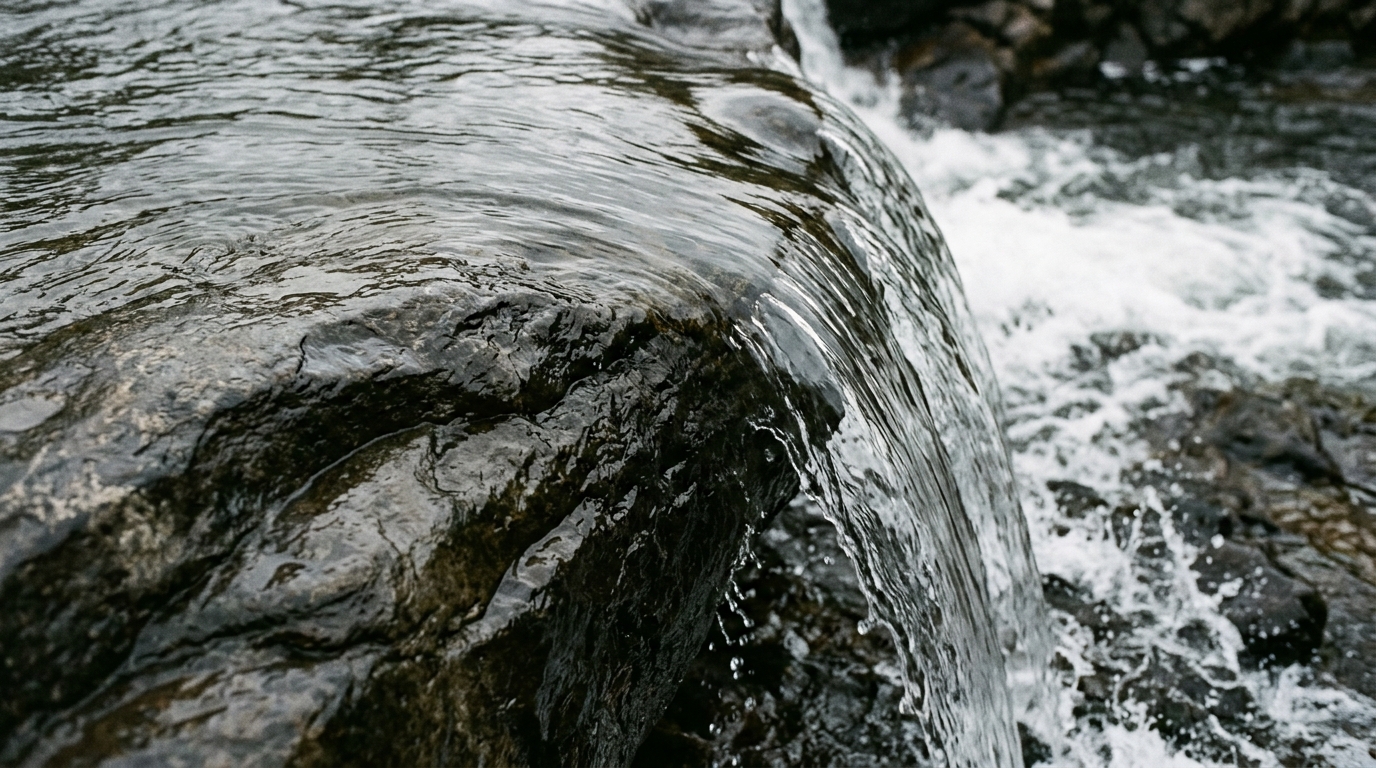
Waterfall quotes about letting go
Letting go is the register this search is really asking for, and it is usually served with anonymous lines. Here are three that carry a source, including one that flatly disagrees with the genre.
Be not like a stream that brawls Loud with shallow waterfalls, But in quiet self-control Link together soul and soul
The contrarian entry, and it is the best answer on the page to the whole let-it-all-go tradition. Be not like a stream that brawls loud with shallow waterfalls. Longfellow’s point is that noise and depth are opposites, and that the quiet river is the one doing the work.
How deep our sleep last night in the mountain’s heart, beneath the trees and stars, hushed by solemn-sounding waterfalls and many small soothing voices in sweet accord whispering peace!
The gentlest thing Muir wrote about water, from the journal he kept in the summer of 1869. Hushed by solemn-sounding waterfalls and many small soothing voices in sweet accord whispering peace. This is the line the caption sites are groping for when they reach for an anonymous one.
Storms of every sort, torrents, earthquakes, cataclysms, “convulsions of nature,” etc., however mysterious and lawless at first sight they may seem, are only harmonious notes in the song of creation, varied expressions of God’s love.
The largest claim in the collection: that torrents, earthquakes and every convulsion of nature are only harmonious notes in the song of creation. Muir put convulsions of nature in quotation marks himself, because he was quoting the people he disagreed with.
Short waterfall quotes
Most of the related searches on this term are asking for something caption-length, so here are the shortest fully sourced lines on the page: card 9, card 14, card 15, card 21, card 23 and card 27. The shortest of the lot is card 14, at eight words, and it still carries a poem and a year.
What this page will not do is give you a wall of six-word lines with no author. If a short attributed line is what you need, the cards above are already it: copy the line, keep the name and the year that sits under it, and the post you put it in becomes the only one in the feed that can be checked.
Not this Waterfall: the two novels
Worth clearing up, because two of the results on this search are not about waterfalls at all. Waterfall is the title of a 2011 young adult time-travel novel by Lisa Tawn Bergren, the first of her River of Time series, and also of a 2014 novel by Lauren Kate. Both have large quote collections on Goodreads, which is why they rank here. Neither is quoted on this page: both are in copyright, and the only available sources for their lines are aggregator pages, which is precisely what this page refuses to treat as a source. If you came looking for either book, you want the novel, not a quote list.
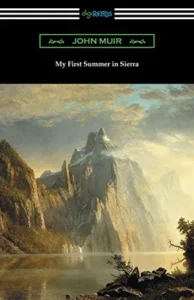
1. My First Summer in the Sierra by John Muir (Digireads)
Best for: Readers who want the 1911 journal behind the Muir waterfall lines on this page.
A 136 page paperback of Muir’s journal of his 1869 summer in the Sierra Nevada, reproducing the illustrations and photographs from the 1911 edition. The best place to read his waterfall passages in context.
Pros
- Reproduces the original 1911 illustrations
- Short enough to read in a weekend
- Low priced paperback
Cons
- Fewer reviews than the Dover edition
- Shorter than the Dover edition at 136 pages
Notes on the selection
How this page was built. Thirteen complete primary texts were read as plain text and every candidate line was matched against them word for word, with the chapter, stanza or journal entry recorded. Every one of the thirty-one lines comes from a work published before 1930, which is why the verification pass cost nothing: those texts are out of copyright and free to read in full. Ten writers are represented, the oldest line dates from 1798 and the newest from 1912, and twenty-nine of the lines appear on this site for the first time. Every line was also checked against the nature hub and both published neighbours so that no quote runs on two pages. One distinction worth being exact about: the wording, the work and the locator on every card come from the text itself, while the year is the standard publication date of the work rather than something a plain text file can confirm. One Longfellow poem was cut for precisely that reason, because this edition gives no date for it and a remembered year is not a source.
What was cut, and why. No line from a captions site, a quote aggregator or a Pinterest board survived, which removed most of what page one offers. Matsuo Basho belongs on this page and is not on it: falling water runs through Oku no Hosomichi of 1702, including the passage where he sits behind the Urami waterfall, but every English translation is in copyright and this site will not quote a translation it cannot cite properly. His profile is live and the work is named here instead. John Muir carries more of this page than anybody and has no profile on this site yet, which is the clearest gap the nature collection has.
Waterfall quotes: the questions people actually ask
Are there famous waterfall quotes with real sources?
Yes, and they are older and better than the ones that circulate. Wordsworth, in Tintern Abbey in the 1798 Lyrical Ballads: the sounding cataract haunted me like a passion. Byron, in canto four of Childe Harold’s Pilgrimage (1818), on the Velino cataract at Terni: the roar of waters, from the headlong height. Dickens, in American Notes (1842), on ten days at Niagara. Muir, across four books published between 1894 and 1912. Every one of those texts is out of copyright and readable in full, which is why the lines on this page could be checked word for word rather than copied from another list.
Where does the line about waterfalls being nature’s way of showing off come from?
Nowhere anybody can name. It was probed as several separate fragments against thirteen complete books and collected poetical works and does not appear in any of them. On the sites that carry it, it is usually unattributed and occasionally given a name with no work beside it. That is the signature of a line written for a caption rather than taken from a text.
Did John Muir write that the rivers flow not past, but through us?
Not in any book he published. The sentence is absent from The Mountains of California (1894), Our National Parks (1901), My First Summer in the Sierra (1911) and The Yosemite (1912), each searched whole as plain text. It is normally traced to John of the Mountains, a selection from his journals edited by Linnie Marsh Wolfe and published in 1938, twenty-four years after his death. So it is very likely his words, from a notebook, published posthumously, which is a different claim from the one most pages make for it.
What is the book called Waterfall?
There are two, and neither is a quote collection. Waterfall (2011) is the first of Lisa Tawn Bergren’s River of Time young adult series. Waterfall (2014) is a novel by Lauren Kate. Both rank on this search because their Goodreads quote pages do, which is how a title collision turns into a search result.




This is the most reposted waterfall sentence on the internet and it has no author at all. It appears on caption lists and picture-quote sites, usually unattributed, occasionally credited to a name with no work beside it. Absent from every text searched here. It is a good line. It is not a quotation, because a quotation has somebody to quote.