
Nature quotes: thirty lines from Thoreau, Emerson, Muir and Wordsworth, with the source attached
Thirty nature quotes, each with its book, year and chapter or poem, plus the forest line Muir never wrote and the Shakespeare favourite that means the opposite.
Search nature quotes and page one hands you lists of hundreds of lines over a photo of a misty lake. Almost none of them tell you which book a line came from, and a few of the most shared ones were never written by the person whose name sits under them.
So every numbered line on this page carries its writer, its book or poem, the year, and the chapter, poem or scene it came from, and every one was read word for word in the original text. That gets you Thoreau at Walden Pond, Emerson in the little book that started American nature writing, Wordsworth telling a bookish friend to go outside, Muir in his first summer in the Sierra, and Shakespeare, Whitman, Keats, Dickinson and Basho alongside them. It also gets you the truth about the forest line credited to Muir, the Einstein line nobody can find in Einstein, and the Shakespeare favourite that means close to the opposite of what people think. The mountains line credited to Muir has a page of its own: our fact-check of the mountains are calling and I must go traces it back to the letter.
This is the hub for nature as a subject. If you want a particular landscape, the woods, the trail, the sea or the last light of the day, the landscape guide near the end sends you to the right page, and the travel angle has its own home in our nature travel quotes.
What are the best nature quotes? The 60 second answer
The writers who built the canon: Thoreau, Emerson, Wordsworth, Muir
Four writers did most of the work. Wordsworth and Coleridge published Lyrical Ballads anonymously in 1798, and its poems argued that the woods could teach more than books. Emerson carried the idea across the Atlantic in Nature (1836), a short book he also published without his name. His friend Henry David Thoreau tested it by living in a cabin beside Walden Pond for two years, and Thoreau’s Walden came out in 1854. John Muir read them all, walked into the Sierra Nevada in 1869 with a flock of sheep and a notebook, and turned that journal into My First Summer in the Sierra (1911). One line from each, then the rest of the page in themes.
I went to the woods because I wished to live deliberately, to front only the essential facts of life, and see if I could not learn what it had to teach, and not, when I came to die, discover that I had not lived.
If the stars should appear one night in a thousand years, how would men believe and adore; and preserve for many generations the remembrance of the city of God which had been shown! But every night come out these envoys of beauty…
The opening chapter of the book that started the whole conversation. The point is familiarity: the night sky is a miracle we have stopped seeing because it turns up every evening. The card stops mid sentence; the sentence ends with the stars lighting the universe with their admonishing smile.
Come forth into the light of things, Let Nature be your teacher.
The instruction everyone paraphrases, in the poem where Wordsworth tells a friend to shut his books. The full title is The Tables Turned; An Evening Scene, on the Same Subject, and it answers the poem printed just before it.
When we try to pick out anything by itself, we find it hitched to everything else in the universe.
Muir’s journal for a day at Lake Tenaya, published in 1911. It matters twice on this page: it is one of his best lines, and it comes from the same journal date that one website claimed for the forest misquote further down.
Nature quotes about wonder
Wonder is the oldest reason anyone writes about the natural world: the sense that the ordinary thing in front of you, a leaf, a field, a mountain morning, is stranger than it has any right to be. These are the lines that say it best, and most of them were written by people who spent a long time looking at one place.
I believe a leaf of grass is no less than the journey work of the stars
Song of Myself, from the first edition of Leaves of Grass in 1855; the section number is from the 1891 text Whitman revised until his death. A single blade of grass, put on equal terms with the stars.
A child said What is the grass? fetching it to me with full hands; How could I answer the child? I do not know what it is any more than he.
The question that the whole of Song of Myself tries to answer, asked by a child. Whitman goes on to offer guesses for the rest of the section, and never settles on one.
To the attentive eye, each moment of the year has its own beauty, and in the same field, it beholds, every hour, a picture which was never seen before, and which shall never be seen again.
From the chapter Beauty in Nature. Emerson goes on to describe the sky, the crops and the roadside plants changing week by week, which is as good an argument as any for going back to a place you think you already know.
This is my letter to the world, That never wrote to me,— The simple news that Nature told, With tender majesty.
The poem that opens the first collection of her work, printed in 1890, after her death. Dickinson barely left her house in Amherst, and most of what she knew of the world came from her garden.
Oh, these vast, calm, measureless mountain days, inciting at once to work and rest! Days in whose light everything seems equally divine, opening a thousand windows to show us God.
Muir in the Sierra, early in the summer of the journal. The exclamation mark is his: the whole book reads like this, a man who cannot quite believe his luck.
Nature is loved by what is best in us.
From the later essay Nature, in Essays: Second Series (1844), not the 1836 book of the same name. They are often mixed up, so the card names the collection.
Nature quotes about patience
The second thing these writers kept noticing is that nature does not hurry. It is the most shared theme online, and also the one with the most lines that cannot be traced. The ones below can. The famous Emerson line on the subject turned out to be real, which is not how these searches usually end.
Leave this military hurry and adopt the pace of Nature. Her secret is patience.
The line people share as “adopt the pace of nature: her secret is patience” is genuine, and this is where it lives: the essay Education, printed in Lectures and Biographical Sketches in 1883. Emerson is talking about teaching children, not about hiking, and the next sentence describes a naturalist sitting so still he becomes a statue.
There can be no very black melancholy to him who lives in the midst of Nature and has his senses still.
From the chapter Solitude in Walden. The condition matters: Thoreau says nature helps the person whose senses are still awake, not anyone who simply turns up.
I think I could turn and live with animals, they are so placid and self-contain’d, I stand and look at them long and long.
Song of Myself again. Whitman’s reason, a few lines on, is that animals do not lie awake in the dark worrying, which is patience of a kind most of us never manage.
Nature quotes about the seasons
The seasons are where nature writing turns into poetry, partly because the poets got there first. Keats and Shelley both wrote their best season poems in the same autumn, and both were printed in 1820. Thoreau, being Thoreau, preferred spring, and said so in a chapter of that name.
Season of mists and mellow fruitfulness, Close bosom-friend of the maturing sun…
The opening of To Autumn, the last great ode Keats wrote, printed in his 1820 volume. The card stops at the end of the first clause; the stanza goes on to load the vines with fruit and bend the apple trees.
Where are the songs of Spring? Ay, where are they? Think not of them, thou hast thy music too…
The same poem, third stanza, answering its own question: autumn has its own music, the gnats and crickets and the swallows gathering. The best reply to anyone who thinks the year peaks in spring.
If Winter comes, can Spring be far behind?
The closing line of Ode to the West Wind, printed in 1820 with Prometheus Unbound. It is a question, and a hopeful one, which is why it has outlived almost everything else Shelley wrote.
The first sparrow of spring! The year beginning with younger hope than ever!
From the chapter Spring, near the end of Walden, where the ice breaks up on the pond and Thoreau gets so excited he starts using exclamation marks.
Rough winds do shake the darling buds of May, And summer’s lease hath all too short a date:
The sonnet that starts by comparing someone to a summer’s day. The weather is the reason the comparison fails: summer is too rough and too short.
What nature teaches: quotes from the poets
The idea that a walk can teach you something a book cannot is the thread running through this whole page. It starts with Wordsworth, but Shakespeare had a banished duke say much the same thing in a forest two centuries earlier.
One impulse from a vernal wood May teach you more of man; Of moral evil and of good, Than all the sages can.
The stanza after the instruction to let nature be your teacher, in The Tables Turned. Wordsworth was making a provocation, and the sages he dismisses are the very books his friend is reading.
Knowing that Nature never did betray The heart that loved her…
Tintern Abbey, the last poem in Lyrical Ballads. The card stops where the sentence turns: it goes on to say that nature leads us from joy to joy.
And ’tis my faith that every flower Enjoys the air it breathes.
Lines Written in Early Spring, from the same book. The poem is quieter than its famous neighbour, and sadder: Wordsworth sets the happy flowers against what man has made of man.
And this our life, exempt from public haunt, Finds tongues in trees, books in the running brooks, Sermons in stones, and good in everything.
Duke Senior in the Forest of Arden, As You Like It, first printed in the 1623 Folio. He has been exiled from court and decides the woods are the better school. It is the oldest line on the page and still the best summary of the idea.
Nature, the gentlest mother, Impatient of no child, The feeblest or the waywardest,— Her admonition mild…
The opening of the poem that leads the nature section of her second collection, printed in 1891. The card stops mid sentence; the poem goes on to put the whole world to bed.
To make a prairie it takes a clover and one bee,— One clover, and a bee, And revery. The revery alone will do If bees are few.
The whole poem, from her third collection (1896). Dickinson’s lesson runs the other way from Wordsworth’s: you can build a landscape in your head when the real one is thin on the ground.
Nature quotes from around the world
The English and American writers above were late to this. Japanese poets were writing about frogs and butterflies a century before Wordsworth, and the Chinese classics were older still. These are translations, so each card names its translator as well as the writer. Every translation here is old enough to be in the public domain and read in full. For the travel journey behind the haiku, see our Basho, Oku no Hosomichi profile.
The old pond, aye! and the sound of a frog leaping into the water.
The most famous haiku in Japanese, in Basil Hall Chamberlain’s prose translation of 1902, which he says every Japanese person knows by heart. Plenty of later versions are neater; this one is early and faithful.
Awake! awake! I’ll make of thee My comrade, sleeping butterfly.
Basho again, in the same Chamberlain paper. A small, funny poem about wanting company on the road, which is the whole of travel writing in a sentence.
A violent wind does not last for a whole morning; a sudden rain does not last for the whole day.
The Tao Teh King in James Legge’s translation of 1891. Weather as the lesson: the violent things do not last, which is the real version of the patience idea that gets shared with no source at all.
The highest excellence is like (that of) water.
Legge again. The brackets are his, marking words he added to make the Chinese read as English. The rest of the passage praises water for settling in the low places other things avoid.
The same stream of life that runs through my veins night and day runs through the world and dances in rhythmic measures.
Rabindranath Tagore, from his own English version of Gitanjali, printed in 1912 with an introduction by W. B. Yeats. It is the book that won him the Nobel Prize.
Nature quotes everyone gets wrong
Three of the most shared nature quotes have a problem. Two were not written by the person named under them, and the third is a real line read backwards. Each verdict below says where we looked, the same standard as our travel quotes fact check hub.
And into the forest I go, to lose my mind and find my soul.
The Sierra Club, which runs the largest online archive of Muir’s writing, lists this as a misquote: it appears nowhere in his books or journals. One website pinned it to his journal for July 27, 1869; the Sierra Club checked the original entry and found nothing like it. What that entry does contain is the hitched to everything line above.
Our verdict: not John Muir. The Sierra Club’s John Muir Misquoted page also records a modern writer’s claim to have written one version of the line, which we have not been able to check, so we name no author. If you want genuine Muir in the woods, our forest quotes carry him with the source attached.
Look deep into nature, and then you will understand everything better.
We found no letter, book or article by Einstein containing this. Every trace runs to a recollection attributed to his stepdaughter Margot, carried in Alice Calaprice’s collections of Einstein quotations, describing something he said to her. We have not read that page ourselves.
Our verdict: reported, not written. It may well be something Einstein said, and the sentiment is not out of character, but it is a family memory, not a source. That is why it has no number on this page. The same grading rule runs through our Emerson verdict on do not follow where the path may lead.
The third one is genuine Shakespeare. It is printed as a warm line about our shared humanity on posters and in wedding speeches. Read it in the scene and it is close to the opposite.
One touch of nature makes the whole world kin— That all with one consent praise new-born gauds…
Ulysses is goading Achilles back into the war. The touch of nature that makes the whole world kin is a shared weakness: everyone praises the shiny new thing and forgets what came before. Achilles is being forgotten while the crowd cheers Ajax. Genuine, sourced, and almost always quoted against its meaning.
Our verdict: genuine, but read backwards. The card above carries the line with the half sentence that follows it, which is the part that never makes the poster. The play is free to read in full at Project Gutenberg.
Short nature quotes
If you want a caption, these are the shortest complete thoughts on the page, every one under ten words and every one still carrying a name and a source: “Let Nature be your teacher.” (Wordsworth, card 3); “Her secret is patience.” (Emerson, card 11); “Nature is loved by what is best in us.” (Emerson, card 10); “If Winter comes, can Spring be far behind?” (Shelley, card 16); “The highest excellence is like (that of) water.” (Laozi, card 28); “Enjoys the air it breathes.” (Wordsworth, card 21); and “The first sparrow of spring!” (Thoreau, card 17). Some are the tail of a longer card, so the card number takes you to the full line and its book.
Where to go next: nature quotes by landscape
This page covers nature as a subject. Each landscape has its own collection, sourced the same way, and the lines that belong to one place live there rather than here: forest quotes for the woods, wilderness quotes for the untamed places, hiking quotes for the trail, outdoor quotes for life outside, camping quotes for a night under canvas, national park quotes for the parks, ocean and coast quotes for the sea, sunrise quotes for first light, sunset quotes for last light, and desert quotes for the dry country. If you are planning a trip rather than a caption, start with nature travel quotes, and the whole collection begins at our travel quotes hub.
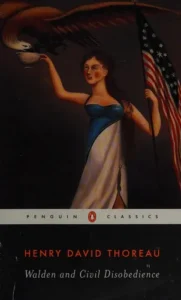
1. Walden and Civil Disobedience (Penguin Classics)
Best for: Readers who want the full text of Walden that the Thoreau lines on this page come from.
A 336 page Penguin Classics paperback carrying the complete text of Thoreau’s Walden alongside Civil Disobedience. A good way to read The Ponds chapter and the rest of the book in context.
Pros
- Complete Walden from a long established classics list
- Civil Disobedience included in the same volume
- Low priced paperback
Cons
- Paperback, so it is not a gift edition
- Fewer reviews than the cheapest reprints
Notes on the selection
How this page was built. Every source was read in full as plain text, most of it from Project Gutenberg: Walden, Emerson’s Nature (in the 1849 reissue of the 1836 text), Essays: Second Series and Lectures and Biographical Sketches, the 1798 Lyrical Ballads, the 1891 text of Leaves of Grass, the 1820 Keats volume, Shelley, Shakespeare, the three Dickinson series, My First Summer in the Sierra, Gitanjali and Legge’s Tao Teh King, plus Chamberlain’s 1902 Basho paper from the Internet Archive. Thirty lines were matched against those texts word for word, and the chapter, poem or scene on each card is the nearest heading above the line, measured rather than remembered. Page numbers are left out because they change with every edition. Where a card stops mid sentence, the cut is shown. Our grading rule: a line is only numbered if it is written down in a text we have read. A remark someone remembers being said, like the Einstein line, is graded reported, not written, and carries no number.
What was left out, and why. Page one of the search results for this term is lists from Reader’s Digest, Wisdom Quotes, Quora and Pinterest, and none of the top ten attaches a work and a year to every line, so nothing here was taken from them. Rachel Carson, Mary Oliver and David Attenborough are in copyright, and we would not number a line we could not read in its book. The speech credited to Chief Seattle is left out on purpose: the version people share is a much later rewrite of a speech first printed from memory decades after it was given, and his Chief Seattle profile sets out the provenance. Thoreau’s in Wildness line belongs to our wilderness page, so it is not repeated here. Twenty-four of the thirty cards appear nowhere else on the site. Song lyrics are not quoted. More Emerson, sourced the same way, is on his Emerson’s Nature, 1836 profile.
Nature quotes: the questions people actually ask
What is the most famous quote about nature?
Henry David Thoreau’s “I went to the woods because I wished to live deliberately, to front only the essential facts of life”, from the chapter Where I Lived, and What I Lived For in Walden (1854).
Did John Muir say “into the forest I go”?
No. The Sierra Club, which keeps the largest archive of his writing online, says the line appears nowhere in his books or journals, and the journal date sometimes given for it contains nothing like it.
What did Emerson say about nature?
A great deal, but the book is Nature (1836). Its first chapter says that if the stars appeared one night in a thousand years, people would believe and adore. His line on the pace of nature is real too, from the essay Education (1883).
What does “one touch of nature makes the whole world kin” mean?
In Troilus and Cressida, Act III, Scene III, Ulysses means a shared human weakness: everyone praises new trinkets over past merit. It is usually quoted as a line about common humanity, which is close to the opposite.
What is a short nature quote for a caption?
Three real ones: “Let Nature be your teacher.” (Wordsworth, 1798). “Nature is loved by what is best in us.” (Emerson, 1844). “If Winter comes, can Spring be far behind?” (Shelley, 1820).


The most famous sentence in American nature writing, from the chapter Where I Lived, and What I Lived For. Thoreau is not praising the woods here so much as using them: the cabin was an experiment, and this is the question it was built to answer.