
Peter Pan quotes: J.M. Barrie’s real lines, with chapter and act
Twenty-one lines from the 1904 play and the 1911 novel, each read out of the original text and labelled with its chapter or act. Plus the famous Peter Pan quotes Barrie never wrote.
Search Peter Pan quotes and most of what comes back is the 1953 Disney film, pixie dust and all, with a few lines from a contemporary poet thrown in. Very few of them say which book they came from, because most of them did not come from a book.
J.M. Barrie wrote Peter Pan twice. The play was first staged in London in December 1904, and the novel, Peter and Wendy, followed in 1911. The wording is not always the same, so every numbered line below names the version it came from, with the chapter or the act, and every one was read word for word out of the original text. The famous lines Barrie never wrote get their own section near the end.
This is one of our literary collections, alongside Alice in Wonderland quotes and the Hobbit quotes, sourced the same way. The whole site starts at the 100 best travel quotes.
What are the best Peter Pan quotes? The 60 second answer
Peter Pan quotes from the book and the play, sourced
Start with the novel, because it is the better read. Peter and Wendy (1911) is free to read in full at Project Gutenberg, and its narrator is as sharp as anything Barrie wrote. The play text, which Barrie revised for decades and only published in 1928, is free to read too. Where a line exists in both, we card the version that reads cleanly as a quote and say so.
All children, except one, grow up.
Her romantic mind was like the tiny boxes, one within the other, that come from the puzzling East, however many you discover there is always one more…
Barrie on Mrs Darling, a few lines later in the opening chapter. The sentence runs on to her kiss, and the card shows the cut.
Stars are beautiful, but they may not take an active part in anything, they must just look on for ever.
The narrator on the night the Darlings go out to dinner. It sounds like a line about stars and is really a line about grown-ups.
You see, Wendy, when the first baby laughed for the first time, its laugh broke into a thousand pieces, and they all went skipping about, and that was the beginning of fairies.
Peter explaining fairies to Wendy, the night they meet. She liked it; he thought it was dull.
You see children know such a lot now, they soon don’t believe in fairies, and every time a child says, ‘I don’t believe in fairies,’ there is a fairy somewhere that falls down dead.
The same conversation, and the line that sets up the most famous scene in the play.
Do you believe in fairies? Say quick that you believe! If you believe, clap your hands!
The famous scene itself: Peter turns to the audience to save Tinker Bell. The stage directions note that many clap, some don’t, and a few hiss.
You just think lovely wonderful thoughts and they lift you up in the air.
Peter teaching the Darling children to fly. The novel has the same words, split by “Peter explained”, so the play gives the cleaner quote.
Wendy, one girl is more use than twenty boys.
Peter, in the novel, using the line that no woman, Barrie says, has ever been able to resist.
I’m youth, I’m joy, I’m a little bird that has broken out of the egg.
Peter’s answer when Hook asks who and what he is, on the deck of the Jolly Roger. Barrie’s narrator calls it nonsense in the novel.
Proud and insolent youth, prepare to meet thy doom.
Hook, in the same fight. Peter’s reply is “Dark and sinister man, have at thee.”
Second to the right: the journey lines
Peter Pan is a departure story: a window left open, a flight over London, an island at the end of it. These are the lines that work as a send-off. Note the address. Barrie never wrote “second star to the right”. In both the novel and the play it is simply second to the right, and the star was added later, most familiarly in the 1953 Disney film. For more lines about setting out, see our adventure quotes.
Second to the right, and straight on till morning.
The directions to the Neverland, as the novel gives them in its flight chapter. Earlier, in chapter III, Peter says it with “and then” before straight on, which is also the play’s wording in Act I.
That, Peter had told Wendy, was the way to the Neverland; but even birds, carrying maps and consulting them at windy corners, could not have sighted it with these instructions.
The line straight after the address, and the most honest thing ever written about travel directions.
On these magic shores children at play are for ever beaching their coracles. We too have been there; we can still hear the sound of the surf, though we shall land no more.
The narrator in the opening chapter, describing the Neverland every child carries in their head. The second sentence is for the adults reading aloud.
Of all delectable islands the Neverland is the snuggest and most compact, not large and sprawly, you know, with tedious distances between one adventure and another, but nicely crammed.
The same chapter. Barrie’s island has no boring stretches between adventures, which is the trip everyone plans and nobody gets.
…the moment you doubt whether you can fly, you cease forever to be able to do it. The reason birds can fly and we can’t is simply that they have perfect faith, for to have faith is to have wings.
From the earlier book, Peter Pan in Kensington Gardens (1906), where Peter is a baby who has flown out of his nursery window into the Gardens. The card picks up mid sentence, and the cut is marked.
To die will be an awfully big adventure.
Peter on Marooner’s Rock as the tide comes in, in the novel. The play keeps the same words in Act III.
Never growing up: the lines about time and childhood
The other half of Peter Pan is a clock. Hook is chased by a crocodile with a clock inside it, Wendy grows up while Peter does not, and the last chapter skips whole generations in a few pages. These are the lines about time.
You always know after you are two. Two is the beginning of the end.
From the opening paragraph of the novel, straight after Mrs Darling wishes Wendy could stay as she is for ever.
I don’t want to go to school and learn solemn things. No one is going to catch me, lady, and make me a man. I want always to be a little boy and to have fun.
Peter to Mrs Darling at the end of the play, refusing to be adopted. The stage direction underneath says it is only his greatest pretend.
Smee, that crocodile would have had me before now, but by a lucky chance he swallowed a clock, and it goes tick, tick, tick, tick inside him; and so before he can reach me I hear the tick and bolt.
Hook to Smee, in the play. Smee’s reply is the scariest line in the story: some day the clock will run down.
When people grow up they forget the way.
Wendy, grown up, answering her daughter Jane in the last chapter of the novel. It is the saddest sentence in the book.
When Margaret grows up she will have a daughter, who is to be Peter’s mother in turn; and thus it will go on, so long as children are gay and innocent and heartless.
The last sentence of the novel. Barrie’s word heartless is deliberate: a page earlier, Wendy explains that only the gay and innocent and heartless can fly.
Did J.M. Barrie really say that?
These are the lines that travel under Peter Pan’s name most often. We searched the full text of the play, the novel and Peter Pan in Kensington Gardens for each one. None of these is numbered with the sourced lines above, and none is carried as a verified quote.
All you need is faith, trust and a little pixie dust.
The word pixie does not appear anywhere in Barrie’s Peter Pan books or the play. Barrie’s word is fairy dust, and in the novel the rule is blunter: “no one can fly unless the fairy dust has been blown on him.” Faith and trust belong to the film.
What if I fall? Oh, but my darling, what if you fly?
It is in none of the Barrie texts. The line circulates as the end of a short poem published under Erin Hanson’s name, and it is her credit that holds up, not Peter’s.
Never say goodbye because goodbye means going away, and going away means forgetting.
Neither the play nor the novel contains it, or anything close. We could not trace it to Barrie, and we will not guess at a film or a writer to make it look sourced.
Dreams do come true, if only we wish hard enough.
Widely printed with Barrie’s name under it, but it is not in Peter Pan, Peter and Wendy or Kensington Gardens. We could not trace it to Barrie at all.
I’m not young enough to know everything.
Real Barrie, wrong play. It is Ernest’s line in the first act of The Admirable Crichton, where he says it to Treherne as an epigram he is rather proud of. Peter Pan never says it.
More lines put right live on our fact-check page, including another line the internet mis-sources.
Peter Pan’s real places: London and Kirriemuir
Peter Pan is a London story, and you can still walk it. In Kensington Gardens, to the west of the Long Water, stands the bronze Peter Pan statue Barrie commissioned from George Frampton. It appeared there overnight in 1912, close to the spot where Peter lands his boat in the Kensington Gardens story, and the Royal Parks tell its story here. The book that made Peter a Londoner, Peter Pan in Kensington Gardens, is free to read before you go.
Barrie himself was not a Londoner. He was born in 1860 in Kirriemuir, in Angus in Scotland, and J M Barrie’s Birthplace is now a National Trust for Scotland property, open to visitors in season (usually April to October; check the Trust’s page before you travel). Back in London, in 1929 Barrie gave the rights in Peter Pan to Great Ormond Street Hospital, and a special provision in the UK’s Copyright, Designs and Patents Act 1988 means the hospital still receives royalties from it in the UK, long after ordinary copyright ran out. The hospital charity explains it here.
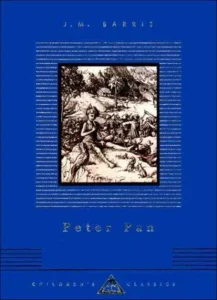
1. Peter Pan, illustrated by F. D. Bedford (Everyman Library)
Best for: Readers who want the novel with the period illustrations that first appeared in Barrie’s own lifetime.
A 240 page hardback of Peter Pan with the F. D. Bedford illustrations, which first appeared in the author’s own day and had long been out of print. A good copy to read the lines on this page in their original setting.
Pros
- Bedford illustrations from Barrie own era
- Hardback in a collectable Everyman Library series
- Well reviewed by over 6,000 readers
Cons
- Costs more than a plain paperback
- Period artwork, not the Disney look
Notes on the selection
How this page was built. Barrie’s texts were read in full as plain text from Project Gutenberg: the novel (Peter and Wendy, published 1911, ebook 16), the play (staged 1904, text published 1928, ebook 78131), Peter Pan in Kensington Gardens (1906, ebook 1332) and The Admirable Crichton for the misattributed epigram. Twenty-one lines were matched against them word for word: fourteen from the novel, six from the play and one from Kensington Gardens. The chapter, act or scene on each card is the nearest heading above the line in that text, so the locator is measured rather than remembered. Where a line appears in both versions we carded the one that reads as a clean quote, and the card says when the other version differs. Page numbers are left out on purpose: they change with every edition. Where a card starts or stops mid sentence, the cut is shown.
What was left out, and why. No line from any film or stage musical is carded: not the 1953 Disney film, not Hook (1991), not the 2003 film or Finding Neverland (2004). Those lines are in copyright, and most of the Peter Pan quotes in circulation are theirs, which is exactly why this page separates them out. Every carded line was also checked against every published page and draft on this site, and none of them runs anywhere else here.
Peter Pan quotes: the questions people actually ask
What is the first line of Peter Pan?
“All children, except one, grow up.” It is the first sentence of the novel, Peter and Wendy (1911), chapter I. The play opens differently, with stage directions for the Darlings’ nursery.
What does Peter Pan say to get to Neverland?
“Second to the right, and straight on till morning.” That is the novel, chapter IV. In chapter III, and in the play, Peter says “and then straight on till morning”. Barrie never wrote second star to the right; the star came later, most familiarly from the 1953 Disney film.
Did J.M. Barrie write “faith, trust and pixie dust”?
No. The word pixie appears nowhere in Barrie’s Peter Pan books or the play. The phrasing comes from Disney’s 1953 film. In Barrie the children fly with fairy dust and lovely wonderful thoughts.
Is Peter Pan a book or a play?
Both. Peter first appeared in Barrie’s novel The Little White Bird (1902), whose Peter chapters were reissued as Peter Pan in Kensington Gardens (1906). The play Peter Pan, or the Boy Who Would Not Grow Up was first staged in London in December 1904, and the novel Peter and Wendy followed in 1911. The play text was not published until 1928.



The first sentence of the novel, and the best opening line in children’s books. The whole story is folded into its middle clause.