Did Hans Christian Andersen Say “To Travel Is to Live”? Yes, and Only That
The four words are his, printed in his own memoir in 1855. The famous four-line poem wrapped around them is not.

The short answer: yes, Hans Christian Andersen wrote “to travel is to live”, and no, he did not write the poem that usually comes with it. The four words are in his memoir Mit Livs Eventyr (The Fairy Tale of My Life), printed in Copenhagen in 1855, in Danish: “At reise er at leve!” The verse that starts “To move, to breathe, to fly, to float” has no source in anything he wrote.
So this is a split verdict, and both halves matter. Credit the line to Andersen and you are right. Credit the poem to Andersen and you are repeating something nobody has ever traced to him, which is what most prints, mugs and caption sites on the internet do today.
Did Andersen say “to travel is to live”? The short answer
At reise er at leve!
We did not take anybody’s word for this, including our own. We read the line on the page in a scan of the 1855 first edition, free to view on archive.org. We checked it against the H.C. Andersen Information centre in Odense, which places it in the same spot, and then against every 19th-century English translation of the memoir we could open. That last check turned up the most surprising part of the story, which we come to below. Primary source first is the rule every verdict on this site follows, as our editorial standards explain.
Where Andersen wrote it: The Fairy Tale of My Life
Mit Livs Eventyr came out in 1855, as volumes 21 and 22 of his collected works. It is his long autobiography, and the line arrives at a turning point in it. He has just finished a warm passage about the singer Jenny Lind, and he looks back at how travel used to feel. As printed (spelling unchanged, our translation): “der var en Tid, jeg følte mig saa haardt trykket og forpiint herhjemme, at det at være ude var idetmindste en Ophør af at lide”, there was a time when he felt so hard pressed and tormented at home that simply being away was at least an end to suffering.
Then the page breaks. Centred on a line of its own, in smaller type and inside quotation marks, comes “At reise er at leve!” The very next paragraph opens “I Sommeren 1844”, in the summer of 1844, and sets off on a journey through northern Germany. So the line is not tucked into a sentence. Andersen set it like a motto over the travels that follow, which is exactly why it lifts out so cleanly as a quote.
Two small corrections to what you will read elsewhere. Most copies drop the exclamation mark; the 1855 page has it. And the quotation marks are Andersen’s own, which suggests he was presenting the four words as a motto rather than as a sentence of his memoir. Whether he coined them or was quoting a saying already in the air, the book does not say. What it does settle is that he chose them, and put his name to the page.
Why English readers did not see the line for a century
Here is the twist. Andersen’s life story first reached English readers in 1847, eight years before the Danish memoir, as The True Story of My Life, translated by Mary Howitt. It tells the same part of his life in almost the same words: after Jenny Lind, a sentence on how calm of mind sits well with “the changing life of travel”, then straight into “In the summer of 1844”. No motto, and no sentence about feeling hounded at home.
We checked the two other 19th-century English versions we could open, an 1852 translation and the 1871 Author’s Edition published in New York. Neither carries the line. The 1871 edition, sold as a translation of the Danish memoir, simply reuses the 1847 English wording for this passage. Our reading of the evidence, so take it as interpretation: the motto was an 1855 addition, and the English editions of the 1800s never caught up with it.
The four English words were in print, though, just not with his name on them. The magazine Every Saturday gives them to an Italian character in a piece of April 1867. John L. Stoddard uses them in the 1897 preface to his published travel lectures, adding that to stay in one place is to stagnate. A 1929 magazine calls the idea a French saying, voyager c’est vivre. The earliest English source we found that ties the words to Andersen is the magazine Saturday Night, in June 1952, describing his birthplace museum in Odense and calling the line one of his favourite sayings.
If you want to read the passage in context, the autobiography is still in print in English as The Fairy Tale of My Life. It is a long book and an uneven one, but the chapter where the line sits is the chapter to read.
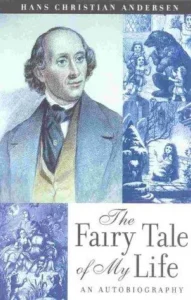
The Fairy Tale of My Life: An Autobiography (Hans Christian Andersen)
Best for: Readers who want the line in the chapter it came from, not on a mug
The Cooper Square Press paperback (2000) is the English edition of Mit Livs Eventyr that is still in print: 610 pages of Andersen on his childhood in Odense, his travels from Portugal to Turkey, and the friendships with Dickens, Hugo and the Grimms. The travel line arrives late, after the Jenny Lind passage, which is where this page sends you.
Pros
- The primary source, in English, in one volume
- Covers the journeys that made him call travel living
- Reprints the 1871 New York text, the first full English edition of the autobiography
Cons
- A 19th-century translation, so the English is formal and sometimes stiff
- 610 pages is a commitment for one line; a library copy will do for the chapter alone
The four-line poem: who wrote “To move, to breathe, to fly”?
To move, to breathe, to fly, to float, to gain all while you give, to roam the roads of lands remote, to travel is to live.
We could not find this poem anywhere in Andersen. It is not on the 1855 memoir page or anywhere else in the memoir text we searched, it is not in any of the three English editions above, and none of the pages we found that print it names a book, a poem title or a date. We found no fact-checking page that traces it, and the quotation reference Wikiquote lists only the four words under the memoir.
The earliest printed copy we could find is in a 2005 American college yearbook, where a graduating student chose it as a senior quote, already credited to Andersen. After that it spreads fast through gift books, travel books and posters from the 2010s onward. A 2014 academic collection on Andersen’s stories is careful to introduce it as a poem attributed to him, which is the most an honest source can say.
Andersen's line and the modern poem, side by side
| Version | Wording | Source and earliest date found |
|---|---|---|
| Andersen, Danish | “At reise er at leve!” | Mit Livs Eventyr, Copenhagen 1855, page 307 (first edition scan) |
| Andersen, in English | “To travel is to live!” | Translation of the 1855 line; not in the English editions of 1847, 1852 or 1871. Paired with his name in English by 1952 |
| The modern poem | “To move, to breathe, to fly, to float, to gain all while you give, to roam the roads of lands remote, to travel is to live.” | No source in his works; earliest copy found in print 2005, already credited to him |
One more clue, and this one is our own observation. The poem rhymes in English: float with remote, give with live. Translations from Danish do not usually land on neat English rhymes, and no Danish original of the verse has ever been cited. Everything points to an English writer building a little poem on top of Andersen’s real line, and the internet doing the rest. Until someone finds a dated source, “author unknown, after Andersen” is the honest credit.
What “to travel is to live” meant for Andersen
This part is interpretation, so read it as ours. In the memoir the line is not a slogan about adventure. It comes straight after Andersen admits that travel was once an escape from feeling miserable at home, and that abroad, among people who welcomed him, he felt well. For him, being on the road was being fully alive, and staying put could feel like the opposite.
He felt that way from the start. His first travel book, written after a trip in the summer of 1831, breaks into exactly this mood (as reprinted in his collected works, 1854): “O reise! reise! det er dog den lykkeligste Lod!”, O travel, travel, it is surely the happiest lot (our translation). For the life behind the line, including his many journeys abroad, see our Hans Christian Andersen travel quotes page, which this check does not repeat.
More travel quotes people get wrong
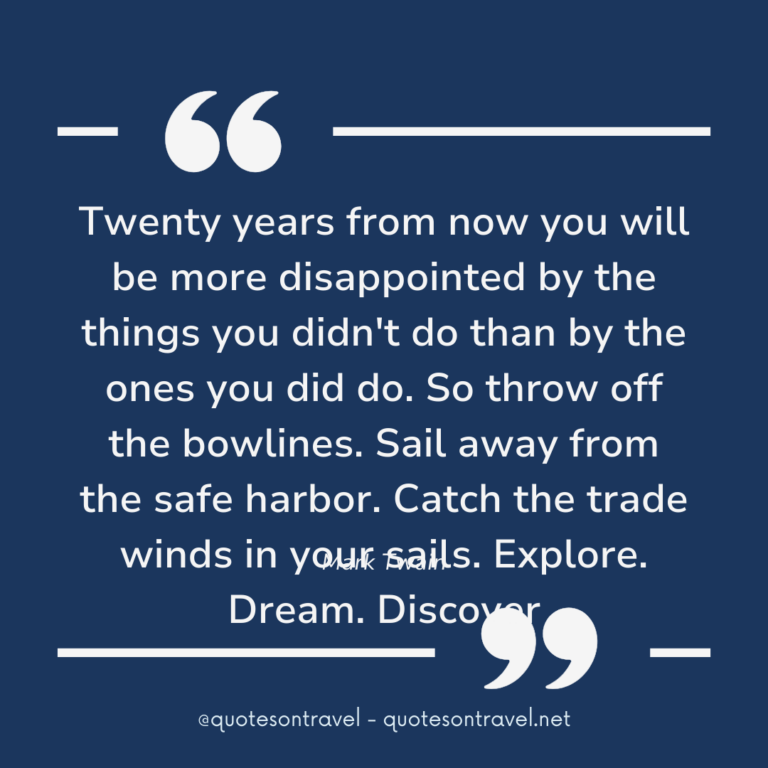
Andersen is lucky: most famous travel lines lose their author completely. “The world is a book, and those who do not travel read only one page” is pinned on Saint Augustine, but our Augustine check finds it in a 17th-century English guidebook. “Twenty years from now you will be more disappointed” is not in Mark Twain’s writing at all. And like this one, some lines do survive a check: Twain’s travel is fatal to prejudice is genuine, though almost every copy trims it.
Every verdict, and the method behind them, lives in our travel quotes fact-check hub.
Questions people ask about this quote
Who said “to travel is to live”?
Hans Christian Andersen, in his memoir Mit Livs Eventyr (The Fairy Tale of My Life), published in Copenhagen in 1855. He set the line on its own, like a motto, before describing his travels of 1844.
Did Andersen write “To move, to breathe, to fly, to float”?
No. Only the last four words, “to travel is to live”, are his. The poem appears in none of his works we searched, and the earliest printed copy we found dates from 2005. The honest credit is “author unknown, after Andersen”.
What is “to travel is to live” in Danish?
As printed in 1855: “At reise er at leve!” In modern Danish spelling it is “at rejse er at leve”.
What does “to travel is to live” mean?
This is interpretation, not quotation. In the memoir the line follows Andersen’s admission that travel was once his escape from unhappiness at home, so it reads as: being on the move is when he felt most alive. Today most people use it simply to mean that travel makes life fuller.
So keep the line, credit Andersen, and drop the poem, or at least drop his name from it. If you want the short version on a print, “To travel is to live!” with his name and 1855 underneath is as solid as a travel quote gets. For more lines with their sources checked, browse the 100 best travel quotes, our adventure quotes and the full travel quotes library.