
Best Packing Cubes: The Five Sets That Actually Change How You Pack
Five sets people actually buy, ranked by who each one suits, with the question the category pages skip: whether you want compression at all.
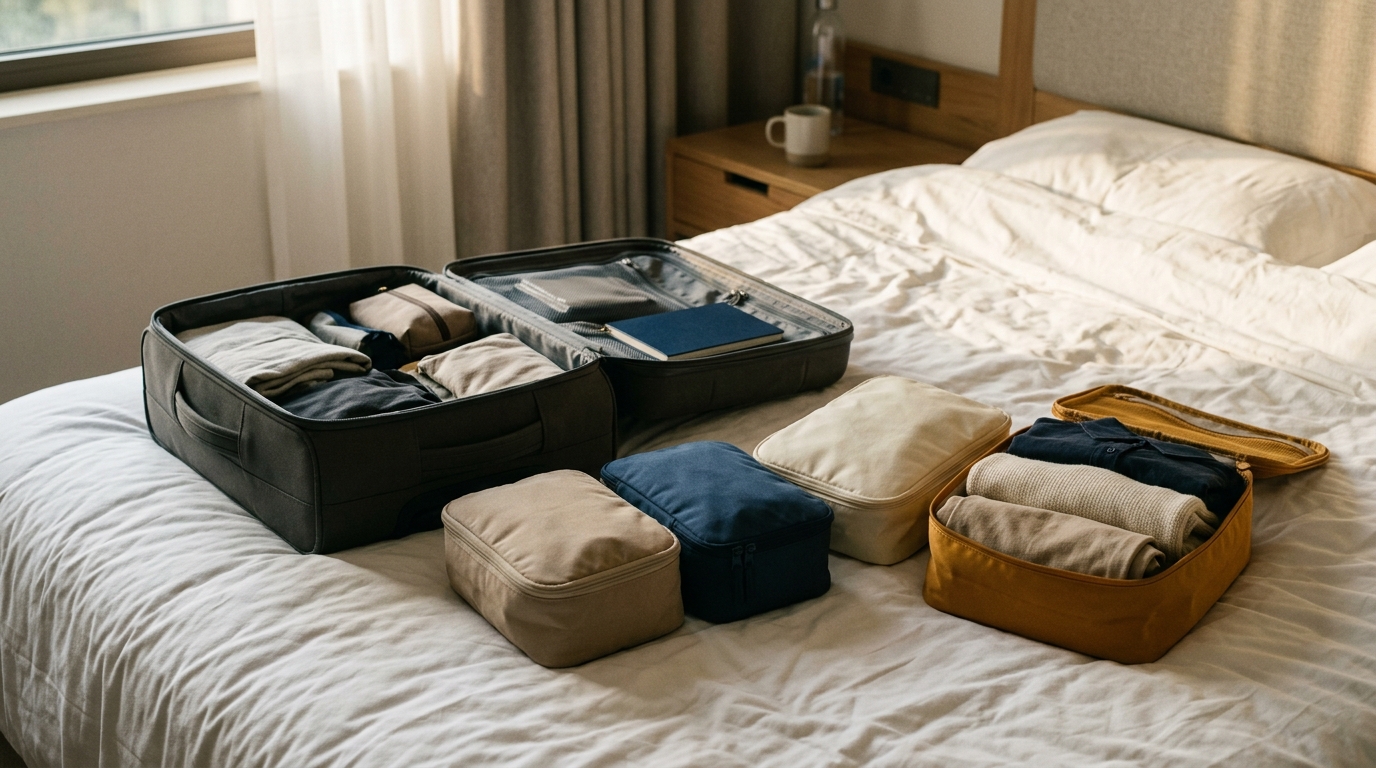
Packing cubes are the rare travel purchase where the cheap option and the expensive option do roughly the same job. A set of fabric boxes with mesh tops sorts a suitcase whether it cost twenty dollars or sixty. So the interesting question is not which packing cubes are best in the abstract. It is which kind you need, how many, and whether the compression versions are worth the extra bulk and the extra zip. This guide answers all three, then ranks five sets that hold up under the evidence available.
I pack light on purpose. I book places with laundry, run a neutral capsule wardrobe, and cut shoes first: fewer clothes, more combinations, wash as you go. That system is the reason I have opinions about cubes at all, because cubes are what make a small number of garments behave like a packed drawer instead of a heap. What I have not done is put these five sets through a side by side test, and I am not going to pretend otherwise. Ratings and review counts below are each product’s own Amazon customer figures, read on 10 September 2026. Where Amazon’s own review summary carries a complaint, it is in the cons.
The best packing cubes: the five sets, ranked
Ranked by who each set suits, not by price. Every link below goes to the listing we verified on 10 September 2026.
Amazon Essentials 4-Piece Packing Cubes
Check price Amazon Essentials 4-Piece Packing Cubes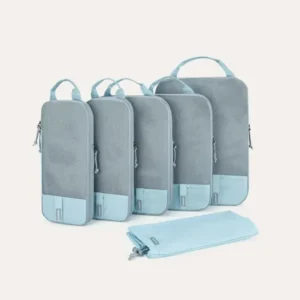
BAGSMART Compression Packing Cubes
Check price BAGSMART Compression Packing Cubes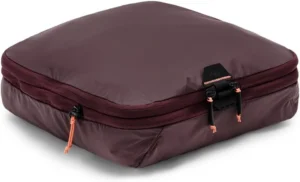
Peak Design Packing Cube, Medium
Check price Peak Design Packing Cube, Medium1. BAGAIL 8 Set, best overall
1. BAGAIL 8 Set Packing Cubes
Best for: The traveller who wants one set to cover a whole suitcase
Eight pieces in graduated sizes, which is the reason this is the default recommendation rather than the clever one. You get enough cubes to sort by category instead of by what happens to fit, plus the smaller bags that hold underwear and cables without swimming. The fabric is water-repellent rather than waterproof, the tops are mesh so you can see what is inside without unzipping, and the two-way zips have extended pulls, which matters more than it sounds when a cube is full and you are kneeling on a hotel floor. More than 44,000 owners have rated it 4.6, which is the deepest evidence base on this page by a wide margin.
Pros
- Eight graduated pieces cover a full suitcase without buying a second set
- The deepest review base here, more than 44,000 ratings at 4.6
- Mesh tops and extended zip pulls, both of which you notice daily
- Water-repellent fabric, so a leaking bottle is a wipe rather than a wash
Cons
- Classic cubes, so they sort your bag but do not compress it
- Eight pieces is more than most travellers need, and unused cubes are just fabric weight
- Sold in several colourways at different prices for the same set, so check you are looking at the cheapest one
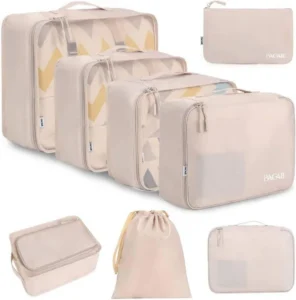
Worth knowing before you buy the eight-piece: the review pool is shared across the colourways, so the cream, matcha, jet black and blush listings all show the same 4.6 and the same 44,000 ratings while sitting at different prices. The set is identical. Buy whichever colour is cheapest on the day.
2. Amazon Essentials 4-Piece, best value
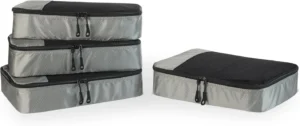
2. Amazon Essentials 4-Piece Packing Cubes, Medium
Best for: A carry-on, a short trip, and no appetite for a packing system
Four cubes, all the same medium size, 13.75 by 9.75 by 3 inches each. That sameness is the point and it is also the limitation. Four identical boxes stack predictably in a carry-on and you never have to work out which cube the jeans go in, but there is no small pouch for socks and cables and no large one for a coat. Mesh top panel, webbing handle on each cube, reinforced double zip pulls, machine washable. This is the set that was Amazon Basics until the rename, which is why the 43,000 ratings go back further than the current brand name does.
Pros
- Cheapest set here and rated 4.7 across more than 43,000 owners
- Four identical mediums stack predictably in a carry-on
- Machine washable, with a webbing handle on every cube
- Exact published dimensions, 13.75 by 9.75 by 3 inches, so you can check the fit before you buy
Cons
- One size only, so no small pouch for socks and cables and nothing sized for a coat
- Classic cubes with no compression zip
- Three inches deep is shallow, which suits shirts and punishes knitwear
If you are buying cubes for the first time and are not sure the idea suits you, this is the set to test it with. Four mediums is enough to run the method for a week away, and it costs less than the difference between two checked-bag fees.
3. Shacke 5 Set, best rated
3. Shacke 5 Set Packing Cubes with Laundry Bag
Best for: Buying cubes once and not thinking about them again
Four graduated cubes plus a laundry bag, and the highest rating on this page: 4.8 across nearly 24,000 owners. The reason people keep them is structural. Shacke stitches a cross web across each sidewall so the cube holds its shape when it is packed full, which is exactly where cheap cubes sag and start losing the tidy edge that made you buy them. Sizes are published: extra large at 17.5 by 12.75 inches down to small at 11 by 6.75, all four inches deep, with a 20.5 by 15.75 inch laundry bag. Water-resistant nylon surface. If your capsule wardrobe depends on washing on the road, that laundry bag is not a throw-in.
Pros
- Highest rated set here at 4.8 across nearly 24,000 ratings
- Cross-stitched sidewalls stop the cubes collapsing when packed full
- Four graduated sizes plus a real laundry bag, all dimensions published
- Four inches deep, which handles knitwear the shallow sets cannot
Cons
- Classic cubes, no compression
- Five pieces where the BAGAIL set gives eight for less
- Nylon surface is water-resistant, not sealed, so a full spill still gets in
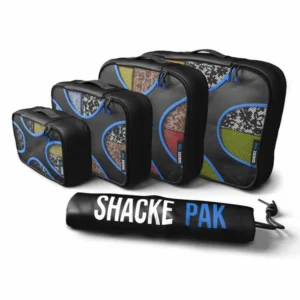
The laundry bag is the quiet argument for this set over the cheaper two. If you travel the way this site keeps recommending, booking places with a washing machine and carrying fewer clothes, then a dedicated bag that keeps worn clothes away from clean ones is doing real work rather than filling out a set count.
4. BAGSMART Compression, best compression set
4. BAGSMART Compression Packing Cubes
Best for: Bulky clothes, winter layers, and a suitcase lid that will not shut
Sold as two, four or six piece sets, each cube with a second zip that pulls the walls down once the clothes are in. That is the whole mechanism: pack, close the main zip, then run the compression zip and watch the cube lose most of its depth. It works best on the things that waste the most space, which is jumpers, fleeces and anything with loft. It does very little for shirts, which were already flat. BAGSMART is one of the better known names in this category and 13,486 owners rate it 4.6, but the honest note is below and it comes from Amazon’s own summary of what those owners say.
Pros
- Genuine second-zip compression, and it earns its keep on bulky layers
- Choice of 2, 4 or 6 piece sets, so you can buy only what you need
- 13,486 ratings at 4.6, deep enough to trust the average
- Known brand in travel organisation rather than an unbranded set
Cons
- Amazon's own customers-say summary records mixed feedback on the compression itself, with some owners reporting it does not compress as much as expected
- The same summary flags cubes running smaller than expected and some zip complaints, which is the standard failure point on compression cubes
- Dearest set on this page, and compression cubes weigh more than classic ones for the same capacity
Two of those cons come from Amazon’s own aggregated review summary rather than from us, and we have left them in because they describe the category, not just this set. Compression cubes trade a second zip and extra fabric for space you only get back on bulky clothes. If you mostly pack shirts and trousers, the classic sets above will serve you better for less.
5. Peak Design Packing Cube, best for one-bag travel
5. Peak Design Packing Cube, Medium
Best for: One-bag travel, and keeping worn clothes away from clean ones
The odd one out, and the one worth understanding even if you do not buy it. This is a single cube, not a set, and it costs about what a whole classic set costs. What you get for that is a dual compartment: clean on one side, worn on the other, opened by separate zips, so the sorting keeps working after day one instead of collapsing into a heap of maybes. It expands and compresses on the same body, the shell is weatherproof nylon, and it measures 12.59 by 12.59 by 6.69 inches in medium. Amazon’s review summary reports owners singling out the back zip for dirty items and calling it right for one-bag travel, which is exactly the use case it is built for.
Pros
- Dual compartment keeps worn clothes separated without a second bag
- Expands and compresses in one body, so it suits a bag that changes load through a trip
- Weatherproof nylon shell rather than water-repellent fabric
- Rated 4.7, and the review summary specifically credits the dirty-clothes compartment
Cons
- One cube for the price of a set, so it only makes sense as a system rather than a bargain
- 310 ratings is a thin evidence base next to the 44,000 above it
- Built to integrate with Peak Design bags, so some of what you are paying for is a system you may not own
Buy this one if you travel out of a single bag and the clean-versus-worn problem is the one that actually bothers you. Buy one of the sets above if you are packing a suitcase and want the whole thing sorted. Both are reasonable; they are answers to different questions.
Compression cubes or classic cubes, and what we did not rank
A classic cube is a fabric box with a mesh top and one zip. It sorts. A compression cube is the same box with a second zip set lower down the sidewall, so once the clothes are in you can pull the walls together and push the air out. It sorts and it squeezes. Everything else people argue about in this category comes back to that one difference.
The decision is simpler than the marketing makes it. Compression helps in proportion to how much air your clothes are holding. Jumpers, fleeces, puffer layers and anything knitted give up real volume. Shirts, trousers and flat synthetics were already compact and give up almost nothing, so you are carrying an extra zip and extra fabric for a result you cannot see. Winter trip, compression. Warm-weather trip, classic. If you are unsure, classic is the safer default, which is why three of the five sets above are classic.
One thing compression does not do is make your bag lighter. It makes it smaller. Airlines that weigh cabin bags will still weigh what you packed, and a compressed suitcase is famously easy to overfill precisely because the lid keeps closing. That is worth remembering if you are pairing cubes with a carry-on case or a travel backpack that has a weight limit attached to it.
The five sets, side by side
| Set | Type | Pieces | Rating and owners |
|---|---|---|---|
| BAGAIL 8 Set | Classic | 8 | 4.6 from 44,052 |
| Amazon Essentials 4-Piece | Classic | 4 | 4.7 from 43,625 |
| Shacke 5 Set | Classic | 5 with laundry bag | 4.8 from 23,822 |
| BAGSMART Compression | Compression | 2, 4 or 6 | 4.6 from 13,486 |
| Peak Design Packing Cube, Medium | Both, one body | 1 | 4.7 from 310 |
Two things we gated and did not rank, because the reason is more useful than the omission. The heritage premium sets are the obvious gap on this page. We checked the Eagle Creek Pack-It Isolate set, the name most often recommended at the top of this category, and it currently sits at 4.1 from 51 ratings, with the larger carry-on sets in the same line on 10 and 3 ratings. That is not evidence that they are bad. It is an absence of evidence, on a page whose entire method is owner ratings at scale, so ranking one above a set with 44,000 would have meant ranking the brand rather than the proof. Second, the Osprey Ultralight cube was out of stock at verify time, so it could not be checked at all.
How many packing cubes you actually need
For a two-week trip, three or four cubes is the honest answer for most people, not eight. The number follows from how you sort rather than from how long you are away, because you repack the same categories whether the trip is five days or fifteen. One cube for tops, one for bottoms, one for underwear and socks, and a laundry bag or a fourth cube for what you have already worn. That is the whole system.
Length of trip changes the laundry plan, not the cube count. If you book accommodation with a washing machine, a fortnight needs roughly the same clothes as five days and the cubes stay full at about the same level throughout. If you cannot wash, you are choosing between more clothes and fewer, and cubes will not resolve that for you. This is why the pack-light argument on our vagabonding page keeps coming back to laundry rather than to gear: the laundry is what makes the small bag possible, and the cubes are just what keeps it tidy.
I don't know how it is, but I never do know whether I've packed my tooth-brush.
Packing cube questions, answered
Frequently asked questions
Are packing cubes really worth it?
For most travellers, yes, but not for the reason they are usually sold. Classic cubes do not create space; they create order, which means you find things without unpacking and you repack in a couple of minutes instead of twenty. That is worth twenty dollars if you move between places on a trip. If you fly somewhere, unpack once into a wardrobe and fly home, cubes are close to pointless and you should not feel bad about skipping them.
Packing cubes or compression cubes?
Classic cubes if your problem is finding things. Compression cubes if your problem is the lid not shutting. Compression only recovers space from clothes that hold air, so it is genuinely useful for jumpers, fleeces and winter layers and almost useless for shirts and flat synthetics. Compression cubes also weigh more and add a second zip, which is the part most likely to fail, so buy them for a reason rather than as an upgrade.
How many packing cubes do I need for a 2 week trip?
Three or four, for most people. Sort by category rather than by day: one cube for tops, one for bottoms, one for underwear and socks, plus a laundry bag for what you have worn. Trip length changes the laundry plan rather than the cube count. If you book accommodation with a washing machine, a fortnight packs like five days. If you cannot wash, no number of cubes will fix the arithmetic.
Does TSA go through packing cubes?
They can, and occasionally they do. Screening officers open bags when the scanner shows something they want to look at, and a packed cube is not exempt. In practice cubes tend to help rather than hurt: the mesh tops let an officer see the contents without emptying anything, and a bag that is sorted into labelled boxes is faster to check and faster to put back together. Keep electronics and liquids where you can reach them rather than buried in a cube.
An entire chapter of 1889 comedy about three men repacking the same hamper, and the toothbrush is the thing that defeats them. Sorting your bag into labelled boxes is not a modern invention. It is a very old surrender.