
Best Carry-On Luggage: Five Cases That Survive the Overhead Bin Fight
Best Carry-On Luggage: Five Cases That Survive the Overhead Bin Fight
Five cases people actually buy, ranked by who each one suits, with the measurement nobody prints on the box: what these bags really measure once you include the wheels.
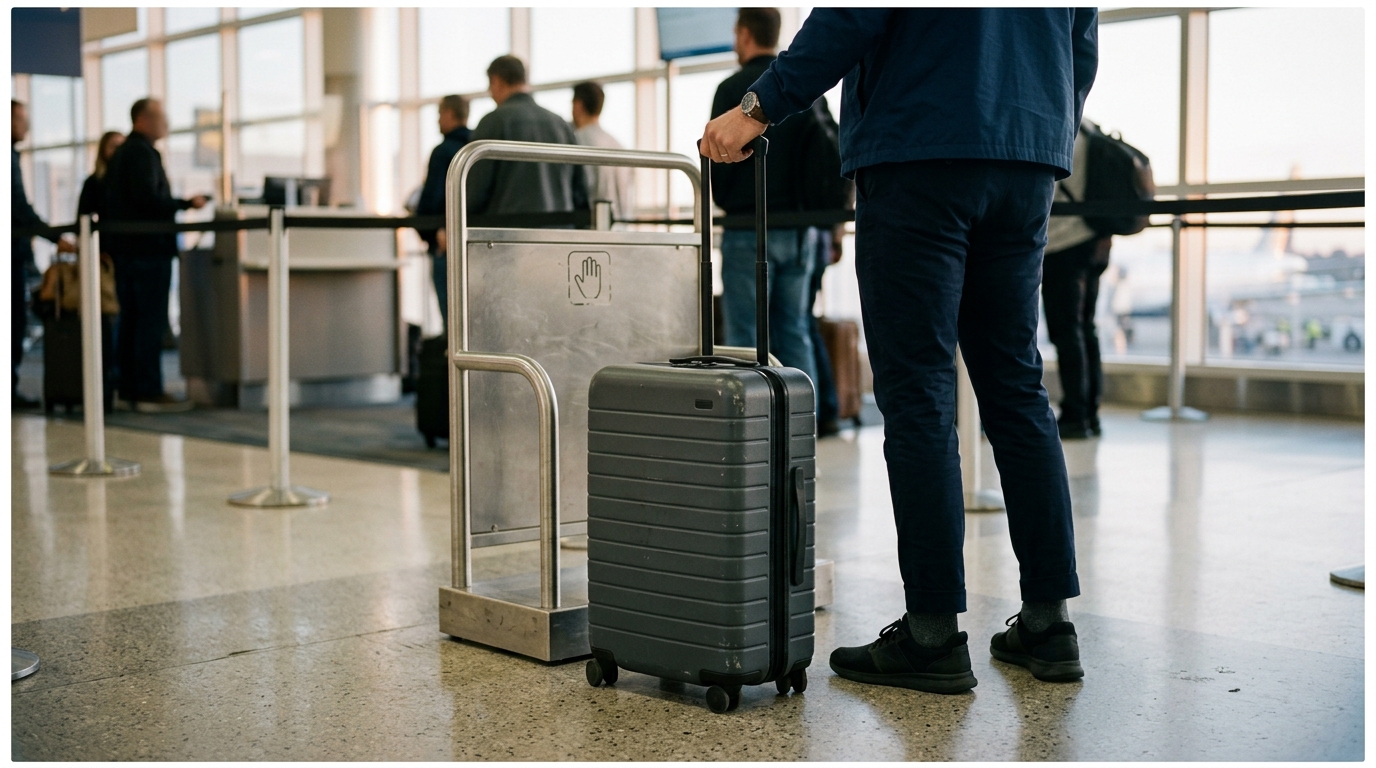
Carry-on luggage is one of the few purchases where the marketing and the measuring tape disagree in public. Every case in this guide is sold as a carry-on. Not one of the five fits inside the 22 by 14 by 9 inch box that American, Delta and United all publish, once you measure it the way a gate agent would, with the wheels and the handle housing included. That is not a scandal and it is not a reason to avoid them. It is the single most useful thing to understand before you spend anything.
So this guide does two jobs. It ranks five cases that hold up under the evidence available, across the full spread from budget to premium, and it explains what carry-on size actually means in practice so you can judge any bag, including ones we have not covered. Ratings and review counts below are each product’s Amazon customer rating at the time of writing, not a score we invented, and we have not put these cases through a lab. We do not print prices: they move constantly and a stale figure is worse than none, so the cards rank on where each case sits relative to the others and the live price is on the listing when you click.
The best carry on luggage: the 60 second answer
If you want one case and you do not want to think about it again, buy the Samsonite Freeform 21 inch. It is the middle of every curve that matters: 6.5 pounds, 34 litres, a hard polypropylene shell that flexes rather than cracks, a TSA combination lock built in, and a customer rating of 4.3 across more than 19,000 people. It sits in the upper middle of this page on price, which is the point where paying more stops buying anything you can feel.
If the price is the problem, the Amazon Basics 21 inch does most of the same work for a fraction of the money and is the best selling carry-on on the site. It has no lock, and owner reviews running six years deep describe telescoping handles and zips that eventually give up. For a few trips a year that is a fair trade. For fifty flights a year it is not.
The five picks, compared
Ranked by who each case suits, not by price. Every link below goes to the product listing we verified on 8 September 2026.

American Tourister Stratum 2.0
See More Here American Tourister Stratum 2.01. Samsonite Freeform 21 inch, best overall
1. Samsonite Freeform Hardside Carry-On Spinner, 21 inch
Best for: The traveller who wants one good case and no further decisions
Polypropylene rather than the usual ABS, which is the quiet reason this one is worth its price: it flexes under a knock and springs back where a cheaper shell scuffs or splits. At 6.5 pounds it is a pound lighter than the budget cases here and holds the same 34 litres. The TSA combination lock is fitted rather than sold separately, the expansion zip adds a useful inch, and there are eight dual spinner wheels instead of four, which is what people are describing when they say it turns easily with a backpack stacked on top.
Pros
- Polypropylene shell absorbs impacts that crack cheaper ABS cases
- Lightest of the three hardsides here at 6.5 pounds
- TSA combination lock and expansion zip both fitted as standard
- Second best selling carry-on on Amazon, so the review base is deep
Cons
- Scratches show, and long term owners say so repeatedly
- At 21.25 by 15.25 by 10 inches with wheels it is over the published US limit on two sides, and well over the stricter European frames
- Usually twice the price of the Amazon Basics case for a difference most occasional flyers will not feel

Samsonite Freeform 21 inch, the numbers
- Weight
- 6.5 pounds
- Capacity
- 34 litres
- Shell
- Polypropylene, expandable
- Size with wheels
- 21.25 by 15.25 by 10 inches
- Lock
- TSA combination lock, fitted
- Wheels
- Eight dual spinner wheels
One review is worth quoting for what it tells you about the limits rather than the case. An owner who took it to Scotland for four weeks reported it cleared US carriers and British Airways comfortably, then said plainly that the size is more than Lufthansa, KLM and Air France allow, so they simply do not use it on those airlines. That is the honest shape of every hardside recommendation on this page.
2. Amazon Basics 21 inch hardside, best value
2. Amazon Basics 21 inch Hardside Carry-On Spinner
Best for: One or two trips a year, and money better spent on the trip
The best selling carry-on on Amazon, rated 4.4 by more than 62,000 owners, and the cheapest case on this page. It is an ABS shell with four spinner wheels, an expansion zip worth about 25 percent more room, an interior divider and three zipped pockets. What it does not have is a lock: the listing’s own spec field reads no lock, so budget for a TSA padlock if that matters to you. The most useful review on the listing is a three star one, from a buyer six years in, describing a telescoping handle that started sticking early and zips that eventually snagged.
Pros
- Roughly a third of the price of the Samsonite for the same 34 litres
- The deepest review base of any case here by a wide margin
- Expansion zip adds about 25 percent more packing room
- Owners with four years of heavy use report the shell holding up
Cons
- No lock fitted, which the listing states plainly in its own spec field
- Heaviest per litre here at 7.7 pounds for 34 litres
- Long tenure reviews point to the handle and the zips as what fails, typically well before the shell does

Amazon Basics 21 inch, the numbers
- Weight
- 7.7 pounds
- Capacity
- 34 litres, expands about 25 percent
- Shell
- ABS, scratch resistant finish
- Size with wheels
- 21.7 by 14.8 by 10 inches
- Lock
- None fitted
- Wheels
- Four spinner wheels
The way to think about this case is cost per trip rather than quality. If you fly twice a year, a case that lasts six years costs you very little per trip, and you will not notice the missing lock, because you are not leaving it out of sight. If you fly monthly, the handle is the part that will end the relationship, and the Samsonite above is the better buy.
3. Travelpro Maxlite 5 21 inch, the lightest case here
3. Travelpro Maxlite 5 Softside Carry-On Spinner, 21 inch
Best for: Weight limits, budget carriers, and frames a rigid shell fails
5.4 pounds and 46 litres, which is the best weight to space ratio on this page by some distance: a pound lighter than the Samsonite and a third roomier. It is softside, stain resistant polyester with a water resistant coating, and softside is the point. A fabric case gives when a gate agent pushes it into a frame, and a polycarbonate one simply does not. Travelpro states that the case meets most international carry-on size limits, which is their claim rather than ours: the case body is 21 by 14 by 9 inches, and the overall figure with wheels and handles is 23 by 14.5 by 9.
Pros
- Lightest here at 5.4 pounds, and the roomiest at 46 litres
- Softside body compresses into tight frames that reject a hard shell
- Case body measures exactly 21 by 14 by 9 inches, the closest thing here to the published US allowance
- Combination lock fitted, and the brand is the one cabin crew buy
Cons
- The most expensive case on this page
- Fabric offers less protection than a shell if it ends up in the hold
- The 23 inch overall height with handles and wheels still exceeds strict 55 centimetre European frames, so read the brand claim as a claim

Travelpro Maxlite 5, the numbers
- Weight
- 5.4 pounds
- Capacity
- 46 litres
- Shell
- Softside polyester, water resistant coating
- Case body
- 21 by 14 by 9 inches
- Size with wheels
- 23 by 14.5 by 9 inches
- Lock
- Combination lock, fitted
The reason to pay the most on this page is not luxury, it is arithmetic. On airlines that weigh cabin bags, and most of the ones outside the United States now do, the 2.3 pound gap between this and the Amazon Basics case is two pairs of shoes you get to bring. If you have never had a bag weighed at a gate, that argument will not move you, and it should not.
4. Samsonite Omni PC 20 inch, the toughest shell
4. Samsonite Omni PC Hardside Carry-On, 20 inch
Best for: Cases that keep getting gate-checked into the hold
100 percent polycarbonate with a micro diamond texture, which is the most impact resistant shell here and the one that hides scuffs best. It carries a side mounted TSA combination lock and a 10 year limited warranty, and at 30,000 ratings it has the second deepest review base on this page. The trade-off is specific and it shows up repeatedly in the critical reviews: the wheels. Several long term owners describe them fighting carpet and door thresholds, especially with a second bag stacked on top.
Pros
- Polycarbonate shell, the most impact resistant construction here
- 10 year limited warranty, the longest cover on this page
- Side mounted TSA combination lock and expansion on all sizes
- One owner nine years in reported replacing only the lock
Cons
- The wheels are the recurring complaint in critical reviews, on carpet and over thresholds
- Overall 22 by 15 by 9.5 inches with wheels, over the published US limit on two sides despite the 20 inch label
- Hard shells do not compress, so a tight frame is a hard no rather than a squeeze

Samsonite Omni PC 20 inch, the numbers
- Weight
- 6.81 pounds per the manufacturer table
- Packing size
- 19 by 14.5 by 9.5 inches
- Size with wheels
- 22 by 15 by 9.5 inches
- Shell
- 100 percent polycarbonate, expandable
- Lock
- Side mounted TSA combination lock
- Warranty
- 10 year limited
Buy this one if your bag ends up in the hold more often than not, which is the reality for anyone who boards in the last group. A polycarbonate shell is the difference between a scuffed case and a cracked one, and the warranty means the brand expects to be around for the argument.
5. American Tourister Stratum 2.0, best for gate-checking
5. American Tourister Stratum 2.0 Hardside Carry-On
Best for: Boarding last, expecting the bag to be taken at the gate
An ABS shell carrying the same 10 year limited warranty language Samsonite puts on its own cases, which is what earns it a place here over cheaper no-name shells. The most useful review on the listing is from a buyer who deliberately chose a case for gate checking and reported it through more than ten checked flights with no visible damage. Note one thing honestly: the listing prose mentions TSA approval while the spec field records the lock type as a zipper, so we do not claim a TSA lock on this case.
Pros
- 10 year limited warranty at one of the two lowest prices here
- Owner reports of repeated gate-checking with no shell damage
- Expands an inch, and the interior has both a modesty pocket and a mesh door pocket
Cons
- Thinnest evidence base here at about 2,800 ratings, against 62,000 for the Amazon Basics case
- Loud wheels are the most common complaint, and one owner reported the case tipping when fully packed
- The lock claim is inconsistent between the listing prose and the spec field, so treat it as unlocked
American Tourister Stratum 2.0, the numbers
- Weight
- 7.3 pounds
- Size with wheels
- 22 by 15 by 9.5 inches
- Shell
- ABS, expands 1 inch
- Lock
- Spec field records a zipper, not a TSA lock
- Warranty
- 10 year limited
How to actually pick a carry on
Four things decide whether a case works for you, and only one of them is on the box.
What carry-on size actually means
Most major US airlines publish the same allowance: 22 by 14 by 9 inches, including wheels and handles. Southwest and Spirit are more generous, and most European and Asian carriers are stricter, commonly around 55 by 40 centimetres with a depth limit near 20 to 23 centimetres. Check the airline you are actually flying rather than trusting a listing, because the listing is describing a category, not a rule.
Here is the part the category pages skip. Take the five cases on this page, measured by their own listings, with wheels and handle housings included.
The five cases against the published US allowance
| Case | Size with wheels | Weight | Inside 22 by 14 by 9? |
|---|---|---|---|
| Samsonite Freeform 21 inch | 21.25 by 15.25 by 10 in | 6.5 lb | No, over on width and depth |
| Amazon Basics 21 inch | 21.7 by 14.8 by 10 in | 7.7 lb | No, over on width and depth |
| Travelpro Maxlite 5 21 inch | 23 by 14.5 by 9 in (body 21 by 14 by 9) | 5.4 lb | Body yes, overall no |
| Samsonite Omni PC 20 inch | 22 by 15 by 9.5 in | 6.81 lb | No, over on width and depth |
| American Tourister Stratum 2.0 | 22 by 15 by 9.5 in | 7.3 lb | No, over on width |
Five for five. This is not a defect in these particular cases, it is how the category is sold: brands measure the packing box and airlines measure the object. In practice US carriers rarely put a domestic carry-on in a sizer, which is why millions of these bags fly every week without incident. Budget European carriers do use the frame, and they use it at the gate where the only options are a fee or a hold. If that is your flying, the softside case is the one that gives, and a smaller case than any of these is the safer buy.
Hardside or softside
Hardside protects better, cleans easier and holds its shape, and it will not be squeezed into a frame it does not fit. Softside is lighter for the same volume, absorbs an overstuffed packing job, and usually adds external pockets for the things you want without opening the case. If most of your flying is domestic and your bag stays with you, take the shell. If you fly budget carriers or you get weighed, take the fabric.
The parts that actually fail
Not the shell. Across every long tenure review on these five listings, the failures are the telescoping handle first, the zips second, and the wheels third. That is worth knowing when you compare prices, because a warranty is only useful if it covers those three parts, and the two Samsonite family cases here carry 10 year cover while the budget case carries three.
What the money buys
At the bottom of the range you get the right size and shape with no lock and a shorter life. In the middle you buy a better shell material, a fitted TSA lock and a long warranty, and that is where the value sits. Above it you are buying weight savings and brand service rather than capacity, because everything on this page holds between 34 and 46 litres. If you are building a system rather than buying a bag, our travel backpack roundup covers the one-bag route instead, and the same 40 litre ceiling applies.
What about Away, Quince and July?
They come up in every search for this term, so here is the straight answer. Away, Quince and July sell direct rather than through Amazon, which means we cannot check a listing, a live price or a review base the way we can for the five cases above, and we do not carry links to them. What we can say is that they compete on finish, on brand and on service rather than on the numbers that decide this page, and that the sizing problem in the table above applies to them equally. A premium case is over the published allowance in exactly the same way a budget one is.
If a case from one of those brands is what you want, buy it with your eyes open on the same four criteria: weight, real measured size, what the warranty covers, and whether the lock is fitted.
The argument is older than the airline industry, which is a mildly comforting thought when you are kneeling on a case at midnight. If the packing keeps getting harder rather than easier, the honest fix is usually the trip rather than the bag, and vagabonding is the version of that argument we find most persuasive.
The wheel business settled, there arose the ever-lasting luggage question.
Carry on luggage questions, answered
Frequently asked questions
What is the best carry-on luggage overall?
The Samsonite Freeform 21 inch, for most people. It sits in the middle of every curve that matters: 6.5 pounds, 34 litres, a polypropylene shell that flexes instead of cracking, a fitted TSA combination lock, and a 4.3 rating across more than 19,000 owners. It sits in the upper middle of this page on price, which is where paying more stops buying anything you can feel.
What size carry-on fits all airlines?
None reliably, and that is the honest answer. Most major US airlines publish 22 by 14 by 9 inches including wheels and handles. Many European and Asian carriers are stricter, commonly near 55 by 40 centimetres with a tighter depth limit. Every case in this guide measures over the US figure on at least one side once the wheels are included, so if you fly budget European carriers, buy smaller than a 21 inch case and buy softside.
What luggage do flight attendants actually use?
Crew tend to buy hard-wearing softside brands built for daily use, and Travelpro is the name that comes up most, because the company was founded by a pilot and sized its cases for cabin work. We have not surveyed crew and are not going to invent an endorsement: what we can point to is that the Maxlite 5 in this guide is the lightest case here at 5.4 pounds, which is the thing daily flyers optimise for.
Is expensive carry-on luggage worth it?
Into the middle of the range, yes. That band buys a better shell material, a fitted TSA lock and a 10 year warranty over a three year one. Above it you are buying weight savings and brand service, not capacity, because every case on this page holds between 34 and 46 litres. The failure points are the handle, the zips and the wheels, so the question worth asking of any price is whether the warranty covers those three.
Hardside or softside for a carry-on?
Hardside for protection, cleaning and holding its shape, which suits domestic flying where the bag stays with you. Softside for weight, external pockets, and the ability to compress into a sizer frame, which suits budget carriers and any airline that weighs cabin bags. A hard shell in a tight frame is a hard no; a fabric case gives.
This guide sits in our travel gear section, where every roundup is built the same way: the criteria named up front, the numbers taken from the listing rather than invented, and the caveats printed next to the recommendation instead of underneath it.
Three men, two bicycles, and an argument about what to bring that consumes an entire chapter and settles nothing. The wheels were the easy part in 1900 as well.