Travel Gear

Most gear guides are written by people who travel for a living. Twelve backpacks on a studio floor, scored to one decimal place, by someone whose job is to fly.

That is not the reader we have in mind, and it is not us either. I take six to ten domestic trips a year, mostly for work and to see family in Cairns and friends in Sydney, Perth and Adelaide. Overseas is one or two weeks a year, with a longer adventure of two or three weeks every couple of years. Annual leave, a calendar, a job to come back to. If that is closer to your travel than a life on the road, the economics on this page will match yours: gear that survives years of light use, not gear that shaves grams off a permanent trip.

There is a second thing shaping every recommendation here. We travel from Australia. A run to Perth or Cairns is longer than plenty of European international flights, and any overseas trip starts with a long-haul before it starts anywhere else. Comfort, power and durability matter more from down here than most guides written in the northern hemisphere assume.

So the rule is narrow. We only point at gear we would put in our own bag, we say plainly which pieces we have lived with and which we have only researched, and we tell you when we have not tested something. Nothing here is scored out of ten. Nothing is essential. Some of the most useful entries in these guides are the things we stopped buying, and why.

If this is your first long trip, start with the bag. Almost every other decision follows from how much you can carry and whether it counts as carry-on.

How we choose travel gear

We are not a testing lab and we will not pretend to be one. We do not buy twelve versions of a thing to rank them, and neither did most of the sites that say they did.

What we do have is a small amount of genuinely lived kit and a clear line drawn around it. Where a piece of gear is in our own bag, we name it and we say what it was chosen against. The travel backpack guide is the worked example: capacity, compliant as both international and domestic carry-on, and tech-safe, meaning lockable and able to run power to devices inside the bag. Those were the actual criteria, not a rubric invented afterwards.

Everything else is research, and it is labelled as research. We read the specifications, we read the pattern across hundreds of owner reviews, and we say when a category has no first-hand claim behind it at all. That admission is the point. A page that implies it tested everything gives you no way to tell which parts to trust.

Some links here earn us a small commission at no cost to you. It never changes what makes a list. The longer version of our method sits in our editorial standards, and the money side is set out in the affiliate disclosure.

What to buy first

If you are building a kit from nothing, the order matters more than the brand names. Four decisions carry most of the value.

Start with the bag, because its size sets every other constraint. Go carry-on if the trip allows it, for reasons the next section covers at length.

Then sort out power. One good adapter, plus a way to run several devices through it, does more for a trip than any other twenty-dollar purchase.

Then organisation. Cubes, pouches, or a system of your own, so you are not emptying the whole bag to find one cable.

Then whatever makes the long-haul survivable for you specifically. For some people that is compression socks. For others it is noise-cancelling headphones and nothing else.

After that, buy on trips rather than before them. Gaps announce themselves, and they are rarely the gaps a packing list predicts. A bag you have owned for two years teaches you more than a fortnight of comparison reading, and the item you improvised on the last trip is the one worth buying properly for the next one.

Quotes don't book flights. We're here to change that.

3-2-1-Go! Weekly travel inspiration to take that next step.

The guides in this section

Every gear guide we have published so far. Each one goes deeper than the category note below it, with the products, the criteria and the trade-offs in full.

Bags and packs

Rome, 2024. A wheel on the checked suitcase jammed early in the trip, and I wheeled it on three wheels or dragged it for the rest of the way. Italian cobblestones are not kind to a bad wheel.

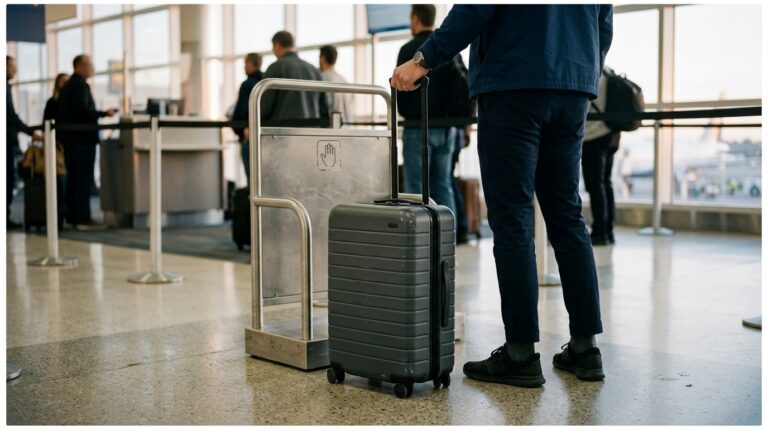
The lesson people usually draw from a story like that is buy a backpack. That is not the lesson I drew, and it is not what I bought. I bought a wheeled hardshell carry-on: a Nere Bondi 56cm in slate, from Strandbags, two hundred and thirty-nine dollars, for a New Zealand trip that has not happened yet. Alongside it I carry a Nordace day backpack as the personal item.

The real lesson was size, not format. A broken wheel only ruins a trip when the bag is too big to carry. Get down to carry-on and the wheels become a convenience rather than a dependency, because a bag you can lift up a flight of stairs still works when a wheel dies, when the lift is out, when the cobblestones win.

Format then follows the trip. A hardshell carry-on plus a daypack is the right answer for city breaks, family visits and anything with one or two bases: it protects a laptop, it stands up on its own, and it packs flat and predictably. A pack is the right answer when the itinerary genuinely moves, with several stops, trains, stairs and accommodation you walk to. Most gear sites pick one side and write as though the other does not exist. Both are correct, for different weeks of the same year.

An honest note on the Nere: it is new and it has not flown yet. We will update this page once it has, including whether a house-brand hardshell at that price holds up. Strandbags is not one of our affiliate partners, so naming it earns us nothing, which is somewhat the point.

For the full comparison, including capacity, carry-on compliance and laptop protection, read our guide to the best travel backpacks.

Power and tech

The one non-negotiable in my bag is a long Australian power board, carried whenever the destination uses a different plug. One adapter into the wall, the board into the adapter, and every charger I own works without any thought. Two laptops, an iPad, a phone. It has saved more evenings than anything else in the kit.

The reason it works is arithmetic. Most people either buy an adapter per device or buy one adapter and then queue their charging overnight. A board turns one converted socket into six familiar ones, and it costs less than a second adapter.

Beyond that, what the research consistently supports:

  • Wattage over port count. A 45W adapter with two ports will charge a laptop. A 12W adapter with four ports charges nothing properly.
  • Build quality at the pins. Cheap adapters fail in a specific way: the prongs do not grip firmly once the weight of a cable hangs off them, and power drops out overnight. This is the category where the cheapest option costs the most.
  • USB-C as the default, with one USB-A port kept for older gear.
  • Check the plug type before you fly, not at the airport. Australia and New Zealand share a family. The UK, Europe and the US are three different answers.

One thing worth not buying: a voltage converter, for most trips. Laptops, phones, cameras and tablets have run on dual voltage for years, so the adapter only needs to change the shape of the plug, not the electricity behind it. Converters get sold alongside adapters and add bulk to solve a problem modern chargers already solved. The exception is anything with a heating element or a motor, which is a short list and usually easier to leave at home.

There is no gear guide in this lane on the site yet. It is next on the list, and the power board is the reason.

Organisation and packing

I roll, always, and have done since backpacking through Europe and Mexico. I have never found a reason to go back to folding. Rolled clothes fit oddly-shaped compartments better, they crease differently rather than worse, and they make a half-empty bag quick to repack in a corridor at six in the morning.

Rolling is a method, not a product, which is why it sits at the top of this section. Learn the method, then buy the system that suits it.

What organisation actually solves, in rough order of value:

  • Packing cubes turn one deep bag into drawers. The gain is not compression, it is that you stop unpacking everything to reach one shirt.
  • Compression cubes trade creases for volume. Worth it on a trip with laundry access, less so on a trip with formal dinners.
  • A dedicated cable pouch removes the single most common thirty-second search of any trip.
  • A hanging toiletry bag wins in hotel bathrooms with no bench space, which is most of them.

Domestic trips get packed light on purpose. A weekend in Sydney does not need a system, it needs a smaller bag, and using a smaller bag is the discipline that makes the longer trips easy. The constraint does the work that willpower will not: a bag with no spare room settles most packing arguments before they start.

Sleep and comfort on long flights

This is where the Australian distance tax lands hardest. Melbourne to Europe is twenty-odd hours of flying before the trip has properly begun, and how you arrive shapes the first two days.

An honest position on pillows: I do not own one. I have borrowed one when a travel companion was not using theirs, and it did make a difference on the second leg. I am open to buying one, and when I do it will be a cushion-style pillow rather than a hard inflatable or a moulded plastic collar, because the borrowed ones I actually liked were all soft.

That is the entire first-hand claim in this category, so the rest is research and labelled as such. The trade-off across pillow types is packed size against support: memory foam supports best and packs worst, inflatables pack smallest and support least, microbead sits in between and splits opinion. Compression socks are the item long-haul flyers recommend most consistently, and because they are health-adjacent it is worth a word with a pharmacist or GP if you have any circulation concerns. Noise-cancelling headphones do more for sleep on a plane than most pillows do. An eye mask is the cheapest upgrade available.

A guide to travel pillows is a planned addition to this section, and it will say plainly which parts of it are borrowed experience rather than ownership.

Health and safety

This category is entirely research-framed. We carry the ordinary things, we have not had the kind of trip that tests the rest, and pretending otherwise on a health topic would be the worst possible place to start.

What the evidence and the experienced-traveller consensus agree on:

  • Keep prescription medication in its original labelled packaging, and carry a copy of the script or a letter from your doctor for anything that would be awkward to explain at a border.
  • A small kit beats a big one, because a big one stays in the room. Blister plasters, painkillers, rehydration sachets, antiseptic, and whatever you personally always end up needing.
  • A doorstop or a portable lock is the cheapest security item there is, and it matters more in budget accommodation than in cities.
  • Digital copies of your documents, stored somewhere you can reach without your phone, cover most of the genuinely bad days.
  • A refillable bottle plus a way to treat water covers most destinations without buying plastic daily, and the filter matters more than the bottle.
  • Read your insurance exclusions before you fly, particularly around adventure activities, motorbikes and pre-existing conditions. We do not write about insurance or travel money on this page, because those decisions deserve their own treatment and a great deal more care than a gear list can give them.

What we stopped buying

The intro promised this section, so here it is, because the things that came out of the bag are more useful than another list of things to put in it.

Cheap travel adapters. I no longer buy them, for a specific and repeatable reason: the pins are not strong enough to hold their grip in the socket once the weight of a cable is hanging off them. Power drops out, usually overnight, usually on the one device that needed charging. On gear you depend on, the cheapest adapter is the most expensive item in the bag.

Bags big enough to check. Covered above, and it is the change that mattered most. The size decision, not the format decision, is what removes a whole category of trip-ruining problems.

Travel-sized toiletries, as a repeat purchase. Buying miniatures every trip costs several times what refilling a set of small bottles costs, and the small bottles last years. This is the least glamorous saving on the page and probably the most reliable.

Clothing and accessories

The most-used bag in my kit is not a travel bag at all. It is an LSKD duffel I train out of, carrying a foam roller, bands and shoes. It is light enough to stay in the overhead, which is the only specification that matters for training gear on a short trip. Keeping a routine on the road is mostly a packing problem, and it is a problem almost no gear guide treats seriously.

On clothing itself we are research-framed and stay there. What holds up across the reading:

  • Fewer items in a tighter colour range beats more items. A neutral palette makes limited clothing produce many combinations, which is the whole trick of a light bag.
  • One jacket that handles both rain and cold is worth more than two that each handle one.
  • Cut shoes first. They are the heaviest, bulkiest decision in the bag and two versatile pairs will nearly always do.
  • Merino earns its price on trips, not at home, because it can be worn several times between washes without complaint.
  • Buy locally for genuine cold. A winter coat bought where the winter is happening is usually better and cheaper than one flown in.

Why a travel-quotes site reviews gear

It is a fair question. This site exists to get the attribution right on the lines people carry with them, and that is a long way from backpack zips.

The connection is the kind of trip we write about. The literature we return to, Potts on vagabonding, Stevenson on going for the sake of going, is about leaving for long enough that something shifts. That trip has a practical shape. It needs a bag you can live out of and a way to keep working while you are gone.

So the gear pages are the same argument as the essays, carried out to its logical end. If you would rather start with the idea than the packing, start at The Long Escape.

“Perfection is achieved not when there is nothing more to add, but when there is nothing left to take away.”

Antoine de Saint-Exupéry, Terre des Hommes (1939), published in English as Wind, Sand and Stars. Browse our authors.

Editorial note, kept because this is an attribution site: Saint-Exupéry wrote that about aircraft design, not luggage. We use it knowing so, and the transfer is honest, because the discipline is the same one.

Travel gear questions

What travel gear is actually worth buying?

The bag, a power solution, and one thing that makes the flight survivable. Everything past that is optimisation. If a purchase does not solve a problem you have already had on a trip, it can wait until it does, and waiting usually reveals that the problem was a habit rather than a missing product.

How much should you spend on travel gear?

Spend on the items where failure ruins a day, and save on the items where failure is an inconvenience. A bag, an adapter and a laptop sleeve are worth real money because a broken one costs you a morning or a device. Cubes, pouches, towels and eye masks are cheap for a reason and the expensive versions rarely do more.

Do you need travel-specific clothing?

Mostly no. A tighter colour range and fewer, more versatile items will do more than technical fabric. The two genuine exceptions are a jacket that handles rain and cold together, and merino for trips where laundry is scarce.

How do you pack for two climates in one carry-on?

Layer rather than duplicate. One warm mid-layer plus the rain-and-cold jacket covers a surprising temperature range, and buying a heavy coat locally where the cold actually is beats flying one there and back. Roll everything, keep the palette neutral, and plan a wash mid-trip rather than a second wardrobe. Booking accommodation with laundry access is the single decision that makes a carry-on work across two climates, and it is worth paying a little more for.