
Slow travel: what it is, and what a working winter in Florence taught me
Slow travel means fewer places and longer stays. Where the idea came from, how it compares with the way most of us travel, and what three months of living and working in Florence actually looked like.
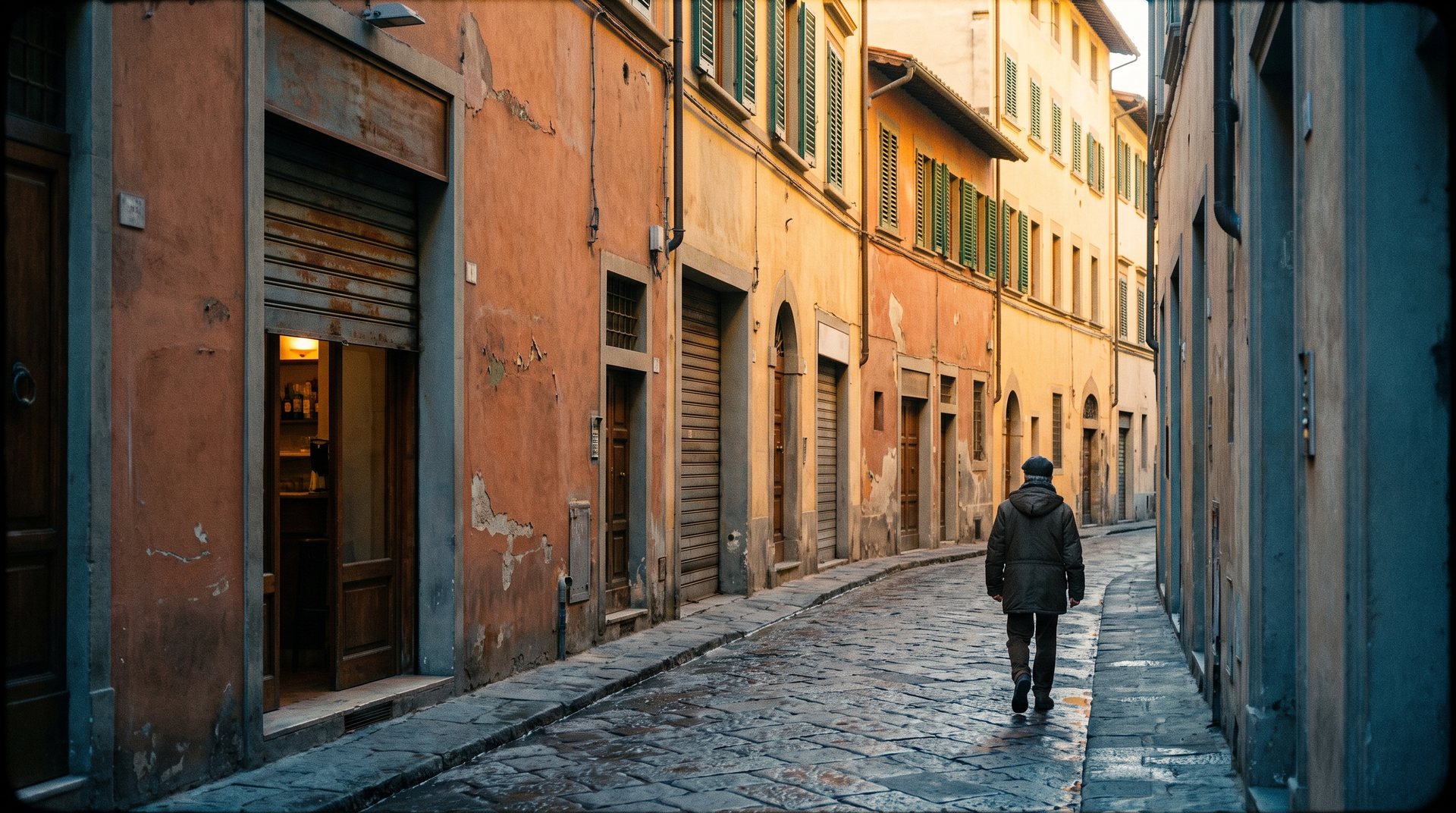
It is 5:30 on a winter morning in Florence and the street outside is still dark. I am at the kitchen table with a laptop open, answering emails from Melbourne, where the working day is nearly over. In three hours I will be in an Italian grammar class, getting my verb endings wrong.
That is slow travel as I actually lived it. Not a long holiday, but an ordinary week moved to another city: fewer places, longer stays, a routine instead of an itinerary. Most of what you read about slow travel is a definition. This page has the definition, the history and an honest comparison, and then the part that usually gets left out: what it looks like when your job is still running on somebody else’s clock.
I’m Jean-Luc (JL), and I write Quotes on Travel. I’ve lived and worked in Florence and Rome, and run a team from Bali and Phuket. The location-independent life is something I’ve actually done, not just written about. Where I haven’t done something, I say so.
What is slow travel? The 60 second answer
The shortest version: slow travel is choosing depth over distance. You trade a long list of places for a short list you come to know properly: a coffee bar, a market, a class, a walk home that stops needing a map.
Where slow travel came from
Slow travel is a child of slow food. In March 1986 a fast food restaurant opened near the Spanish Steps in Rome, and the national protest that followed convinced Carlo Petrini and the other founders that it was time to act. The result was Slow Food. In 1989 cultural figures from Italy and representatives from 14 other countries signed the Slow Food Manifesto at the Opéra Comique in Paris, and the movement went international.
Ten years later the idea moved from the table to the town. In 1999 Paolo Saturnini, then mayor of Greve in Chianti, joined by the mayors of Bra, Orvieto and Positano and backed by Slow Food, started Cittaslow, a network of small towns committed to a slower, more local way of living. Greve sits in the Chianti hills south of Florence, which is a fitting place for it to start.
From there the word spread well beyond food. Carl Honoré’s book In Praise of Slow (2004) carried it into work and everyday life, and travellers picked it up along the way: stay longer, move less, take the train, eat what the place eats. Nobody owns the term and there is no official definition. The spirit of it is simple: travel in a way that lets the place change you, rather than the other way round.
There is an irony in that Roman origin story. On my second trip to Rome, more than one night ended at the McDonald’s next to the Spanish Steps, the same steps where the slow movement started. Fast travel is easy. That is exactly the problem.
Everywhere means nowhere. When a person spends all his time in foreign travel, he ends by having many acquaintances, but no friends.
A winter in Florence: what a slow travel working day actually looked like
I lived in Florence from November to January, through the coldest part of the year: cold, but never unbearable. I wasn’t on holiday. I was still working for clients and a team back in Melbourne, studying Italian, and finding out whether the life I kept reading about would hold up on an ordinary Tuesday.
The day started at about 5:30. In winter Florence runs ten hours behind Melbourne, so the early morning was the last hour or two of the Australian workday: client and prospect emails, catching up with the team, anything that couldn’t wait for their tomorrow.
Then breakfast at home and a coffee on the walk in, standing at the bar the way Italians do: order, drink, go. At nine I was in a grammar class at the Accademia Europea di Firenze, then a fifteen-minute break for a coffee and something small next door, then the conversation class. Lunch was somewhere near the Galleria dell’Accademia and Piazza San Marco.
Afternoons were a few hours at a co-working space off Libertà, then a twenty-minute walk home. Tuesday and Wednesday nights were Champions League at the Lion’s Fountain pub. Other nights it was a meetup, or just walking the city until dinner found me.
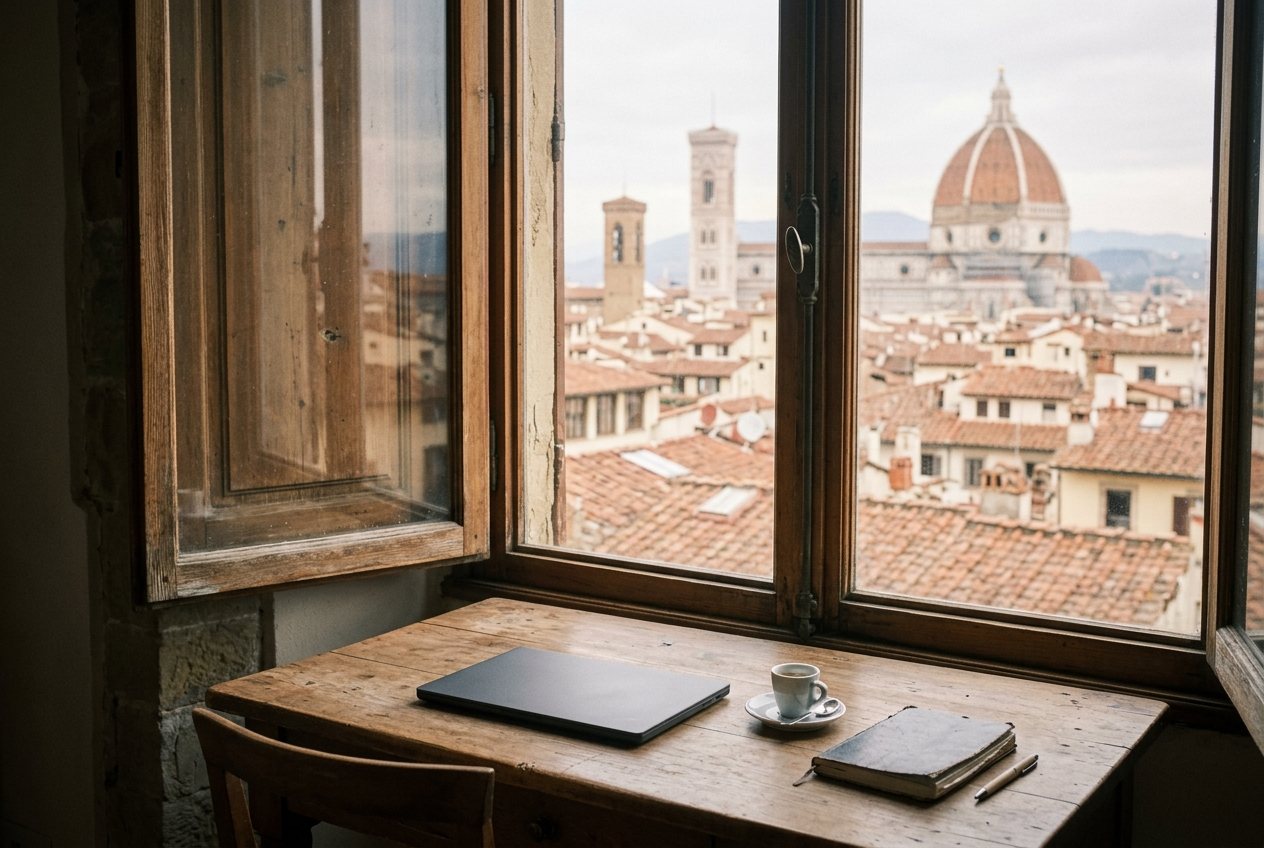
I lived five minutes from Dante’s statue at Santa Croce, and read The Divine Comedy because of it. Around the corner from home was a lampredotto stall, selling the Florentine tripe sandwich, which I later saw featured on food shows. In Florence I learned that Google reviews and the ‘authentic’ Florence are not the same thing. The lampredotto stall around my corner was never going to show up in a top-ten list.
A few small things nobody tells you. Most Florentines speak English, so when I made a mistake in Italian the answer often came back in English, which is kind and terrible for your grammar. Italian Christmas is embraced with a passion that felt nothing like an Australian one. And I missed a proper Melbourne brunch far more than I expected: in Florence it felt expensive, and not really how the city starts its day. If Florence is on your list, our Florence quotes are a good place to begin.
Rome twice: why the second, slower visit was the one that counted
The first time I did Rome I ticked off the big list: the Colosseum, the Vatican, the Forum, the Pantheon. It was beautiful and a bit flat.
The trip that stuck was the second one. Neighbourhood food tours, a game at the Stadio Olimpico, a hotel next to the Colosseum, and nights out with people I met along the way. Then I hired a car and drove from Rome to Florence over two nights, through the Lazio countryside and up into Tuscany, with a night in Bagnoregio, right next to Civita di Bagnoregio on its ridge of rock.
It was not graceful. It took me an extra twenty-five minutes to get out of Rome in a hire car from Termini, because the car was too big for some of the turns, the signals were hard to read, and I just kept driving straight. In Bagnoregio I had to reverse up a side lane to reach the rental house, because I could not work out how to turn into it. The woman waiting for me laughed when I finally got the car to the door, then told me I was supposed to park in the town lot at the bottom of the hill.
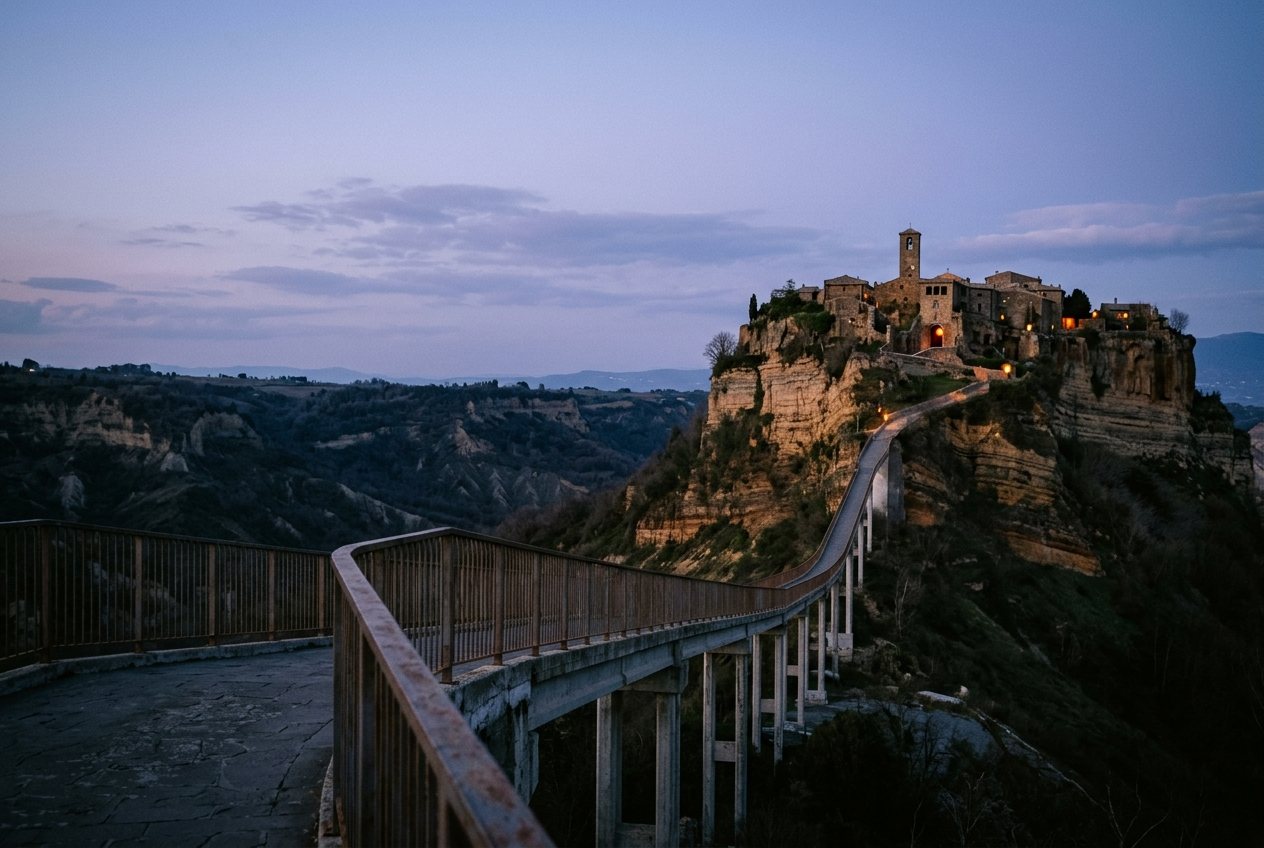
That drive is the whole argument for slow travel in one story. Same country, same traveller. The first trip collected places. The second went deeper into fewer of them, and it is the one I still talk about. If you have been somewhere once and came away a little flat, it may not have been the place. Our Rome quotes carry a few of the lines that city has inspired.
Slow travel vs fast travel
Slow travel vs fast travel, side by side
| Fast travel | Slow travel | |
|---|---|---|
| Pace | A new city every two or three days | One base for weeks or months |
| Where the money goes | Flights, transfers, short stays and eating out | Rent, groceries and everyday routines, with far fewer bookings |
| Who you meet | Guides, hotel staff and other travellers | Classmates, neighbours and the regulars at your local |
| Working while away | Hard: every move costs a day of setup | Possible, if your hours fit the time zone |
| What you remember | The list | The routine, and a few people |
Neither is wrong. Fast travel is how most of us start. My first Europe trip was a three-week sprint through Madrid, Barcelona, Paris, Interlaken, Venice, Cinque Terre and Pisa, and I wouldn’t give it back. The one place we booked ahead on that whole trip, an ocean-view apartment in Cinque Terre, fell through when we arrived, and we ended up walking an abandoned train tunnel to a hidden beach. Over-planning was the only thing that let me down. But a sprint shows you places. Staying shows you a life.
The real problem: your job still runs on someone else’s clock
Florence was not a leap. After Covid, with Melbourne rent about to rise, I gave up my lease and moved back to Shepparton for four months to build a buffer. I booked a one-way flight with only the first six weeks of accommodation locked in. Before I left, I moved from part-time in the office to part-time remote, so the team and I could both practise working with me gone.
Here is the honest part. Florence is the closest I have come to the three-to-six-month trip I first read about in Rolf Potts’ Vagabonding, and it stayed short of it for two reasons. The first was people: over Christmas and New Year the people I had met had left or were with family, and I didn’t know many people in the city. The second was the clock. After two months, getting up every morning to line up with Australian working hours had become a real drain. The city was never the problem. The hours were.
I have done the opposite, too. After my study exchange in Miami I came home to Melbourne and was back in the same routine inside a week: back at the front desk, back on the roster, like the whole thing had happened to someone else. A long trip that ends in the same routine is still a holiday. That is why I think slow travel is less about the length of a trip than the shape of a life.
If you are mid-career, good at what you do and quietly wondering whether there is another way to arrange things, this is probably your problem too. It is rarely courage. It is that your income is tied to a place and a time zone. You can take the job abroad for a while, the way I did, but the job still decides when your day starts.
The answer I keep coming back to is income that is genuinely location-independent: work that doesn’t care which city you wake up in. That is a different project from planning a trip, and it is the one I am working on now. I wrote about the longer pull on the long escape, and about the book that first named it for me in vagabonding, the deliberate way out.
Take the quiz: find your way out
The method sits behind a short quiz rather than on this page, because the right next step depends on where you are starting from. Twelve questions, one at a time, no right answers. It reads where you are, names it, and opens the door that fits. If slow travel is the life you want and the clock is what is in the way, this is where I would begin.
Rather read first? Start here walks through the whole idea.
Slow travel quotes to take with you
Five lines on staying put, from writers who worked it out long before the term existed. Each was read word for word in its original text: Seneca in Richard Gummere’s 1917 translation as transcribed on Wikisource, Stevenson and Thoreau from Project Gutenberg.
You need a change of soul rather than a change of climate.
Seneca to Lucilius, who had travelled a long way and come home no lighter. It is the best answer to the hope that a new place will fix an old feeling, and the reason slow travel is about how you live, not where.
Why do you wonder that globe-trotting does not help you, seeing that you always take yourself with you?
Seneca passes on Socrates’ reply to a man who complained that travel had not helped him. No writing by Socrates survives, so the line reaches us through Seneca, and it is credited that way here.
Alas, as we get up in life, and are more preoccupied with our affairs, even a holiday is a thing that must be worked for.
From Stevenson’s walking trip through the Cévennes with a donkey called Modestine, a slow journey long before anyone called it that. The line just before it, “I travel not to go anywhere, but to go”, is the one everyone quotes. This one is for anyone with a job.
He who sits still in a house all the time may be the greatest vagrant of all; but the saunterer, in the good sense, is no more vagrant than the meandering river, which is all the while sedulously seeking the shortest course to the sea.
Thoreau on the saunterer, a word he traces to pilgrims bound for the Holy Land. His point is that going slowly is not the same as going nowhere.
…a plant which is often moved can never grow strong.
From the same letter as “everywhere means nowhere”. Seneca lists the things that fail when they are moved too often, and ends here. It may be the shortest case for slow travel ever written.
For more lines like these, the 100 best travel quotes are the place to start, and if you are standing at the edge of a change yourself, our new chapter quotes were written for that moment.
The book that named it for me
Ferriss and Potts gave me the words: the trip I wanted was not a holiday, it was a rearrangement of how life is structured. If you read one book on long, slow travel, this is the one I would hand you.
Vagabonding (Rolf Potts)
Best for: Anyone who feels the pull of a long trip and wants it to be more than a holiday
Rolf Potts on taking real time out to travel, written as a way of thinking rather than a guidebook. I found it through Tim Ferriss in the same few months I was teaching myself digital, and it is the book that turned a vague pull into a plan.
Check price
How this page was written
Everything in the first person here happened to me, and nothing on this page is sponsored. The Slow Food dates come from Slow Food’s own history page and the Cittaslow founding from Cittaslow International. Every quotation was matched word for word against its source text, and none of the five carded lines runs anywhere else on this site. This is not immigration, visa, tax or legal guidance: if you are planning a long stay, check the official rules for your passport and destination.
Slow travel: the questions people ask
What is slow travel?
Slow travel is a way of travelling that favours fewer places and longer stays. Instead of a new city every few days, you base yourself somewhere for weeks or months, live on a local rhythm, and get to know the place rather than tick it off.
Where did the slow travel movement start?
It grew out of Slow Food, which began in Rome in March 1986 after a fast food restaurant opened near the Spanish Steps and sparked a national protest. Slow Food went international with its 1989 manifesto in Paris, and in 1999 Cittaslow took the idea to towns, starting with Greve in Chianti. The travel version grew out of both and has no single founder or official definition.
Can you work while slow travelling?
Yes, and for many people it is the only way a long stay is possible. The catch is time zones. In Florence I was up at about 5:30 to catch the end of the Melbourne workday, and after two months that early start had become a real drain. Work that is not tied to one time zone makes it far easier. This is not visa or immigration advice: check the official rules for your passport and destination before a long stay.
Is slow travel cheaper?
It changes where the money goes more than how much. You spend less on flights, transfers and short-stay bookings, and more on rent, groceries and the everyday costs of living somewhere. Whether that adds up to less depends on the place and how you live there.
How long is slow travel?
There is no rule. Most people mean weeks to months in one base rather than a few days. My Florence stay ran from November to January, and even that fell short of the long trip I had in mind.

The idea is far older than 1986. Seneca wrote this to his friend Lucilius almost two thousand years ago. He was really talking about reading, and used travel as the comparison. Read the other way round, it is the whole case for slow travel in two sentences.