
Fishing quotes: 32 lines traced to the book, and 3 that are not
Anglers, novelists and one US president on why people stand in cold water on purpose. Every line was matched against the full text it comes from, with the chapter named. The three at the bottom carry none of that, and almost every fishing quote page prints them anyway.
Search “fishing quotes” and page one gives you two quote aggregators, a Goodreads tag, a Reddit thread and three fishing blogs. Between them they do not attach a source to a single line. Not one.
Google’s own answer box opens with “a bad day of fishing is always better than a good day at work” and credits it to a magazine, which credits it to Unknown. So the most-shared fishing quotation in the language has no author, and every page that runs it says so without ever asking why.
Which is strange, because angling has the oldest and best-documented literature of any outdoor pursuit in English. Izaak Walton published the founding text in 1653. Thoreau argued with himself about fishing across two books. A sitting US president wrote a defence of fishermen that is funnier than anything on page one.
So every line below had to clear one bar: a named writer, a named work with a year, and a place inside it we can point you to. Eleven complete texts were downloaded and searched this week, and each sentence was found in the chapter named beside it. Nothing was copied off another list. Thirty-two cleared the bar.
Three did not, and they are in a marked section near the bottom rather than quietly dropped, next to the real sentences they were probably built out of.
This page owns the angler. Water as landscape lives at ocean and coast quotes, the end of the day at sunset quotes, and the wider outdoors at nature travel quotes, which is the hub this page sits under. The hundred we return to most are at 100 best travel quotes.
What are the best fishing quotes? The short answer
Fishing quotes from the books
Ten lines with the title and the year attached, from the books that actually built the literature. Every one of these texts is out of copyright and free to read in full, which is precisely why we can show you where the sentence lives instead of asking you to take our word for it. The links are in the selection notes.
“Doubtless God could have made a better berry, but doubtless God never did”; and so, if I might be judge, God never did make a more calm, quiet, innocent recreation than angling.
angling is somewhat like poetry, men are to be born so: I mean, with inclinations to it, though both may be heightened by discourse and practice
Said to a hunter who has just accused anglers of being simple men. Walton does not argue that fishing is easy. He argues that it is a talent, which is a far cheekier defence.
he that hopes to be a good angler, must not only bring an inquiring, searching, observing wit, but he must bring a large measure of hope and patience, and a love and propensity to the art itself
The sentence that follows the one above, and the more useful of the two. Hope and patience are listed as equipment, in the same breath as the wit to observe. Three hundred and seventy years on, no tackle catalogue has improved on that inventory.
The wildness and adventure that are in fishing still recommended it to me.
Worth knowing what surrounds it. This is the one chapter where Thoreau turns on fishing, argues himself towards vegetarianism, and admits he cannot fish without falling a little in his own esteem. The line is quoted as a celebration. In the book it is a confession.
The traveller fancies that he has seen the country. So he has; the outside of it, at least: but the angler only sees the inside.
The best argument on this page that fishing is a form of travel rather than a break from it. Kingsley’s claim is geographic and quite specific: the riverbank is the one strip of countryside nobody has tidied, and you only reach it by having a reason to stand in it.
The attraction of angling for all the ages of man, from the cradle to the grave, lies in its uncertainty.
Van Dyke was a Presbyterian minister who later became a US ambassador, and he wrote the most companionable book on this list. His whole thesis is that uncertainty is the product, not a defect in it.
I have a kind feeling towards all “brothers of the angle” ever since I read Izaak Walton.
From the same collection as Rip Van Winkle and Sleepy Hollow. Irving spends the essay admitting he was a hopeless fisherman who gave up by lunchtime, then finds an old one-armed angler in Wales and decides the book was right about the men even if it was wrong about him.
His fishing was not a sport, nor solely a means of subsistence, but a sort of solemn sacrament and withdrawal from the world, just as the aged read their Bibles.
Five years before Walden, and gentler about it. He is describing one specific old man on the riverbank rather than making a rule, which is why it lands where the rules do not.
They were beautifully colored and firm and hard from the cold water.
The Burguete chapter, five days of trout fishing in the Irati before the fiesta in Pamplona ruins everyone. It is the only stretch of the novel where anybody is happy, and Hemingway signals that by dropping every adjective except the ones a fisherman would actually use.
What we have gained is ours; what is lost is gone, whether fish, or use, or love, or name, or fame.
Written straight after losing a seven-foot tarpon to a frayed line. Grey was a dentist who became the best-selling western novelist in America and then spent the money on big-game fishing, which tells you everything about the conviction behind this one.
Short fishing quotes
Twelve lines short enough to use and old enough that the source is settled rather than asserted. Every one is attributed, because a short quote is exactly where attribution usually gets dropped: the line fits on the image and the author does not.
Study to be quiet.
The last line of the book, and Walton is quoting scripture rather than himself: 1 Thessalonians 4:11. Four words is the shortest fully sourced fishing quotation in English and it has outlived every slogan written since.
Time is but the stream I go a-fishing in.
He is not talking about fishing. He is using it to say that time is shallower than it looks, and the sentence immediately after this one proves it: he drinks from the stream and sees the sandy bottom.
Shall I go to heaven or a-fishing?
From a comic dialogue between a Hermit and a Poet, which is Thoreau arguing with himself in two voices. The Hermit has lost his train of thought and decides fishing will do instead. It is the funniest thing in the book.
To capture the fish is not all of the fishing.
The opening sentence of the book. If you only take one line off this page, this is the one that says what the unsourced favourites are trying to say, and it has an author, a book and a year.
Hope burns always in the heart of a fisherman.
Written on a Mexican river at dawn, a few pages before the tarpon breaks his line. Hope and the loss of it are the same chapter, which is the honest version of this sentiment.
the true hunter or fisherman is born, not made
Cleveland is the only person to serve two non-consecutive terms as US president, and he wrote a whole book defending fishermen against the charge of laziness. He is not being modest here. He means the rest of you cannot be taught.
no man can lose what he never had
Said to a pupil who has just lost a trout, half a line and a good hook. It is a consolation and a piece of logic at the same time, and it is the reason nobody has ever won an argument with a fisherman about the one that got away.
’Tis an affair of luck.
Five words, and the shortest statement of the whole argument. Van Dyke spends the following two hundred pages refusing to apologise for it.
This sort of fishing is pleasure and not work
The distinction the whole book turns on: he is separating the angler from the commercial fisherman, and then daring anyone to call the first one idle.
It is good even to be a fisherman in summer and in winter.
The sentence before it describes a man with a hazel pole and a flaxen line and concludes that is invention enough. Thoreau is arguing that the simplest possible tackle is a complete technology, which every angler knows and every tackle shop would rather you forgot.
I measured him with a fisherman’s glance.
Seven words that contain an entire way of looking. A fisherman’s glance is a unit of measurement, and Grey knows exactly how unreliable he is being.
He who has not hooked the red chivin is not yet a complete angler.
A chivin is a chub. Thoreau spends several pages describing the fish of his own river one by one, like a naturalist with a grudge, and then sets this quiet entry requirement for anybody who wants the title.
Funny fishing quotes
The brief for this section was to say plainly which of these are anonymous. None of them are. That is the finding: the funniest writing about fishing was done by people who put their names on it, and the anonymous jokes that circulate instead are the weaker ones. Five of the seven below are by a sitting US president or a former one.
there can be no such thing as an impatient fisherman
A president defining patience out of existence by definition. He is quite serious, which is what makes it work.
Never believe a fisherman when he tells you that he does not care about the fish he catches.
Van Dyke immediately calls it what it is: not a lie, but an unconscious pose and a delicate bit of self-flattery. He had just landed two good salmon in a dry season, which is the only reason he was in a position to say it.
It is perfectly plain that large fish are more apt to escape than small ones.
This is a president constructing a legal defence of the one that got away, on the presumption of evidence, and he is not finished: the next paragraph argues the escaped fish was measured by feel on the rod, which the fisherman knows better than anyone.
Fish are constantly doing the most mysterious and startling things; and no one has yet been wise enough to explain their ways or account for their conduct.
The alibi underneath every fishing story ever told, and it happens to be true. If nobody can explain what fish do, nobody can contradict an account of what they did.
So all this row was because you thought you’d get to stay home from school and go a-fishing?
Aunt Polly, mid-toothache, arriving at the real explanation. Twain never wrote a fishing quote for a plaque, which is why the funniest fishing line he did write is an accusation.
It was kind of lazy and jolly, laying off comfortable all day, smoking and fishing, and no books nor study.
Huck has been locked in a cabin by his father and is describing it as a holiday. It is the most persuasive case for doing nothing in American literature, and it is fourteen words long before the clothes fall apart.
Of course there are many who call themselves fishermen and who insist upon their membership in the fraternity who have not in their veins a drop of legitimate fisherman blood.
Gatekeeping, 1906 vintage, from the highest office in the land. Read it twice and you will recognise somebody.
Who actually said “a bad day of fishing is better than a good day at work”?
Nobody, as far as anyone can show. It appears on page one of the search results four times and the two that name a source both name “Unknown”. A site-restricted search of Quote Investigator, which is the reference of record for this kind of question, returns no entry for it. The phrase appears zero times across all eleven full texts searched for this page. It is a modern proverb, and calling it one is more honest than the alternative.
That would be a small finding on its own. It is not small, because the other two most circulated fishing quotations on the internet have the same problem, and one of them is attached to a book you can check in thirty seconds.
A bad day of fishing is always better than a good day at work.
Runs on page one with no author, and that is the whole story. Two of the four pages that carry it credit Unknown; the rest credit nobody at all. It is a good line and it belongs to everyone, which is a fine thing for a proverb to be. It is not a quotation, and printing it beside sourced ones without saying so is where the trouble starts.
Many men go fishing all of their lives without knowing that it is not fish they are after.
This one is checkable, and it fails. The complete text of Walden and the complete text of A Week on the Concord and Merrimack Rivers were both searched this run. The phrase “not fish they are after” appears zero times in either, in any wording. Jeffrey Cramer, curator of collections at the Thoreau Institute at Walden Woods, files it in the misquotations appendix of The Quotable Thoreau.
They might go there a thousand times before the sediment of fishing would sink to the bottom and leave their purpose pure
This is the real sentence the fake one was built out of. Thoreau is watching men fish his pond without ever seeing it. Note what he actually claims: not that fish are the wrong goal, but that fishing is the sediment that has to settle before anything else becomes visible. That is a harder and better idea than the version on the fridge magnet.
they know nothing about the hook of hooks with which to angle for the pond itself, impaling the legislature for a bait
And this is where that paragraph lands, four sentences later. The legislature regulates how many hooks may be used and misses the only hook that matters. Nobody has turned this into a poster, because it is an argument rather than a sentiment, and arguments do not fit on posters.
The charm of fishing is that it is the pursuit of what is elusive but attainable, a perpetual series of occasions for hope.
Held, not killed, and here is exactly what was checked. The phrase “elusive but attainable” appears zero times in Musa Piscatrix (1896), the angling anthology Buchan edited, and zero times in Scholar-Gipsies (1896), the essay collection that carries his fishing writing. His Wikiquote page does not list it. Both books were read from the scanned first editions this run. Buchan wrote a great deal and not all of it is digitised, so this is a documented absence from the two obvious places, not proof he never wrote it.
we swear that the world is a good one and life well worth living.
What Buchan demonstrably did write about fishing. Four in the morning on the Tweed, walking four miles in the dark to reach the bend he wants, and this is the sentence when the fly goes up and the trout start rising. It says the same thing as the famous line and it has a book behind it. Read off the scanned first edition, which is linked in the notes below.
Notes on the selection
What was verified, and how. Thirty-two of the thirty-five cards above were extracted programmatically from a complete source text, not copied from another quote page. Each card names a source file, a start phrase and an end phrase, and a script pulls the exact run of text between them, so the wording on this page cannot differ from what the book prints. The chapter beside each quote was read off the nearest preceding heading in the same file rather than assumed. Thirty-three extractions were attempted and thirty-three matched. One card, the sentence from Grover Cleveland about what a true fisherman is, sits in the short section rather than the books section, because it is nine words long and that is where a reader will look for it.
The sources, all free to read in full. The Compleat Angler (Walton, 1653), Walden (Thoreau, 1854), A Week on the Concord and Merrimack Rivers (Thoreau, 1849), Prose Idylls (Kingsley, 1873), Fisherman’s Luck (Van Dyke, 1899), The Sketch-Book of Geoffrey Crayon (Irving, 1820), Fishing and Shooting Sketches (Cleveland, 1906), Tales of Fishes (Grey, 1919), The Sun Also Rises (Hemingway, 1926), plus Tom Sawyer and Huckleberry Finn. Buchan is not on Project Gutenberg, so Scholar-Gipsies and Musa Piscatrix were read from the scanned first editions at the Internet Archive.
What did not close, stated rather than hidden. The Buchan line is a documented absence from two books, not a verdict. Buchan published more than a hundred titles and a good deal of his journalism has never been digitised, so a source may exist that we cannot reach. The card says so on its face. The “bad day of fishing” line has no author anyone has produced, and the honest description of it is proverb, not quotation.
On the Thoreau misattribution, the trail is unusually complete. The American Museum of Fly Fishing published a full investigation by the folklorist Jan Harold Brunvand in 2025. The earliest printed version he found is Joseph Wood Krutch in 1961, paraphrasing Thoreau rather than quoting him; by 1995 an angler on a river was repeating it to Michael Baughman as something he thought was in Walden; from there it went everywhere. Buchan’s missing line was checked against his Wikiquote page as well, which does not carry it.
What was cut. Every line attributed to The Old Man and the Sea and to A River Runs Through It, because both books are in copyright, neither is on Gutenberg, and a quotation we cannot open and search is a quotation we are repeating rather than sourcing. Hemingway is still here, from a book that is public domain and that we read. Quoting the famous book we cannot check over the real book we can is the exact habit this page was written against. The wider running list of lines we have traced, corrected or failed to find at all is at quote fact checks, and how we work is set out in our editorial standards.
Fishing quotes: the questions people actually ask
What is a famous quote about fish?
“To capture the fish is not all of the fishing.” Zane Grey wrote it as the opening line of Tales of Fishes in 1919. It is the sourced version of the sentiment that usually circulates with no author attached, and Grey earned the right to it: he held several world big-game records while writing the best-selling westerns in America.
What to caption a fishing picture?
Three that are short, attributed and will not embarrass you if somebody checks. “Study to be quiet.” Izaak Walton, 1653. “Shall I go to heaven or a-fishing?” Henry David Thoreau, 1854. “’Tis an affair of luck.” Henry Van Dyke, 1899. The author and the year are the caption, not an afterthought to it.
What is a good slogan for fishing?
Worth separating the two things. A slogan is written to sell something and belongs to whoever wrote it, which is usually a tackle brand. A quotation comes out of a book and can be checked. “A bad day of fishing is better than a good day at work” is the most popular fishing slogan in English and it has no known author, which is fine as long as nobody prints a name beside it. If you want a line with a source behind it, use one from the short section above.
Who wrote The Compleat Angler?
Izaak Walton, first published in 1653 and revised by him across five editions until 1676. It is the founding book of English fishing writing and it supplies five of the quotes on this page, including the last four words of the book itself. His profile, and every line of his we have verified, is linked from his name on each of those cards above.



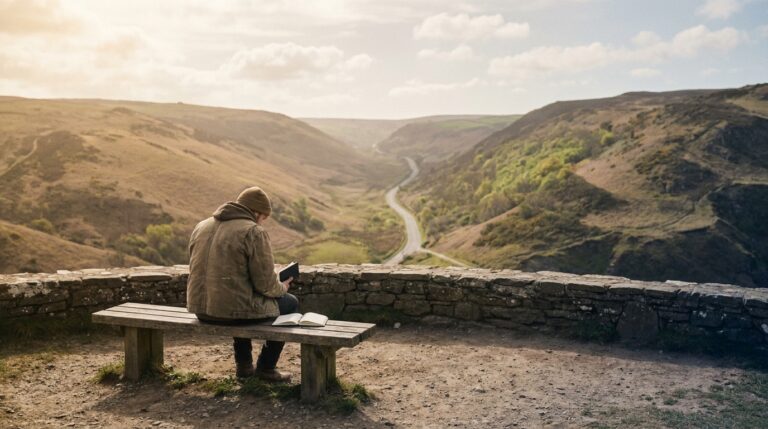
The most quoted sentence in angling, and it is usually clipped to the strawberry half. Walton is borrowing a line about fruit from a clergyman called Boteler and then quietly outbidding it. The joke is the structure: he compliments fishing by praising something else first.