Jon Krakauer's Into the Wild: The Book, the Film, and the Real Story
The 1996 book, the 2007 film, the real Chris McCandless story, and the famous lines with their actual sources. Which version to start with, and why.
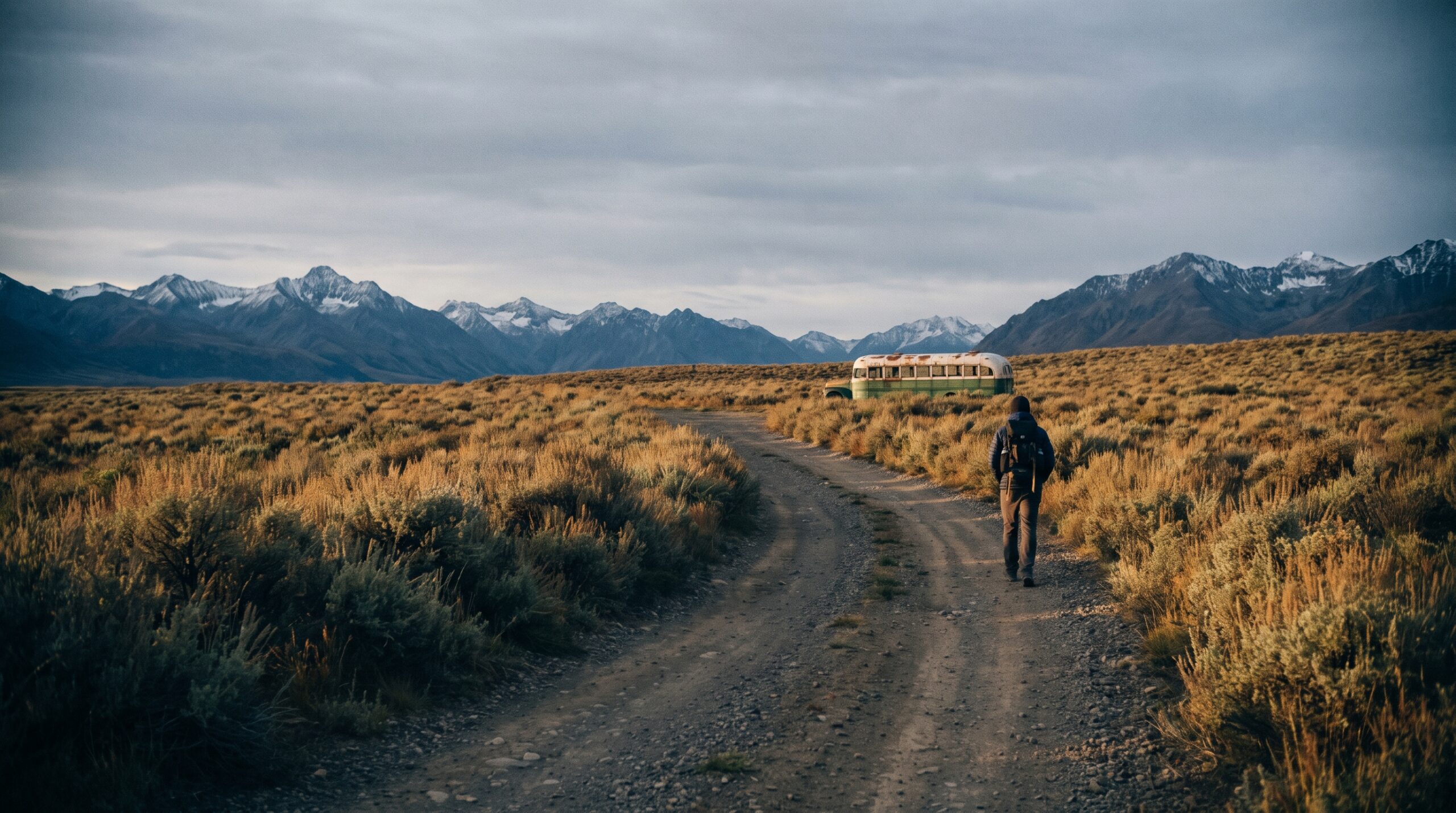
Every few months the line surfaces again, laid over a photograph of an old bus: happiness only real when shared. Most people who post it have never read the book it comes from, and a surprising number credit it to the wrong man. If you arrived here holding half the story, a name, a bus, a line about happiness, this page assembles the whole of it.
Below: what Into the Wild actually is, what happened to Chris McCandless without the varnish, how Sean Penn’s 2007 film bends the book, which edition is worth your money, and where the famous lines really come from. Every quote on this page is traced to its source. That is the house rule here, and this story needs it more than most.
What is Jon Krakauer’s Into the Wild? The 60-second answer
Into the Wild is a 1996 nonfiction book by Jon Krakauer, grown from his January 1993 Outside magazine article “Death of an Innocent.” It reconstructs the last two years of Christopher McCandless, a 24-year-old college graduate who gave his savings to charity, cut contact with his family, drifted across the American West under the name Alexander Supertramp, and walked alone into the Alaskan backcountry in April 1992. His body was found that September in an abandoned bus he had used as a shelter. The 2007 film of the same name, written and directed by Sean Penn, adapts the book.
The real story of Chris McCandless, told straight
McCandless graduated from Emory University in 1990, donated roughly 24,000 dollars of savings to Oxfam, and disappeared from his family’s life without a word. For nearly two years he moved through the West: a grain elevator in Carthage, South Dakota, where he worked for Wayne Westerberg; a canoe run down the Colorado River toward Mexico; stretches in the Sierra and the desert. The people he met on the road, and there were many who loved him quickly, knew him as Alex.
In April 1992 he hitched north. An electrician named Jim Gallien dropped him at the head of the Stampede Trail, west of Healy, Alaska, and watched him walk in carrying a light pack, a rifle, and a ten-pound bag of rice. McCandless spent 113 days living out of a derelict Fairbanks city bus, hunting small game, reading, and keeping a spare journal. In July he tried to walk out and found the Teklanika River swollen with meltwater, uncrossable at the point he had forded it in spring. He went back to the bus.
He starved. Krakauer has revised the mechanism more than once across editions and follow-up reporting, from toxic seeds to a toxic amino acid in the seeds of the wild potato plants McCandless had been eating. The honest summary is that he weakened past the point of recovery, and the seeds may have hastened it. Hunters found his body on September 6, 1992. He had left a note asking whoever found him to stay; he wrote that he was too weak to hike out, and that he was living alone.
None of this settles what the story means, which is exactly why the book exists. To some Alaskans he was an unprepared kid who died of hubris a day’s walk from help. To Krakauer he was something more complicated, and more familiar.
The book: what Krakauer actually argues
Into the Wild is not a straight biography. Krakauer widens the frame deliberately, setting McCandless beside other young men who vanished into wild country: Everett Ruess in the Utah canyons in 1934, and a line of Alaskan seekers who fared no better. Then, in the book’s most argued-over move, he spends two chapters on himself, on his own near-fatal solo attempt on the Devils Thumb at 23, as evidence that a young man can court death in the wilderness without wanting to die.
That is the book’s actual thesis, and it is easy to miss under the folklore: McCandless was not insane and he was not suicidal. He was young, romantic about the wild in a way readers of Tolstoy, Thoreau and Jack London will recognise, and he made one or two mistakes that a forgiving landscape would have absorbed. Alaska is not a forgiving landscape.
The criticism deserves its place too. Many Alaskans, including park rangers who have written about the case, read McCandless as unprepared rather than tragic, and resent the pilgrim traffic the story still sends up the Stampede Trail. Krakauer prints versions of that objection inside the book itself, which is part of why it holds up: it argues with itself, and it shows its sources.
Book vs film: what the adaptation changes
Sean Penn spent a decade securing the family’s blessing before making the film, and it shows in what the film chooses to feel. Emile Hirsch plays McCandless; Hal Holbrook earned an Oscar nomination as Ron Franz, the widower who tried to adopt him; Eddie Vedder’s songs carry the road sections. It was shot on many of the real locations, including the Stampede Trail country.
The differences matter if you care about the record. The book is an investigation that admits doubt; the film is an elegy that resolves it. Penn gives McCandless a spoken inner arc, moves the family wound to the centre of the story, and stages the happiness line as an on-screen realisation at the end. It is a beautiful film. It is not the evidence. Watch it after the book and the changes become part of the interest rather than a substitute for the facts.
Book vs film at a glance
| Aspect | The book (1996) | The film (2007) |
|---|---|---|
| What it is | Investigative nonfiction built from journals, letters and interviews | An elegiac road film built on the book’s spine |
| The storyteller | Krakauer, weighing evidence and admitting doubt | McCandless himself, given voice-over and certainty |
| The family | Sketched with restraint | Dramatised as the engine of the story |
| The famous line | A margin note found after his death | A realisation staged on screen |
| Time it asks of you | Two or three evenings | 148 minutes |
What happened after the book
The story did not stop in 1996. Carine McCandless, Chris’s sister, published The Wild Truth in 2014, describing a violent family home the book had only gestured at. It reframed the walking-away for many readers, and Krakauer has endorsed her account. Krakauer himself kept working the question of how McCandless died, publishing new analysis in 2013 and again in 2015 and revising later editions: the seeds of the wild potato carry a toxin that can cripple an already starving body, which moves the death another step away from the incompetence story.
The bus is gone from the trail. Pilgrimages to Bus 142 kept ending in rescues, and twice in drownings at the Teklanika, so in June 2020 the Alaska Army National Guard lifted it out by helicopter. It is being conserved at the University of Alaska’s Museum of the North in Fairbanks, which means the safest way to stand in front of the real bus is to fly to Fairbanks, not to walk the Stampede Trail. The replica built for the film sits outside the 49th State Brewing Company in Healy, and that is the one in most of the photographs.
Which version to get
Three honest doors into the same story, ranked for a first-time reader. The short answer: the paperback first, the audiobook if your reading time lives in the car, the film as a companion piece rather than a replacement.
1. Into the Wild (paperback)
Best for: Anyone coming to the story for the first time
The book itself, in the standard Anchor paperback. Krakauer’s reconstruction of McCandless’s two years on the road runs a little over 200 pages and reads in two or three sittings. This is the version to start with: the film is built from it, the famous lines live in it, and the arguments about what McCandless was doing out there only make sense once you have seen Krakauer’s evidence laid out in order.
Pros
- The complete story, including the investigation the film cannot carry
- Short enough to finish in a weekend
- The edition most readers, courses and book clubs use
Cons
- Krakauer spends two chapters on his own climbing history, which some readers find a digression
- The timeline is deliberately non-linear; a straight chronology it is not

2. Into the Wild (audiobook)
Best for: Listeners whose reading time lives in the car or on the trail
Philip Franklin’s unabridged narration for Random House Audio. It is a steady, unshowy reading that suits Krakauer’s reportorial tone, and a road story turns out to be a natural fit for the format. If the paperback would sit unopened on your nightstand, this is the honest alternative.
Pros
- Unabridged; nothing trimmed
- Restrained narration that stays out of the story's way
- The natural format for a story that lives on the road
Cons
- The audio edition carries only a few dozen ratings, so its 4.6 rests on a thin sample
- No maps or photographs, and this story leans on geography

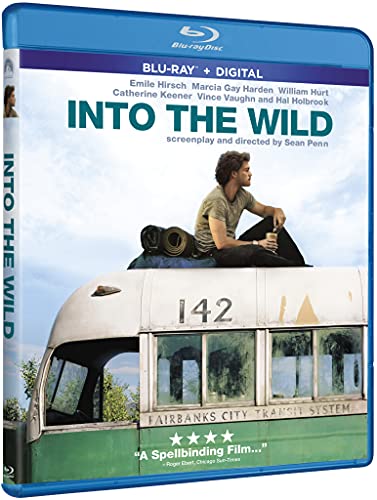
3. Into the Wild, the 2007 film (Prime Video)
Best for: A night in, after you have read the book
Sean Penn’s adaptation, with Emile Hirsch as McCandless, Hal Holbrook’s Oscar-nominated turn as Ron Franz, and Eddie Vedder’s soundtrack. A few dollars rents it on Prime Video. Watch it second: knowing what the record actually says turns the film’s departures into part of the experience instead of a substitute for it.
Pros
- Hal Holbrook and Catherine Keener give the supporting cast real weight
- Eddie Vedder's songs carry the road sections
- Shot on many of the real locations
Cons
- 148 minutes and unhurried; it asks for patience
- Invents and rearranges scenes; the book's evidence trail does not survive the adaptation
Notes on this ranking
The order is a reading order, not a quality score. The paperback leads because the book is the source document; the audiobook and film are ranked by how faithfully they carry it. Ratings shown are Amazon customer ratings as recorded in early September 2026; we display them as context, we do not certify them. One omission is deliberate: we left the DVD out because every current listing we checked was a region import at three to five times the Blu-ray price with weeks of delivery time.
If you want a simple starter path: read the paperback over a weekend, then rent the film the following week and watch what Penn changed. That pairing, in that order, is the whole phenomenon in seven days.
The lines everyone quotes, with their real sources
This is the part of the story where the internet has been least careful, so we will be exact. Two lines carry most of the traffic, and both belong to Chris McCandless, not to Jon Krakauer.
“Happiness only real when shared.”
“The very basic core of a man's living spirit is his passion for adventure.”
This one comes from a real letter, quoted at length in the book, that McCandless wrote to the widower he had befriended in the California desert. Read in full it is less a slogan than a young man trying to hand an old man his own hunger. Franz took the advice; the ending, in the book, will stay with you.
For Krakauer’s own words, verified line by line against the books they come from, his author page collects them with sources and years. The habit of checking the line against the page is the whole reason this site exists.
If Into the Wild gripped you, read these next
Two natural next steps, both Krakauer, both verified on his author page.
4. Into Thin Air
Best for: Readers who want Krakauer inside the story instead of investigating it
Krakauer’s first-person account of the 1996 Everest disaster, written in the raw year after he came down. Where Into the Wild reconstructs a stranger, this one is Krakauer inside the catastrophe, and it is the sharper, harder book for it. His readers rate it the best thing he has written.
Pros
- First-person reporting from inside the disaster
- The highest-rated of Krakauer's books among readers
- Pairs naturally with Into the Wild: the same question, asked of the author himself
Cons
- A heavy read; people die and the guilt is never resolved
- His account of guide Anatoli Boukreev sparked a long dispute; The Climb gives the other side

5. Eiger Dreams
Best for: Meeting Krakauer the climber before Krakauer the investigator
The early essay collection: Alaska, the Eiger, K2, and the Devils Thumb piece that later grew into the most personal chapters of Into the Wild. Short, funny in places the famous books never are, and readable in any order.
Pros
- Short pieces you can read in any order
- The Devils Thumb essay is the seed of Into the Wild's self-portrait chapters
- Lighter company than either of the famous books
Cons
- An essay collection, so it is uneven by design
- The thinnest review base of the books on this page

And if it is the pull of wild places you came for rather than the books, the adventure quotes collection gathers the verified lines from the whole tradition McCandless was reading.
Frequently asked questions
Is Into the Wild a true story?
Yes. It is nonfiction: Krakauer reconstructs Chris McCandless’s 1990 to 1992 journey and his death in Alaska in 1992 from journals, letters, photographs and interviews with the people who knew him on the road.
Did the book or the movie come first?
The book, in 1996. Sean Penn’s film adaptation followed in 2007.
Did Jon Krakauer know Chris McCandless?
No. They never met. Krakauer reported the story after McCandless’s death, beginning with his January 1993 Outside magazine article, Death of an Innocent.
Who said happiness is only real when shared?
Chris McCandless, in a note written in the margin of his copy of Doctor Zhivago near the end of his life, and reported by Krakauer in the book. The note reads happiness only real when shared; the popular version adds the extra words.
Where is the Into the Wild bus now?
Bus 142 was airlifted off the Stampede Trail by the Alaska Army National Guard in June 2020 after years of dangerous pilgrimages, and is being conserved at the University of Alaska’s Museum of the North in Fairbanks. The film’s replica bus stands outside the 49th State Brewing Company in Healy.





Note the wording. The version that circulates, happiness is only real when shared, smooths out a four-word note McCandless pencilled beside a passage of Boris Pasternak’s novel. It was found after his death and reported by Krakauer in the book. The film stages it as a spoken realisation, which is where most people met it. It is routinely misattributed to Krakauer himself, and sometimes to Pasternak; it belongs to McCandless.