
Venice Quotes: What Writers Actually Said About the Floating City
Sixteen lines about Venice, each traced to the book, the year and the page it sits in, plus the most famous Venice line of all and why it does not mean what everyone thinks.
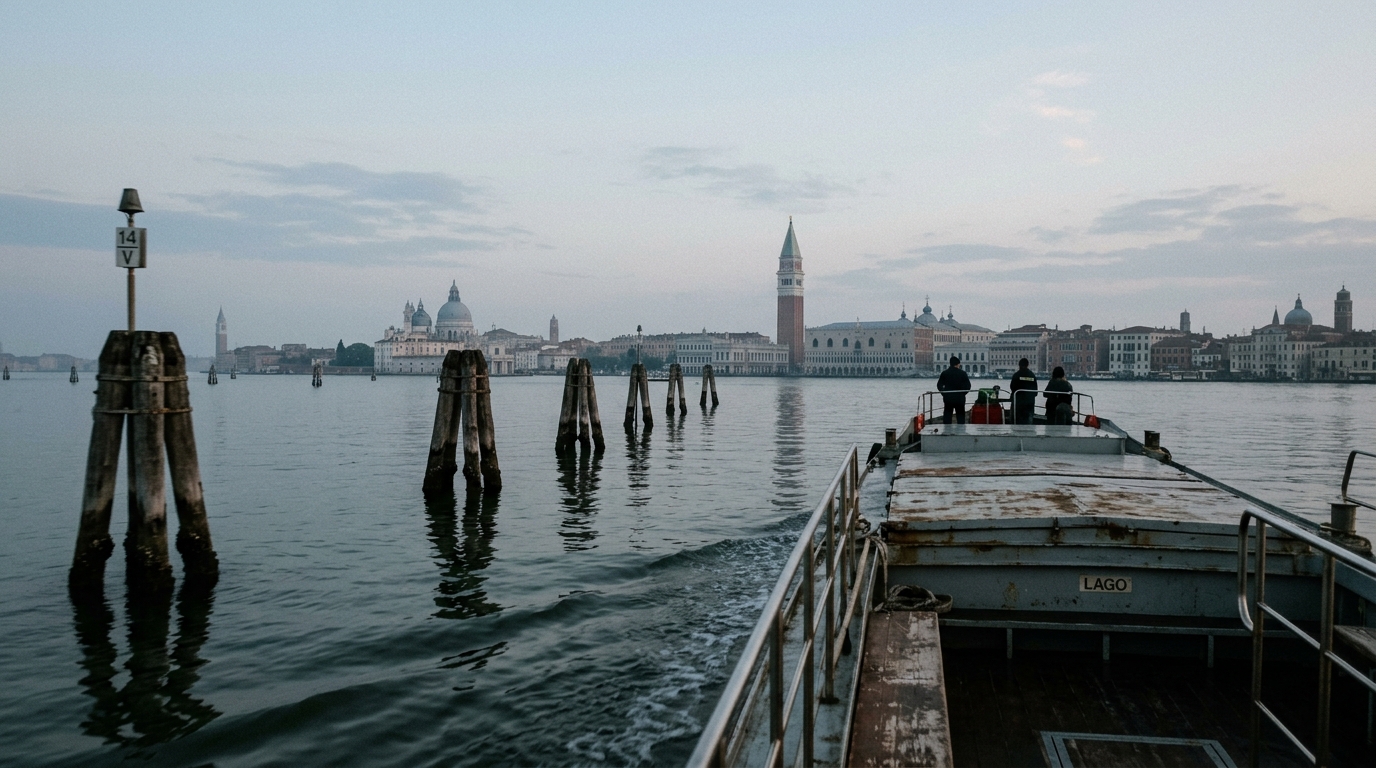
Venice quotes have a specific problem, and it is not the one Florence has. Florence attracts invented lines. Venice attracts real lines that have drifted loose from where they came from, so a sentence Ruskin wrote in a three-volume architectural study ends up floating over a photograph of a gondola with no book, no year and no idea that the man who wrote it was arguing the opposite of what the caption suggests.
My clearest Venice memory is a breakfast of cicchetti and a one-euro glass of wine at nine in the morning. It quietly rearranges what you think a morning is for.
So this page keeps the count honest rather than long. Sixteen lines, every one of them matched this week against the full text it comes from, with the chapter or the canto where you can go and find it. Two of them are corrections, because Venice’s most repeated line is genuine and almost universally misread, and the funniest thing anybody ever said about the city cannot be traced to the man who supposedly said it.
If you want the wider library first, it is at travel quotes, and the sibling page for the other Italian city that does this to people is Florence quotes.
Venice quotes worth trusting: the 60-second answer
If Venice is calling
Venice punishes a tight schedule and rewards an aimless one. Nearly everything quoted on this page happened inside a walk of about an hour, and every writer here arrived by water, which is still the arrival worth engineering. The tours and tickets below are drawn live from GetYourGuide for Venice. The honest advice from the people quoted on this page is unanimous and slightly rude: book the one or two things that genuinely need booking, then get lost on purpose in Cannaregio or Dorsoduro at an hour when nobody else is out.
The writers who arrived by water
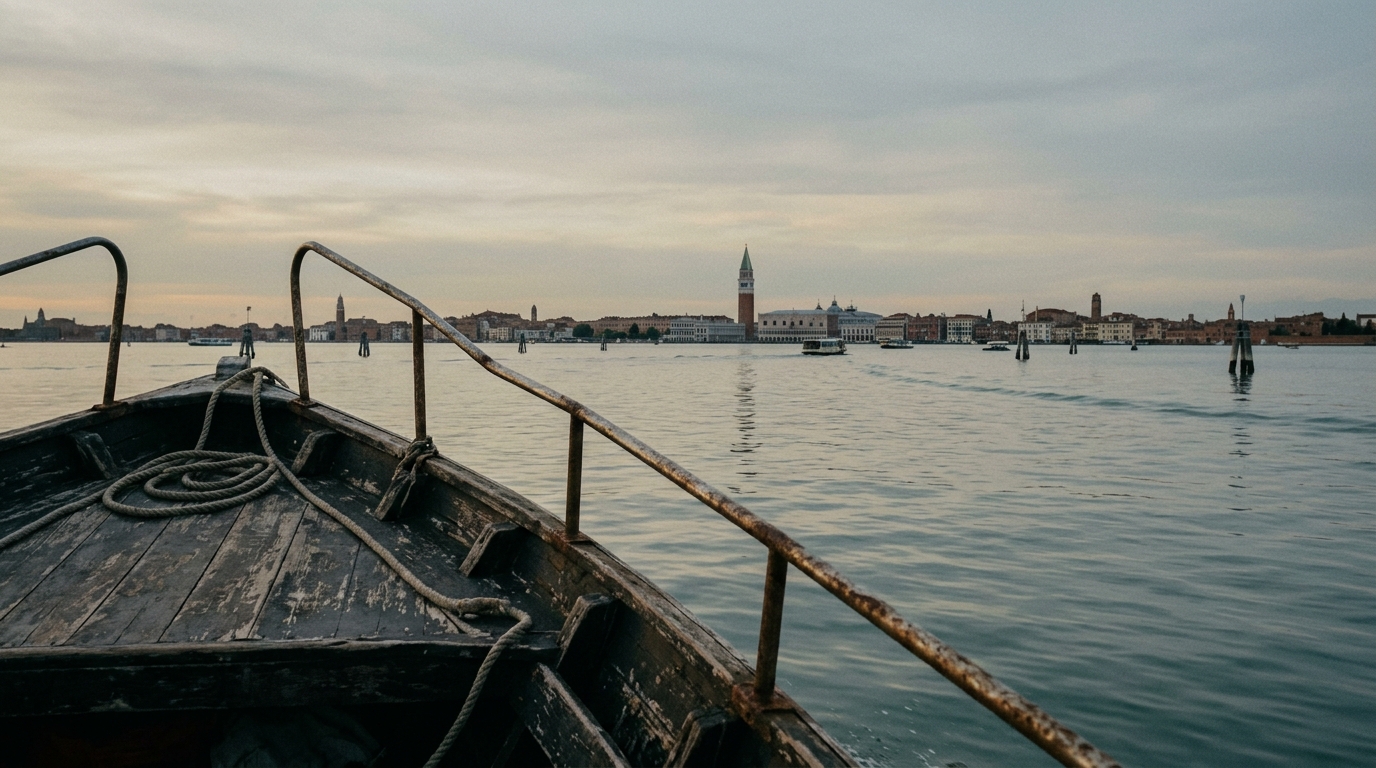
Before the causeway, everybody came to Venice the same way: across the lagoon, at the end of a long day, in a boat. Four arrivals, spread over eighty years, and what is striking is how little the reaction changes. One of them is not impressed at all, which is why he is here.
Now it stood written on my page in the Book of Fate, that on the evening of the 28th of September, by 5 o’clock, German time, I should see Venice for the first time, as I passed from the Brenta into the lagunes. So now, Heaven be praised, Venice is no longer to me a bare and a hollow name, which has so long tormented me.
We reached Venice at eight in the evening, and entered a hearse belonging to the Grand Hotel d’Europe. At any rate, it was more like a hearse than any thing else, though to speak by the card, it was a gondola.
Twain is the corrective every Venice quote list needs. He had read the same romantic descriptions everyone else had, arrived, got into an actual gondola, and reported that it looked like a hearse. He comes round later on the same page, which is the honest arc most first visits follow.
So we advanced into this ghostly city, continuing to hold our course through narrow streets and lanes, all filled and flowing with water.
Dickens wrote his whole Venice chapter as a dream he is not sure he woke from, which is a device, and it works because arriving by boat at night genuinely feels like that. He never names the city in the chapter. He does not need to.
I think it does not matter just when I first came to Venice. Yesterday and to-day are the same here.
Howells was the American consul in Venice for four years, which makes him the one writer on this page who did the unglamorous version: paperwork, winters, and the same canal every morning. The line is a quiet joke about a city that refuses to be dated, and it is also the reason his book is still the best-value read on this list.
The poets on the floating city
Byron lived here. Shelley visited him here. Wordsworth never came at all and wrote one of the best things anybody has written about the place, which tells you something about how Venice works on people who have only imagined it. All three are writing about the same event: the Republic had just ended, after a thousand years, and everyone knew it.
I stood in Venice, on the Bridge of Sighs; / A palace and a prison on each hand: / I saw from out the wave her structures rise / As from the stroke of the enchanter’s wand.
This is the single most repeated sentence about Venice and it is entirely genuine. What it is not is a description of doomed lovers or condemned prisoners, which is what the caption versions imply. See the corrections section below, where Ruskin takes the whole idea apart in one sentence.
Once did She hold the gorgeous east in fee; / And was the safeguard of the west: the worth / Of Venice did not fall below her birth, / Venice, the eldest Child of Liberty.
Wordsworth wrote this without ever seeing Venice, about a republic that had just been handed to Austria. The sonnet closes on a line worth the whole poem: “Men are we, and must grieve when even the Shade / Of that which once was great, is passed away.” If you want one Venice quote that is not about the view, it is that one.
Sun-girt City, thou hast been / Ocean’s child, and then his queen;
Shelley is looking down at Venice from the hills near Padua, not standing in it, which is why the poem gets the shape of the place better than most things written inside it. He wrote it the same year Byron was living there and drafting the Venice canto above.
Ruskin, who loved Venice and refused to be sentimental about it
John Ruskin spent years measuring Venetian stonework by hand and produced three volumes about it. Almost every Venice caption you have ever scrolled past borrows his imagery and drops his argument, which was that the city is a warning, not a mood board. These three lines are the ones worth carrying.
Since the first dominion of men was asserted over the ocean, three thrones, of mark beyond all others, have been set upon its sands: the thrones of Tyre, Venice, and England.
The opening sentence of the book, and it is a threat aimed at Ruskin’s own country. Tyre is gone, Venice is a ruin, and England is next unless it pays attention. Venice, to him, was never a holiday. It was evidence.
we might well doubt, as we watched her faint reflection in the mirage of the lagoon, which was the City, and which the Shadow.
From the same opening page, a few lines on. If you have stood on the Zattere at dusk and lost track of where the buildings stop and the water starts, this is that, written in 1851 by a man who was measuring the buildings for a living.
The Ducal palace of Venice contains the three elements in exactly equal proportions, the Roman, Lombard, and Arab. It is the central building of the world.
A wildly grand claim, made on architectural grounds rather than romantic ones: the Doge’s Palace is where three traditions meet in balance, so it is the hinge of the whole story. Worth knowing before you queue for it, because it changes what you look at.
Short Venice quotes and captions
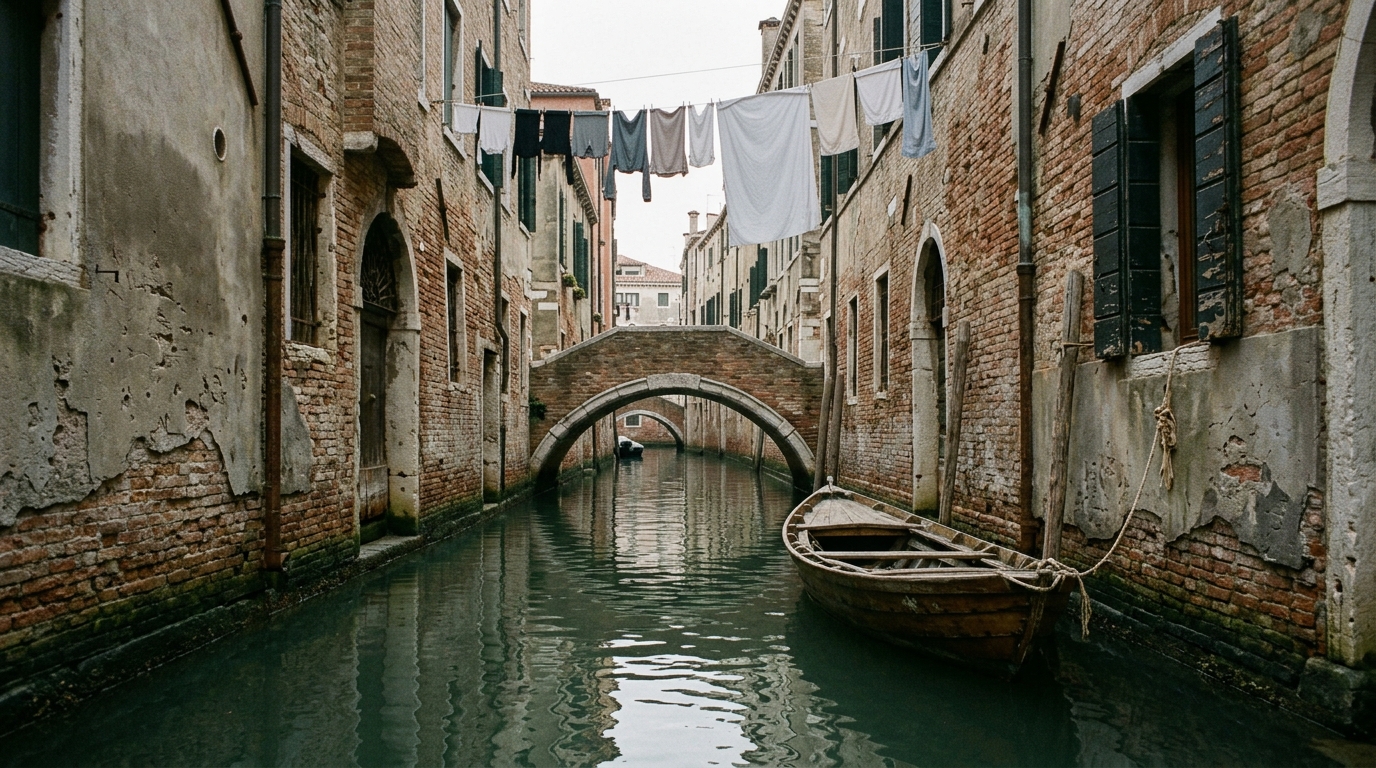
Short enough to sit under a photograph, and old enough that the source is settled rather than asserted. All three are out of copyright, which is exactly why we can show you where they come from instead of asking you to take our word for it.
And when I say beyond the Alps, all I really mean is Venice. If I try to find a new word for music, I can never find any other than Venice.
Wording note, because this one drifts. The version on every quote site is “When I seek another word for music, I never find any other word than Venice”, which is a later translator’s English. The wording above is what the freely available Ludovici translation actually says. Same thought, different hands, and neither is Nietzsche’s German.
In the glare of day, there is little poetry about Venice, but under the charitable moon her stained palaces are white again, their battered sculptures are hidden in shadows, and the old city seems crowned once more with the grandeur that was hers five hundred years ago.
The same chapter as the hearse. Twain arrives, is unimpressed, walks around by daylight, is still unimpressed, and then the light changes. “The charitable moon” is the phrase that earns it: he is admitting the city needs help and giving it anyway.
The glory of the day that broke upon me in this Dream; its freshness, motion, buoyancy; its sparkles of the sun in water; its clear blue sky and rustling air; no waking words can tell.
The morning after the night arrival on card 3. If you only take one caption off this page, take this one, because it is the rare Venice line that is about weather and movement rather than decay.
Venice in literature, and the play that is not the city
Search for Venice quotes and roughly half of what comes back is Shakespeare, which is a search-engine accident rather than a fact about Venice. The Merchant of Venice is a play about money, mercy and a trial. Shakespeare had almost certainly never been to Venice, and the play contains no description of the city worth quoting as a description of the city. The one line everyone wants from it is genuine, and it is about gold, not gondolas.
All that glisters is not gold
Note the verb. It is “glisters”, not “glitters”, in every early text, and the modernised version is the one you will see printed on things. If you came here looking for the play rather than the city, that is the line, and this is the page you can stop reading.
For the city itself in fiction, the two books people mean are Thomas Mann’s Death in Venice (1912) and Joseph Brodsky’s Watermark (1992), which is the finest thing written about Venice in the last fifty years and the source of the “Venice is eternity itself” line that circulates in about four different wordings. Both are in copyright, so we quote neither. Our rule is that a line only runs here if we can show you the source, and for an in-copyright book that means sending you to the book rather than printing a paragraph of it.
The Innocents Abroad (Signet Classics)
Best for: The one book on this page to actually read before Venice, if you would rather be entertained than instructed
Twain’s Venice chapter is quoted twice above, and the whole book is the funniest travel writing of the nineteenth century. Two honest notes before you buy anything. The text is out of copyright and free in full at Project Gutenberg, which is exactly where we checked both quotes on this page. The Signet paperback is worth paying for only if you want a physical copy with an introduction and an afterword, and it is the cheapest reputable edition of a 560-page book we could find.
Check price
The free full text of The Innocents Abroad is at Project Gutenberg. Both Twain quotes above were checked against it this week, and if you only want to read the Venice chapter, it is chapter XXII.
The Venice lines that do not check out
Two corrections, and they fail in opposite directions. One is a real line that almost nobody reads correctly. The other is a joke that is probably not by the man whose name is on it. This is the part of the page we are most careful about, because both of these are printed on things you can buy near San Marco this afternoon.
Streets full of water. Please advise.
The best joke ever made about Venice, and the trail runs cold. Benchley died in 1945. The earliest version anyone has found is David Niven telling the story secondhand in The Saturday Evening Post, reprinted in Reader’s Digest in October 1958, and the wording is already unstable: “STREETS FULL OF WATER. ADVISE” there, “STREETS FLOODED. PLEASE ADVISE” in The Algonquin Wits in 1968. A cable nobody has produced, first reported thirteen years after the sender died, is a good story rather than a sourced quotation.
The Venice of modern fiction and drama is a thing of yesterday, a mere efflorescence of decay, a stage dream which the first ray of daylight must dissipate into dust. No prisoner, whose name is worth remembering, or whose sorrow deserved sympathy, ever crossed that “Bridge of Sighs,” which is the centre of the Byronic ideal of Venice.
Byron’s line on card 5 is real. The romance built on top of it is not. The Bridge of Sighs joined the criminal courts to the criminal prison, so the people who crossed it were, in Ruskin’s blunt phrasing, housebreakers and cut-purses rather than tragic lovers. William Dean Howells, who lived there, called the whole legend “that pathetic swindle” in Venetian Life. Quote Byron happily. Just know what he is standing on.
The Benchley trail was traced by Quote Investigator, which is where the 1958 and 1968 citations above come from. Corrections like these are a standing series here; the full set lives in the travel quote fact-check hub.
Notes on the selection
How these sixteen were chosen. Every line was matched this week against the complete text it comes from, downloaded from Project Gutenberg, rather than copied from another list. Where a book has a chapter, a canto or a line number, it is printed above so you can check us. Fifteen of the sixteen are first-time verifications; the Shakespeare line was already in our verified library from an earlier fact-check.
Cut this week, and why. Truman Capote’s chocolate-liqueurs line about Venice is quoted everywhere and the citation trail leads to a magazine interview we could not reach, so it is not on the page. “There is a glorious city in the sea”, which Twain quotes without naming anyone in the same chapter we used twice, is Samuel Rogers, from Italy, and the only Rogers volume we could reach is his 1814 Poems, which predates it. Both may be perfectly genuine. That is not the same as checked.
How we decide what counts as a source is set out at editorial standards. If the version of Venice you are working towards is the one where you are not counting annual leave, vagabonding is the practical argument and start here is the honest place to begin.
Questions people ask about Venice quotes
What are the most famous quotes about Venice?
Three, in order of how often they are repeated. “I stood in Venice, on the Bridge of Sighs; A palace and a prison on each hand”, Lord Byron, Childe Harold’s Pilgrimage, Canto the Fourth, stanza I, 1818. “In the glare of day, there is little poetry about Venice, but under the charitable moon her stained palaces are white again”, Mark Twain, The Innocents Abroad, 1869, chapter XXII. And “Once did She hold the gorgeous east in fee”, William Wordsworth, on the end of the Venetian Republic, composed 1802.
What is a good caption for Venice?
Two short sourced options, both dated and checkable, which most captions are not. “If I try to find a new word for music, I can never find any other than Venice.” Friedrich Nietzsche, Ecce Homo. Or, if the photograph is a morning one, “its sparkles of the sun in water; its clear blue sky and rustling air; no waking words can tell.” Charles Dickens, Pictures from Italy, 1846. The full run of short lines is in the section above.
Did Robert Benchley really send a telegram saying “streets full of water”?
Probably not, or at least nobody can show it. Benchley died in 1945 and the earliest known telling is David Niven recounting it secondhand in 1958, in The Saturday Evening Post and then Reader’s Digest. The wording changes between tellings, which is what usually happens to an anecdote rather than to a quotation. It is a great line. It is not a sourced one.
Is “Venice is eternity itself” a real Joseph Brodsky quote?
Brodsky wrote Watermark (1992), a short book about Venice in winter, and the sentiment is his. The exact wording circulates in several different forms, which is the signature of a line that has been paraphrased in transit. The book is in copyright, so we do not reproduce lines from it, and we will not print a wording we cannot show you in the source. Read Watermark; it is under a hundred pages and it is the best modern writing on the city.
Are the Merchant of Venice quotes about the actual city?
No, and this is the biggest source of confusion on this search. The Merchant of Venice is a play about a loan and a trial, written by someone who had almost certainly never been to Venice, and it contains no usable description of the place. “All that glisters is not gold” is genuine and is about a gold casket, not the city. Every line on this page other than that one is by a writer describing Venice itself.
Goethe was thirty-seven and had left Weimar in secret to make this trip. The phrase worth sitting with is “no longer to me a bare and a hollow name”: he is describing the moment a place you have only read about stops being a word. Anyone who has saved for a trip for years knows the feeling exactly.