
Paris Quotes: 20 Lines With the Book, the Chapter and the Year
Paris quotes with the work and the year attached, from Hugo and Balzac to Hemingway and Proust, plus the famous lines that Jefferson never wrote and Audrey Hepburn never said.
Search for Paris quotes and page one opens with the same handful of lines every time. One is credited to Thomas Jefferson, who never wrote it as far as anyone can find. One is credited to Audrey Hepburn, and it comes from a film she was not in. A third is the clipped end of a sentence that a friend remembered Hemingway saying, not a line from the body of his book.
This page is the other kind of list. Twenty lines about Paris the city, the river, the streets and the quarters, written by people who lived there or came to look, from a Jefferson letter of 1785 to a film line of 1995. Seventeen were matched this week against the complete text they come from, and the other three rest on sources we name on the card. Where a line has a chapter, a book or a letter, it is printed, so you can check us.
If you want the wider library first, it is at travel quotes. Paris joins Florence and Rome in the city series. This is the city of Paris only; Paris Hilton, the Paris of Romeo and Juliet and the Judgement of Paris belong to other pages.
What are the best Paris quotes? The 60-second answer
If Paris is calling
Most of the writers below learned Paris on foot: Hemingway crossing the Seine to the Left Bank, Proust in the Bois de Boulogne, Twain and Henry James in the galleries of the Louvre. It is still the right way to do it. The tours and tickets below are drawn live from GetYourGuide for Paris. The honest advice this page has earned: walk the islands and the quais at dusk before you pay for a river cruise, and give the Louvre a morning, not an hour.
The Paris quote Thomas Jefferson never wrote
“A walk about Paris will provide lessons in history, beauty, and in the point of Life.” Google’s AI summary gives it to Jefferson, and so do quote sites, posters and travel blogs by the hundred. None of them names a letter, a date or a page.
We looked. Jefferson’s papers are published in full and searchable at Founders Online, run by the US National Archives. A search of everything he wrote returns nothing for “point of life” and nothing for “lessons in history”. The same search for a phrase he really did write from Paris finds its letter at once, so the search works. Monticello, which keeps a list of spurious Jefferson quotations, has not added this one, so we do not claim it has. Our verdict is plain: unsourced, and not in his papers.
Jefferson did write about Paris, at length, in the five years he lived there as the American minister. This is what he actually said, a year after arriving, to his friend Charles Bellini in Virginia.
Behold me at length on the vaunted scene of Europe!
Were I to proceed to tell you how much I enjoy their architecture, sculpture, painting, music, I should want words.
The same letter, a few lines on. This is the real Jefferson on Paris: a hard critic of the society and a man helplessly in love with its art. It is a better line than the one on the posters, and it has the advantage of being his.
Read the whole letter at the Avalon Project, Yale Law School.
Did Audrey Hepburn really say “Paris is always a good idea”?
Not in any film we can find. The line is the most repeated Paris quote on the internet, and almost every copy gives it to Hepburn, because she played Sabrina in Billy Wilder’s 1954 film, where the character comes home changed by a Paris cooking school. The line itself is not in that film’s record. It is in the record of the 1995 remake, directed by Sydney Pollack, where Julia Ormond plays Sabrina.
Paris is always a good idea.
Credited everywhere to Audrey Hepburn, who played Sabrina in 1954. IMDb’s quote record for the 1954 film carries no such line; its record for the 1995 remake does, spoken by Sabrina, played by Julia Ormond. It is screen dialogue written for a character, and the honest attribution is the film. We have not seen a screenplay page, so the card says exactly which record we are relying on.
Three more Paris lines page one gets half right
None of these is a fake. Each is quoted with the name right and the source wrong or missing, and each time the missing piece changes the story.
If you are lucky enough to have lived in Paris as a young man, then wherever you go for the rest of your life, it stays with you, for Paris is a movable feast.
Page one quotes the last four words as if Hemingway wrote them in the book. He did not. The book was published in 1964, three years after his death, and this sentence sits on its title page as an epigraph, credited “to a friend, 1950”. The friend was A. E. Hotchner, who remembered Hemingway saying it and suggested the phrase as the title. The epigraph, as reproduced from the first edition, spells it “movable”, while the title on the cover has the extra e. The book is in copyright, so this is the one line it gets here.
They say that when good Americans die they go to Paris,
Usually given to Lord Henry, the novel’s chief wit. In the text it is Sir Thomas, a dull guest at a lunch party, who says it, and Lord Henry who tops it: asked where bad Americans go, he murmurs “They go to America.” The exchange is also not in the first, 1890 magazine version of the novel at all. It arrived with the expanded 1891 book.
Good Americans, when they die, go to Paris.
Thirty-three years before Dorian Gray, Holmes printed the line in his Boston table-talk book and credited it to “one of the wittiest of men”, without a name. Oxford’s quotation dictionaries name him: Thomas Gold Appleton, a Boston epigrammatist. Wilde did not invent the joke. He gave it to the dullest man at the table, which is a better joke.
One book is worth carrying in a coat pocket in Paris, and it is the source of card 4.
A Moveable Feast (Vintage Classics)
Best for: Walking Hemingway’s Left Bank of the 1920s with his own map in hand
Hemingway’s memoir of his Paris years in the early 1920s, written late in his life and published after his death: the cafes on the Place Saint-Michel, Shakespeare and Company, Gertrude Stein’s apartment, the Luxembourg Gardens on an empty stomach. Short chapters, easy to read one at a time in the place it describes. An honest note before you buy: it is a memoir written thirty years after the events, and some of its portraits of friends are unkind and contested.
Check priceParis on the page: Hugo, Balzac, Henry James and Twain
The nineteenth century wrote Paris as a whole world in one city: a crown, an ocean, a jewel, a second city under the first. These lines are the reason the cliches exist, and they are better than the cliches.
For Paris is a total. Paris is the ceiling of the human race.
Hugo stops the novel for a whole book to study Paris through its street children, and this is where he lands. The next sentence says that whoever sees Paris thinks he sees the bottom of all history. He wrote it in exile on Guernsey, which may be why it reads like a love letter.
Paris has a child, and the forest has a bird; the bird is called the sparrow; the child is called the gamin.
The opening of the same book. The gamin, the Paris street boy, is Hugo’s way into the city, and the character he is introducing is Gavroche, who became the most famous child in French literature.
Paris has beneath it another Paris; a Paris of sewers; which has its streets, its crossroads, its squares, its blind-alleys, its arteries, and its circulation
The start of Hugo’s long study of the sewers, written so the reader understands the route Jean Valjean is about to take underground.
Paris is in truth an ocean that no line can plumb.
Balzac is describing the shabby boarding house in the Latin Quarter where the novel is set, and the faces nobody in fashionable Paris notices. The sentence goes on: you may survey the surface and describe it, but there will always be unexplored places in its depths. He spent a career trying to chart them anyway.
the vast bright Babylon, like some huge iridescent object, a jewel brilliant and hard, in which parts were not to be discriminated nor differences comfortably marked
Lambert Strether, a middle-aged American sent to Paris to bring a young man home, looks at the city one morning and is afraid of liking it too much. The whole novel is that fear coming true.
On a brilliant day in May, in the year 1868, a gentleman was reclining at his ease on the great circular divan which at that period occupied the centre of the Salon Carré, in the Museum of the Louvre.
The first sentence of the novel. The gentleman is Christopher Newman, a rich American with a headache from looking at too many paintings, and James sets him down in the middle of the most famous room in the most famous museum in the city. The divan is gone. The Salon Carré is still there.
Live all you can; it’s a mistake not to.
Strether again, at a garden party in Paris, telling the young man little Bilham not to waste his youth the way he wasted his own. James wrote in his preface that this speech holds the essence of the whole book. It is the best travel advice on the page, and it was said in a Paris garden.
The guides deceive and defraud every American who goes to Paris for the first time and sees its sights alone or in company with others as little experienced as himself.
Twain’s first visit, in 1867, with a group of American tourists and a guide who spent a day steering them into silk shops instead of the Louvre. The chapter is a comic revenge on him. The warning has not aged at all.
The Left Bank: Hemingway and Proust
Two writers who knew the city from the inside, a generation apart. Hemingway’s Paris is the Left Bank of the 1920s, cafes and bridges. Proust’s is the Bois de Boulogne of his childhood, and the discovery that you cannot go back to it.
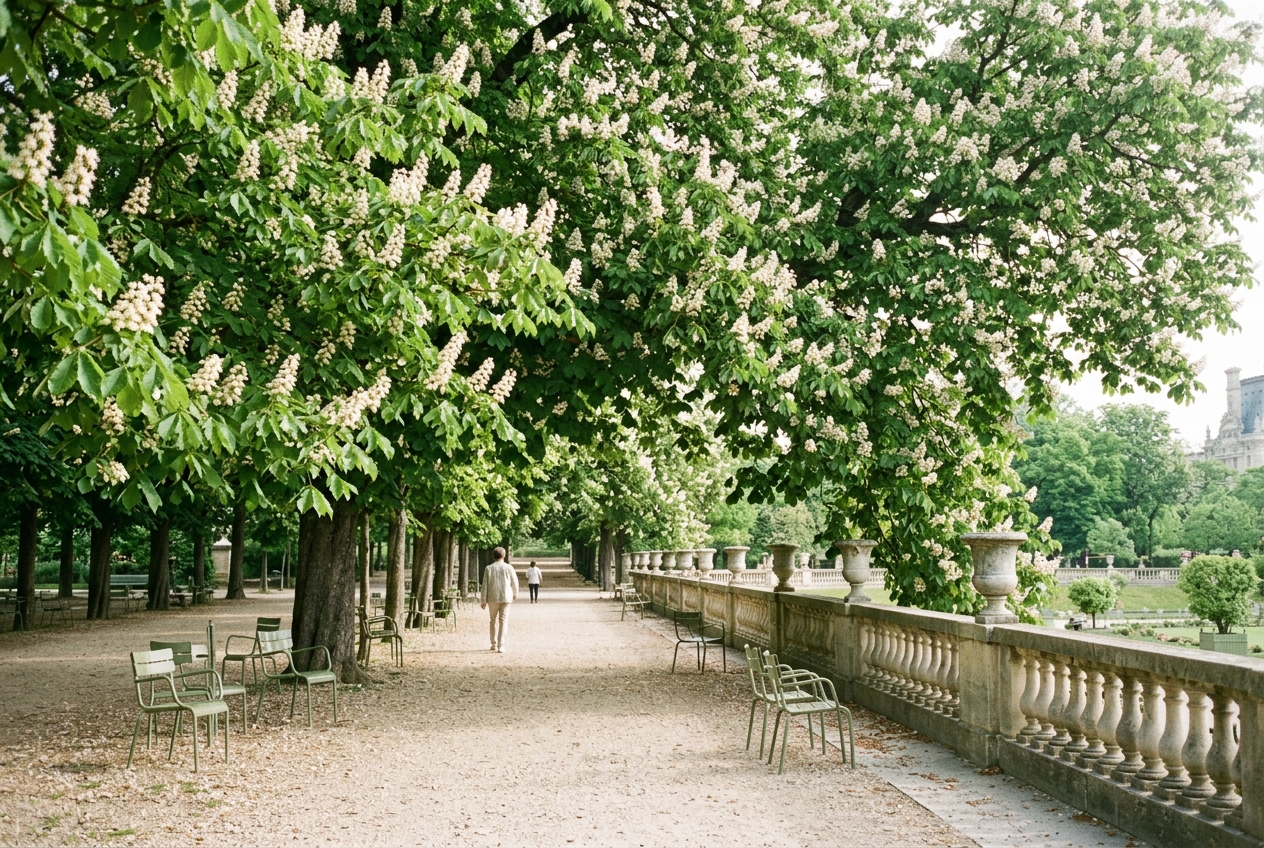
The horse-chestnut trees in the Luxembourg gardens were in bloom.
Jake Barnes walking down the Boulevard to the rue Soufflot for coffee and brioche on a fine morning. Nothing happens in the paragraph, which is the point: it is the most exact description in the book of an ordinary good morning in Paris. The novel has been in the US public domain since 2022.
“It’s pretty grand,” Bill said. “God, I love to get back.”
Jake and Bill have walked round the Île Saint-Louis at night and stopped on the wooden footbridge from the Quai de Béthune to look down the river at Notre Dame. Bill is just back in Paris. Anyone who has returned to Paris knows the feeling.
The places that we have known belong now only to the little world of space on which we map them for our own convenience.
The narrator goes back to the Bois de Boulogne as a grown man, hoping to see it as he saw it as a boy, and finds the avenues and the women in them changed. This is where Proust ends the first volume of his novel.
remembrance of a particular form is but regret for a particular moment; and houses, roads, avenues are as fugitive, alas, as the years.
The last words of the volume. Scott Moncrieff’s word is “fugitive”. It is the truest thing on this page about going back to a city you loved when you were young, and it was written about a Paris park.
Short Paris quotes
Short enough for a caption, with the author and the work attached, because a caption is still a quotation. Add card 6 (Holmes), card 13 (Henry James) and card 15 (Hemingway) to these two and you have five.
lo, we stood in magnificent Paris!
The end of a long day on a French train, the travellers half persuaded they are dreaming. Six words, and for once no joke.
America is my country and Paris is my hometown.
Stein lived in Paris from 1903 until her death in 1946, at 27 rue de Fleurus for most of it, and ran the most famous salon of the century there. The essay is in copyright, so it gets this one line, which is how it begins.
Source for card 20: the American Writers Museum. The free full text of The Innocents Abroad is at Project Gutenberg.
Paris has more songs than most cities have poems. We do not reproduce lyrics, so none of them is here.
The Louvre, the Seine and the Left Bank: lines with an address
Most of these lines are tied to a place you can still stand in. Here is where each is set, which doubles as a rough walking list.
Where the Paris lines are set
| Place | Writer and year | What the line is about |
|---|---|---|
| The Louvre | Henry James 1877, Mark Twain 1869 | Newman on the divan in the Salon Carré, and Twain’s guide steering the party anywhere but the galleries |
| The Seine and the Île Saint-Louis | Ernest Hemingway 1926 | The night walk round the island and the view of Notre Dame from the footbridge |
| The Latin Quarter and the Luxembourg | Balzac 1835, Hemingway 1926 | The boarding house of Father Goriot, and chestnut trees in bloom on the way to the rue Soufflot |
| The Bois de Boulogne | Marcel Proust, Swann’s Way | The park of his childhood, and the discovery that places are as fugitive as the years |
Montmartre is missing because none of the lines we could verify are set there. If you know a sourced one, the fact-check hub below is where to send it.
Notes on the selection
How these twenty were chosen. Seventeen lines were matched this week against the complete text they come from, downloaded from Project Gutenberg or, for Jefferson, read in the Avalon Project’s transcription of the letter, rather than copied from another list. Where a work has a chapter, a book or a date, it is printed so you can check us. Three lines rest on credible secondary sources, and those cards say so: the 1995 Sabrina (IMDb’s quote record), Hemingway’s epigraph (the published record of the 1964 first edition) and Gertrude Stein (the American Writers Museum).
Cut, and why. The brief for this page asked for twenty-six. It has twenty, because that is what checked out. André Gide, Victor Hugo’s poems, Henry Miller and T. S. Eliot are left out because we could not fix a public text or a page to hang their Paris lines on. Hugo’s famous line about sauntering being Parisian checked out perfectly and is left out anyway, because it already runs on our France page and we do not repeat lines across pages; the same goes for two of Hemingway’s and three of Twain’s. The “walk about Paris” line is printed only inside the Jefferson verdict, never as a card, because we could not find that he wrote it.
How we decide what counts as a source is set out at editorial standards, and the corrections live in the travel quote fact-check hub. If the Paris you are working towards is the one where you are not counting annual leave, vagabonding is the practical argument and start here is the honest place to begin.
Questions people ask about Paris quotes
Did Thomas Jefferson say “a walk about Paris will provide lessons in history, beauty, and in the point of Life”?
Not as far as anyone can show. A search of Jefferson’s complete published papers on Founders Online returns nothing for the line, and no quote site that uses it names a letter or a date. What Jefferson did write from Paris, to Charles Bellini on 30 September 1785, includes: “Were I to proceed to tell you how much I enjoy their architecture, sculpture, painting, music, I should want words.”
Who actually said “Paris is always a good idea”?
The character Sabrina, in the 1995 film Sabrina directed by Sydney Pollack, where she is played by Julia Ormond. It is usually credited to Audrey Hepburn, who played Sabrina in the 1954 original, but the line is not in the record of that film.
Where is “Paris is a moveable feast” from?
The epigraph on the title page of Ernest Hemingway’s A Moveable Feast, published in 1964 after his death: “If you are lucky enough to have lived in Paris as a young man, then wherever you go for the rest of your life, it stays with you, for Paris is a movable feast.” It is credited “to a friend, 1950”, the friend being A. E. Hotchner, who remembered Hemingway saying it.
What is a good short Paris caption?
Three short sourced options: “Paris is the ceiling of the human race.” (Victor Hugo, Les Misérables, 1862), “Live all you can; it’s a mistake not to.” (Henry James, The Ambassadors, 1903), and “America is my country and Paris is my hometown.” (Gertrude Stein, 1936).
The next sentence calls himself “a savage of the mountains of America”, and most of the letter is not kind to the place: he finds the condition of the poor deplorable and the manners of the great worse. Then he turns, and the turn is card 2.