
T.S. Eliot: The Poet of Arriving Where You Started
The American who became more English than the English, the poet behind the most-cited travel line in modern literature, and the small stack of his books worth owning before your next trip.
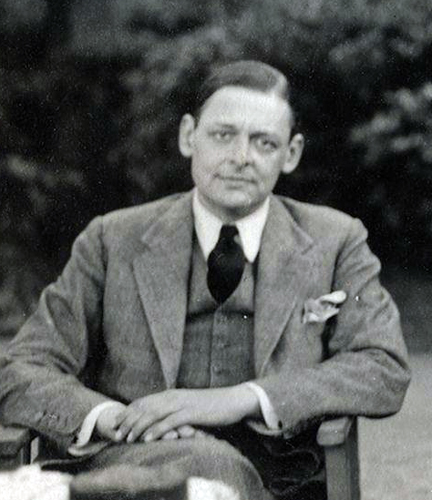
Eliot is the poet of arriving where you started. Of all the lines he gave the English language, “we shall not cease from exploration” is the one travellers keep coming back to, because it answers a question travel keeps asking. Not where am I going. Where will I be when I get home.
This page is the working bio: the American who became more English than the English, the poet behind the most-cited travel line in modern literature, and the small stack of his books worth owning before your next trip. Every quote here cites the primary edition. Where attribution drifts, we say so.
Early Life and Roots
Thomas Stearns Eliot was born in St. Louis, Missouri on 26 September 1888, the seventh and youngest child of Henry Ware Eliot, a brick-manufacturing businessman, and Charlotte Champe Stearns, a teacher and amateur poet. The Eliots were old New England stock; the family kept a summer house at Gloucester, Massachusetts, where Tom learned to sail and watched the Atlantic do what only the Atlantic can do to a young writer’s sense of scale.
He went to Harvard (1906-1909), the Sorbonne (1910-1911), and back to Harvard for philosophy doctoral work. In 1914 he sailed for Marburg, Germany on a Sheldon travelling fellowship. The war redirected him to Oxford, then to London, and London held him for the rest of his life. He took British citizenship in 1927. The American who became, as Virginia Woolf put it, “more English than the English” did so by deliberate act, not by drift. Lyndall Gordon’s two-volume biography, later combined into T.S. Eliot: An Imperfect Life, is the primary scholarly source for these years.
Career Milestones and Literary Travel
Prufrock and Other Observations appeared in 1917, the year Eliot took a clerk’s job at Lloyds Bank in the City of London. The job paid the rent while the poems built a reputation. The Waste Land followed in 1922, the modernist landmark that fractured English-language poetry along a new fault line. He joined Faber and Gwyer (later Faber and Faber) as a director in 1925, the editorial chair he held for the rest of his working life. Old Possum’s Book of Practical Cats arrived in 1939 as light verse for friends’ children and ended up, half a century later, the source text for Andrew Lloyd Webber’s Cats.
The poem most travellers care about is the last he completed in his lifetime: Four Quartets, written between 1936 and 1942, published as a single volume in 1943. Each of the four sections is named for a place: Burnt Norton (a Gloucestershire manor garden), East Coker (the Somerset village his ancestors had left for America in 1669), The Dry Salvages (a small group of rocks off Cape Ann, Massachusetts, where he had sailed as a boy), and Little Gidding (the Huntingdonshire chapel where the 17th-century Anglican community of Nicholas Ferrar had practiced contemplative prayer). The four are a deliberate map of his lives, set down in the order he had to walk back through them. The exploration line, on which his entire travel reputation now rests, sits in the last movement of ‘Little Gidding’.
Eliot was awarded the Nobel Prize in Literature in 1948 and the Order of Merit the same year, citations rare enough that holding both is its own small landmark. He died in London on 4 January 1965. His ashes are interred at East Coker, the village he had imagined himself returning to in the second Quartet.

T.S. Eliot’s Best Books, Poems, and Recommended Reading
1. Four Quartets: A Poem
Best for: Travellers who want the book that holds the exploration line
The single book most travellers should own. Four meditations on place, time, and return, including the ‘Little Gidding’ passage that holds the exploration line. Mariner Classics paperback.
Check Price on Amazon →2. The Waste Land and Other Poems
Best for: Readers who want the 1922 poem that rebuilt English verse
The 1922 modernist landmark that broke and rebuilt English-language poetry. Read it for the Phoenician sailor passage and the ‘Unreal City’ of post-war London. Vintage Classics paperback.
Check Price on Amazon →3. Old Possum's Book of Practical Cats
Best for: Readers who want the warm, playful Eliot
The 1939 light verse that became Cats. The lightest, warmest Eliot, and a reminder that the same hand that wrote The Waste Land could also write Macavity the Mystery Cat. Faber Children’s Classics edition.
Check Price on Amazon →4. Selected Essays 1917-1932
Best for: Readers who want the essays that taught a generation to read
Eliot the critic. ‘Tradition and the Individual Talent’ and ‘The Metaphysical Poets’ are the essays that taught a generation how to read. The Harcourt print is out of print; this is the in-print Kindle edition.
Check Price on Amazon →5. T.S. Eliot: An Imperfect Life
Best for: Readers who want the standard scholarly life
Lyndall Gordon’s two-volume Eliot biography, combined into one paperback. The standard scholarly life, used by every Eliot bio that came after. Norton paperback.
Check Price on Amazon →T.S. Eliot’s Travel Philosophy in His Own Words
Eliot’s travel philosophy is not a philosophy of going. It is a philosophy of returning. The journey is real, but the arrival is what does the work, and the arrival only does the work if you can finally see the place you started from. He says it in the closing passage of ‘Little Gidding’, the last movement of the last Quartet, the closest thing in modern English poetry to a thesis statement on travel:
We shall not cease from exploration, and the end of all our exploring will be to arrive where we started and know the place for the first time.
— T.S. Eliot Four Quartets, 'Little Gidding' V (1942) Verified primary source: Faber and Faber 1944 first complete edition
The hardest part of the line is the second half. The exploration is given. The arrival is given. The hard part is the knowing, and Eliot’s claim is that you cannot know the place you started from until you have left and come back. The opening of ‘Burnt Norton’ sets the frame the rest of the sequence elaborates:
Time present and time past are both perhaps present in time future, and time future contained in time past.
— T.S. Eliot Four Quartets, 'Burnt Norton' I (1936), opening lines Verified primary source: Faber and Faber 1944 first complete edition
The lesson for travellers, if Eliot will let us call it that, is that the trip is not finished when the plane lands at the start of it. It is finished when you have come home and finally understood what you left.
Memorable T.S. Eliot Quotes by Theme
On Beginnings and Endings
In my beginning is my end.
— T.S. Eliot Four Quartets, 'East Coker' I (1940), opening line Verified primary source: Faber and Faber 1944 first complete edition
- “In my end is my beginning.” Four Quartets, ‘East Coker’ V, closing line
- “Home is where one starts from. As we grow older the world becomes stranger, the pattern more complicated of dead and living.” Four Quartets, ‘East Coker’ V
- “The end is where we start from.” Four Quartets, ‘Little Gidding’ V
On Time and the Present Moment
Eliot on time is Eliot at his most philosophical. The traveller’s version: the place you are visiting today is also the place you visited as a younger person, and the place you will be remembering on the way home.
- “Only through time time is conquered.” Four Quartets, ‘Burnt Norton’ II
- “At the still point of the turning world.” Four Quartets, ‘Burnt Norton’ II
- “What we call the beginning is often the end / And to make an end is to make a beginning.” Four Quartets, ‘Little Gidding’ V
On Daring to Go Too Far (Contested)
One frequently attributed Eliot line on risk and travel sits in the borderline-attribution zone. We include it because it appears on the cited authority pages, and we flag it because its primary-source location in Eliot’s published work is contested.
- “Only those who will risk going too far can possibly find out how far one can go.” Widely attributed to T.S. Eliot. Source contested; the primary-source citation does not survive a Quote Investigator audit. Use with care.
- “If you aren’t in over your head, how do you know how tall you are?” Often attributed; primary source not confirmed in Eliot’s published work.
Other Voices in Classic Literature
If Eliot’s “we shall not cease from exploration” speaks to you, these adjacent voices belong on the same shelf:
Frequently Asked Questions about T.S. Eliot
What is T.S. Eliot's most famous travel quote?
It is the line that closes Little Gidding, the last of the Four Quartets, published 1942: we shall not cease from exploration, and the end of all our exploring will be to arrive where we started and know the place for the first time.
What did T.S. Eliot mean by we shall not cease from exploration?
The line is not about travel as escape. It is about travel as return. Eliot’s claim is that we have to keep moving, but the meaning of the moving only arrives once we have come back to where we began and finally seen it for what it is. The trip ends not when you land, but when you finally understand home.
Where can I read the full Little Gidding poem?
The standard reading edition is Faber and Faber’s Four Quartets, with Mariner Classics publishing the US trade edition. Eliot’s work remains in copyright (US until 2060, UK until 2035), so there is no free public-domain edition. The book links in the section above go straight to it.
What was T.S. Eliot's inspirational quote?
Beyond the exploration line, the Eliot lines most cited as inspirational are in my beginning is my end (and its mirror in my end is my beginning) from East Coker, and the end is where we start from from Little Gidding. All three come from Four Quartets.
Did T.S. Eliot travel much in real life?
His travel was almost entirely transatlantic and English: born in St. Louis, summers in Gloucester Massachusetts, Harvard, a year at the Sorbonne, a Sheldon fellowship to Marburg cut short by the war, then Oxford and London for the rest of his life. His travel writing is the writing of a man who left one country for another and spent a lifetime working out what that meant.
How can I read more T.S. Eliot?
Start with Four Quartets, the most accessible of his major poems and the one that holds the travel canon. Move to The Waste Land and Other Poems for the 1922 landmark. For the life behind the work, Lyndall Gordon’s T.S. Eliot: An Imperfect Life is the standard biography. They are all linked in the books section above.
T.S. Eliot’s Lasting Legacy for Travellers
Eliot’s gift to travellers is permission to come home and finally see it. He does not romanticise the trip and he does not dismiss it. He insists that the trip is half the work, and the other half is the slow business of arriving back where you started and recognising the place. If you want one book to take with you and read on the flight home, take Four Quartets.
More Classic Literature Quote Collections
If you came for Eliot, you will find the rest of the conversation here: