
Freya Stark: Travel Quotes, the Original Solo Travel Line, and the Quotes That Float Free of Her Books
Verified Freya Stark travel quotes with real book sources: the original solo travel line from Baghdad Sketches, the travel versus tourism distinction in her own words, the famous favourites that float free of any book flagged honestly, and the editions worth owning.
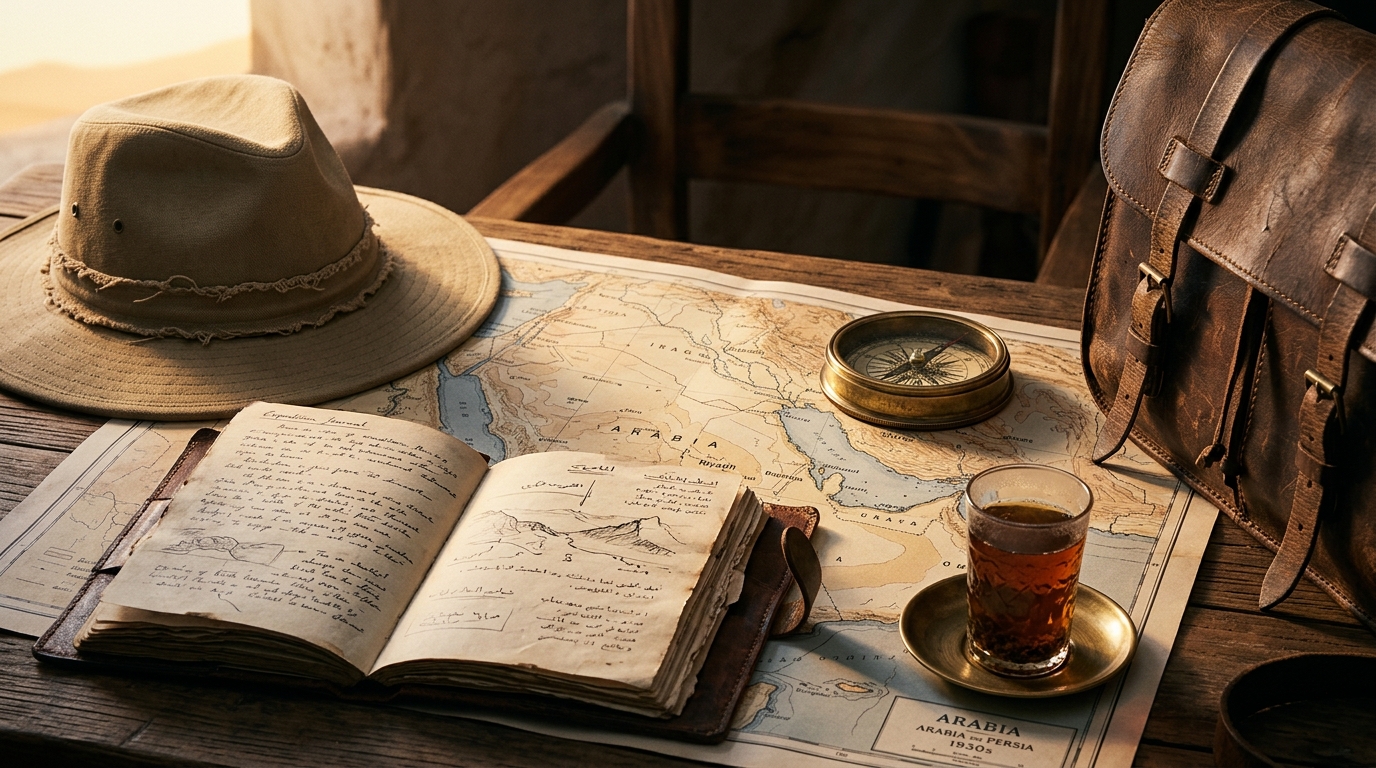
Search for Freya Stark travel quotes and two kinds of lines come back. The first kind has receipts. “To awaken quite alone in a strange town is one of the pleasantest sensations in the world.” She published that in Baghdad Sketches in 1932, nine decades before solo travel needed a patron saint, and it remains the most quotable defence of travelling alone ever written. The second kind floats free. “Curiosity is the one thing invincible in Nature” and the lovely line about gathering good days like grapes appear on every quote site under her name, and not one of the major aggregators cites a book or a page for either. Dame Freya Madeline Stark earned better sourcing than that. Born in Paris in 1893 and raised between Italy and England, she did not reach the Middle East until she was 35, then spent the next half century out-travelling everyone: the first Western woman through the Hadhramaut, the mapper of the Valleys of the Assassins, a Dame of the British Empire, dead at 100 in her beloved Asolo. This page sorts the verified Stark lines from the floating ones, cites the real quotes to a book, flags the unsourced favourites honestly, and lists the editions worth owning.
Early Life: A Childhood Between Countries and a Late Door Out
Freya Madeline Stark was born in Paris on 31 January 1893 to artist parents, and grew up moved about between Asolo in northern Italy and Dartmoor in England. She had no formal schooling as a child, but the constant movement gave her French, German and Italian before she ever entered the University of London in 1912. (britannica.com) The defining accident of her girlhood happened at thirteen, in an Italian carpet factory, when her hair caught in a machine and tore part of her scalp away. She wore her hair pinned over the scarring, and biographers have read much of her later fearlessness into that early disfigurement: the sense that the conventional prizes of Edwardian womanhood had been taken off the table, so the world might as well be claimed instead.
The door out opened slowly. She nursed in Italy through the First World War, then returned to London and the School of Oriental Studies to learn Arabic, a decision that baffled almost everyone around her. (britannica.com) In the autumn of 1928, aged 35, she finally sailed east. She would spend most of the next four years in Iraq and Persia, at one point living in a Baghdad slum on less than a pound a day, studying the Quran and befriending the neighbours while the British colonial set looked on appalled. Most travel writers start young. Stark started late, and never stopped.
Career Milestones: The Late Starter Who Out-Travelled Everyone
Her breakthrough came in 1934 with The Valleys of the Assassins, the account of her journeys into Luristan and the Alamut valleys of Persia, often with a single guide and a donkey, hunting the mountain strongholds of the medieval Assassin cult that Marco Polo had described. She charted the first accurate Western maps of the region and handed them to the Royal Geographical Society, which would later award her its Founder’s Gold Medal. (Wikipedia) Two years later The Southern Gates of Arabia (1936) recorded her attempt on the lost incense city of Shabwa, the journey that made her the first Western woman to travel through the Hadhramaut, in what is now Yemen.
The Second World War turned the traveller into an operator. She worked for the British Ministry of Information in Aden, Baghdad and Cairo, where she founded the Brotherhood of Freedom, an anti-Nazi network run through tea parties and conversation rather than guns. (britannica.com) After the war the books kept coming, more than two dozen in all, from the Turkey of Ionia and The Lycian Shore to the autobiographies and the essay collection Perseus in the Wind. She was appointed Dame Commander of the Order of the British Empire in 1972, kept travelling into her nineties, and died at Asolo on 9 May 1993, one hundred years old.
Freya Stark’s Best Books for Travellers, with Receipts
1. The Valleys of the Assassins: and Other Persian Travels (Modern Library)
Best for: Readers who want the book that made her name, and the home of her driest famous line
Her 1934 classic: Luristan and the Alamut valleys by donkey, bandit country crossed on charm and grammar-book Persian, and the first accurate Western maps of the Assassin strongholds. It is also the source of her much-shared line about the comfort of being underestimated as a woman. The Modern Library paperback, with an introduction by her biographer Jane Fletcher Geniesse, is the standard reading copy. Sit with this one first.
Check Price on Amazon →
2. The Southern Gates of Arabia: A Journey in the Hadhramaut
Best for: Anyone who wants the journey that made her the first Western woman through the Hadhramaut
Her 1936 account of chasing the lost incense city of Shabwa through southern Arabia, travelling the frankincense routes by camel and falling dangerously ill before the goal. She missed the city and wrote a better book for it. This is Stark the pioneer, moving alone through country almost no European had seen, with the grace and patience that made closed doors open. The Kindle edition is the easy way to carry it.
Check Price on Amazon →
3. Baghdad Sketches (Marlboro Travel)
Best for: Travellers who want the book where the original solo travel quote actually lives
The 1932 essay collection from her first years in Iraq, where the famous line about awakening quite alone in a strange town appears in its real context: a thirty-something Englishwoman living in a Baghdad slum because the company was better. These sketches are the sharpest, funniest Stark, written before fame smoothed anything. A niche Marlboro Press reissue with a small review count, named here honestly, and worth hunting down anyway.
Check Price on Amazon →
4. Perseus in the Wind: A Life of Travel
Best for: Readers who want the woman behind the traveller, one essay theme at a time
Written just after the Second World War and named for a constellation, this is the most personal of her books: essays on happiness, beauty, memory, education and death, each lit by a lifetime of moving through other people’s worlds. If the travel books show you where she went, Perseus in the Wind shows you why. The 2020 Tauris Parke reissue is a modest-review-count edition of a genuinely loved book, and the one to give as a gift.
Check Price on Amazon →
5. A Winter in Arabia: A Journey Through Yemen
Best for: Readers ready for the return journey, an archaeological dig and a war of personalities
Her 1940 account of returning to the Hadhramaut with an archaeological expedition, where the dig politics proved rougher than the desert. It completes the southern Arabia story begun in The Southern Gates and shows Stark at her most patient and most quietly ruthless. Another niche reissue with a small review count, included because the journey matters, not because the algorithm loves it.
Check Price on Amazon →
An honest note from our editors: Stark is a niche-reissue author these days, so apart from the two Modern Library staples her editions carry modest review counts, and we have said so on each card rather than pretend otherwise. If you want the life as well as the journeys, Jane Fletcher Geniesse’s biography Passionate Nomad: The Life of Freya Stark is the fullest single account, named here in prose because it is a book about her rather than by her.
Freya Stark’s Travel Philosophy in Her Own Words
Stark’s whole theory of travel fits inside one distinction she made late in life: “One can only really travel if one lets oneself go and takes what every place brings without trying to turn it into a healthy private pattern of one’s own, and I suppose that is the difference between travel and tourism.” The tourist imports a routine and defends it abroad. The traveller surrenders the routine at the border. Everything she did reads as that sentence in practice: learning Arabic before she ever sailed, choosing the Baghdad slum over the colonial club, taking the guide’s pace and the village’s hospitality as they came, and writing it all down with the dry affection of someone who expected people to be interesting and was rarely disappointed.

The deeper layer is the solitude. The line about awakening quite alone in a strange town is usually shared as a pretty sentiment, but Stark meant it as a method. Alone, you are approachable, adaptable and awake; accompanied, you are a closed system moving through scenery. Writers who walked the same road later, from Cheryl Strayed to Elizabeth Gilbert, inherited an idea she had already tested in the 1930s with far higher stakes: that a woman alone on the road is not a problem to be managed but a person becoming larger. She would have recognised Ibn Battuta as family too, another believer that the road itself is the teacher.
Memorable Freya Stark Quotes by Theme
The Original Solo Travel Quote
To awaken quite alone in a strange town is one of the pleasantest sensations in the world.
— Freya Stark Baghdad Sketches (1932) The line every solo travel listicle reaches for, and one of the rare famous travel quotes with a clean source. Stark published it in her Baghdad essays at a time when a woman alone in Iraq was a scandal on two continents. Ninety years of solo travel writing descends from this sentence.
Travel Versus Tourism
One can only really travel if one lets oneself go and takes what every place brings without trying to turn it into a healthy private pattern of one's own, and I suppose that is the difference between travel and tourism.
— Freya Stark Cited in Molly Izzard, A Marvellous Eye (Cornucopia, Issue 2) Her clearest statement of method, recorded by an interviewer late in her life and preserved in Wikiquote's sourced section. The tourist defends a routine abroad; the traveller lets the place set the terms.
Believing and Doing
There can be no happiness if the things we believe in are different from the things we do.
— Freya Stark The Journey's Echo (1963), p. 161 From the anthology of her own writings she selected herself, page-cited via Wikiquote. It is the quiet engine of her biography: she believed the world was worth seeing on its own terms, so that is what she did, for seventy years.
The Driest Line She Ever Wrote
The great and almost only comfort about being a woman is that one can always pretend to be more stupid than one is and no one is surprised.
— Freya Stark The Valleys of the Assassins (1934) Stark weaponising the condescension of her era. Officials who underestimated the small Englishwoman with the donkey kept granting her permissions no one else could get, and she wrote the joke down on her way through bandit country.
The Lines That Float Free of Her Books
Curiosity is the one thing invincible in Nature.
— Popularly attributed to Freya Stark, book source unconfirmed No book or page citation on any major quote aggregator Shared everywhere under her name, including BrainyQuote and AZQuotes, but none of the aggregators ties it to a book, a page or a letter. It sounds like her and it may well be her, somewhere in two dozen books and eight volumes of letters, but until someone produces the page we list it as attributed rather than verified.
Good days are to be gathered like grapes, to be trodden and bottled into wine and kept for age to sip at ease beside the fire.
— Popularly attributed to Freya Stark, book source unconfirmed No book or page citation on any major quote aggregator The most beautiful of the floating Stark lines, complete with a second sentence about the traveller who has vintaged well. Every aggregator carries it; not one cites a source. Treat the wording as decoration until a page citation surfaces, and enjoy the verified lines above with a clear conscience.
A sourcing note, because this page exists to be the accurate one and our editorial standards ask for receipts: the verified lines above are tied to Baghdad Sketches, The Valleys of the Assassins, The Journey’s Echo with a page number, and a documented interview citation, cross-checked against Wikiquote’s sourced section. The two floating lines are flagged because the big aggregators carry them without any book citation at all, and with Stark that distinction matters: she wrote so much quotable prose that nobody needed to invent more. More on how we verify lives is on our about us page.
For the full canon in context, browse the 100 best travel quotes mega-pillar, where Stark’s awakening-alone line anchors the solo travel end of the collection.
Other Voices in Solo Travel
Frequently Asked Questions about Freya Stark
What is the most famous Freya Stark travel quote?
‘To awaken quite alone in a strange town is one of the pleasantest sensations in the world,’ from Baghdad Sketches (1932). It is the original solo travel quote, and unlike most quote-page staples it has a verifiable source in her own book.
Did Freya Stark really say 'Curiosity is the one thing invincible in Nature'?
It is attributed to her on every major quote site, but none of them cites a book, page or letter. It may be genuine somewhere in her large body of work, but until a source surfaces it should be treated as attributed rather than verified.
Was Freya Stark really a solo traveller?
Emphatically. She sailed for the Middle East alone in 1928 at age 35, lived in a Baghdad neighbourhood on less than a pound a day, crossed bandit country in Persia with a single local guide, and became the first Western woman to travel through the Hadhramaut in southern Arabia.
Which Freya Stark book should a traveller read first?
The Valleys of the Assassins (1934). It is the book that made her name, the easiest edition to find, and the best introduction to her mix of hard travel, history and dry wit. Read Baghdad Sketches next for the famous solo travel line in its real context.
What honours did Freya Stark receive?
She received the Founder’s Gold Medal of the Royal Geographical Society for her explorations and was appointed Dame Commander of the Order of the British Empire in 1972. She died in Asolo, Italy in 1993, aged 100.
Freya Stark’s Lasting Legacy for Travellers
Stark’s gift to travellers is permission with a method attached. She proved that the road does not care when you start: she was 35 when she first sailed east and a hundred when she died, still in love with the horizon. She proved that preparation is a form of respect, learning Arabic before asking anything of Arabia. And she proved that solitude is not the price of travel but the instrument of it, the thing that leaves you open enough for a strange town to walk in. So check the sourcing when a pretty line wears her name, start with the books that hold the verified sentences, and take the woman’s actual advice: let yourself go, and take what every place brings. More sourced voices are waiting in our author bio library.
