
Aldous Huxley: Travel Quotes, the Restless Tourist Who Mocked Tourists, and the Lines He Actually Wrote
Verified Aldous Huxley travel quotes labelled as what they actually are: real passages from Along the Road and Jesting Pilate with sources, the famous fakes flagged honestly, and the editions worth owning.
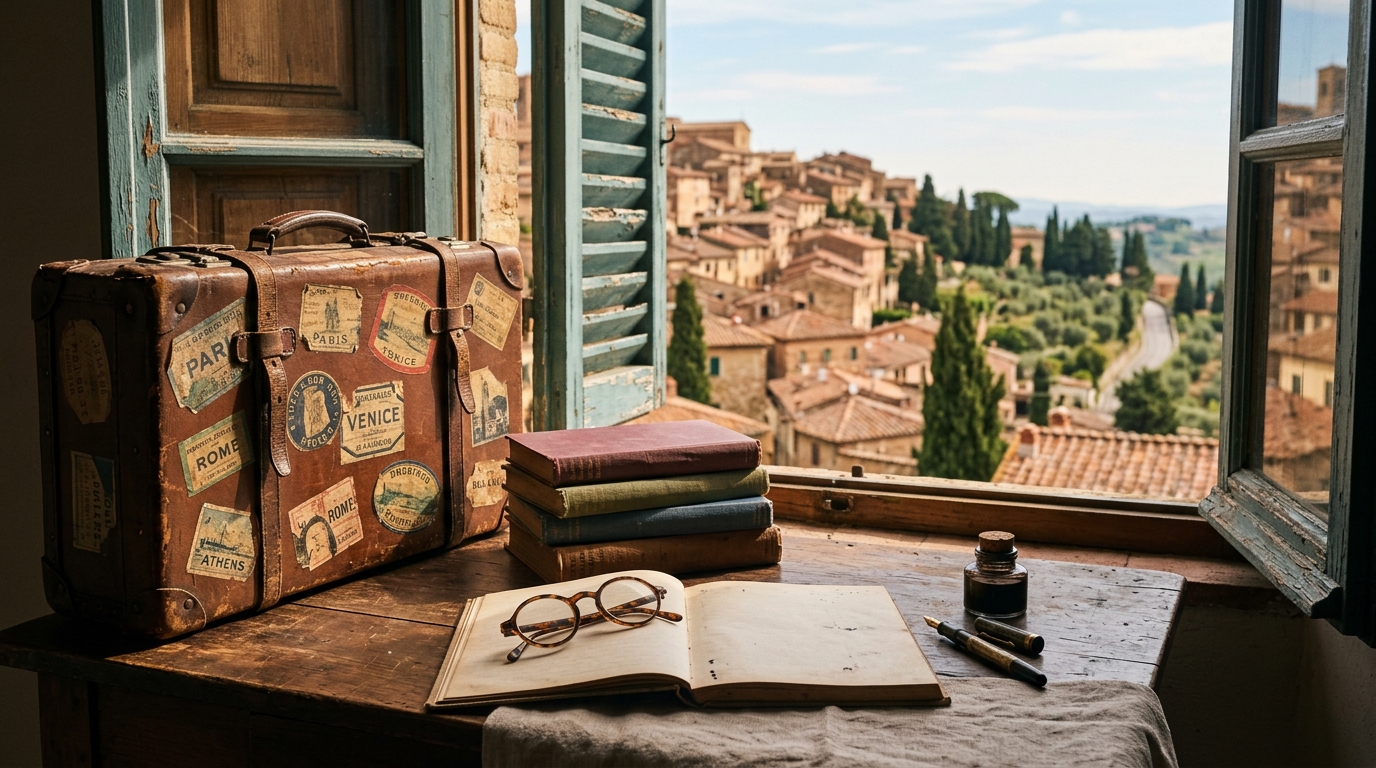
Ask the internet for Aldous Huxley travel quotes and the line that comes back most often is this one: “The real voyage of discovery consists not in seeking new landscapes, but in having new eyes.” Here is the catch, and the reason this page exists. Huxley never wrote that sentence. Marcel Proust did. It gets pinned on Huxley because it sounds like him, and because Huxley is the kind of writer people reach for when they want a clever traveller to quote. The irony is that the real Huxley is far more interesting on the subject than the fake. He was a compulsive traveller who thought most tourism was snobbery, a man who crossed Europe and the world by car and steamer and then wrote essays mocking the very people doing the same thing, himself included. So this page sources it properly: every quote below is either a verified passage cited to book and essay, or flagged honestly as a line he never wrote, and the editions worth owning are here with their receipts.
Early Life: a Scientific Dynasty and the Eton Illness That Turned Him to Words
He was born in Godalming, Surrey, in the summer of 1894, into one of the most formidable intellectual families in England. His grandfather was Thomas Henry Huxley, the biologist who championed Darwin so fiercely that he earned the nickname Darwin’s Bulldog; his father, Leonard, was a writer and editor; his brother Julian became a famous biologist, and his half-brother Andrew would win a Nobel Prize. Science was the family trade, and the young Aldous expected to follow it. Then, at Eton, an attack of the eye disease keratitis left him almost completely blind for the better part of two years. He recovered enough sight to read with difficulty, but a medical career was over. He went up to Balliol College, Oxford, read English literature instead, and graduated in 1916. (britannica.com)
The blindness matters to the traveller he became. A man who has nearly lost his sight does not take seeing for granted, and Huxley spent the rest of his life obsessed with perception, with how we look at things and how rarely we look properly. He published his first book in 1916, worked on the literary magazine the Athenaeum, and by his late twenties was already famous for witty, malicious novels like Crome Yellow and Antic Hay. But he was restless, and as soon as the books sold he started to move, first to Italy, then much further, carrying his bad eyes and his sharp pen across a world he could only half see and yet noticed better than almost anyone.
Career Milestones: Italy, Brave New World and the Road to California
Through the 1920s Huxley lived mostly in Italy and travelled hard, and travel became copy. Along the Road: Notes and Essays of a Tourist (1925) gathered his essays on why people go abroad and how badly they do it, and Jesting Pilate (1926) was the diary of a journey that took him through India, Burma, Malaya, the Pacific and the United States. Beyond the Mexique Bay (1934) recorded a trip through Central America and the Caribbean. These are the books the travel quotes actually come from, and they are far less famous than the novel that arrived in the middle of all this wandering. Brave New World (1932) turned a satirist into a prophet, a nightmare of a future where comfort and conditioning have quietly killed the soul, and it remains the book his name is bolted to. (britannica.com)
In the late 1930s he made his last and longest move, across the Atlantic to California, where he spent the rest of his life. The later work turned inward and upward: The Perennial Philosophy (1945) gathered the mystics of every tradition, and The Doors of Perception (1954) recorded his experiments with the drug mescaline and the idea that the most important journey a person can take is the one inside their own head. His final novel, Island (1962), imagined a sane society on a fictional Pacific island, the destination he had been travelling toward all along. He died in Los Angeles on the 22nd of November 1963, the same afternoon the world was watching Dallas, and the same day the writer C.S. Lewis died in Oxford. He was sixty-nine.
Aldous Huxley’s Best Books for Travellers, with Receipts
1. Brave New World
Best for: Anyone who wants the book his name is built on, and the traveller's nightmare of a world with nowhere left to go
The novel that made Huxley a prophet, a future of engineered comfort where real experience has been travelled out of existence. It is not a travel book, but it is the reason you have heard of him, and the dark twin of the curiosity that drove his real journeys. Start here, then go to the travel essays.
Check Price on Amazon →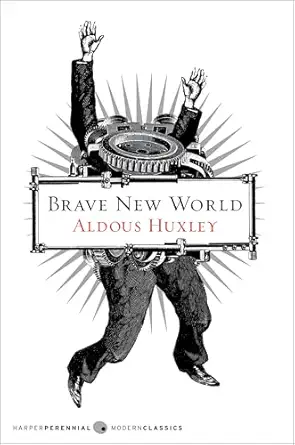
2. The Doors of Perception and Heaven and Hell
Best for: Readers who want the journey Huxley rated above any other, the one that goes inward
His account of taking mescaline in 1953 and the argument that the mind has its own continents to explore. This is the real Huxley voyage of discovery, the one people keep crediting to Proust, and the closest thing he wrote to a guidebook for seeing the ordinary world with new eyes.
Check Price on Amazon →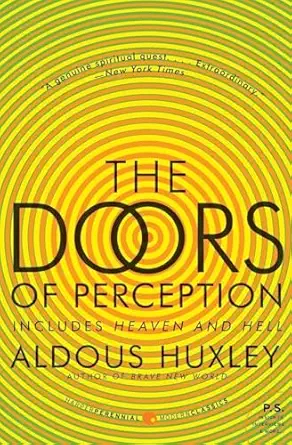
3. Island
Best for: Anyone who wants the utopia at the end of all his travelling
Huxley’s last novel, set on the fictional island of Pala, where a shipwrecked cynic finds a society that got almost everything right. After a life of crossing borders and finding everyone wrong about everyone else, this is the imaginary country he finally wanted to arrive at.
Check Price on Amazon →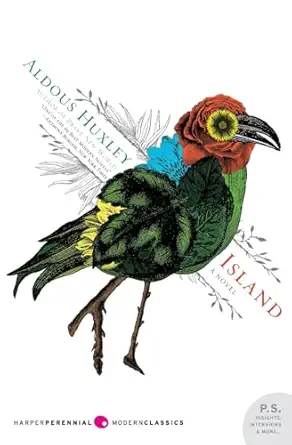
4. The Perennial Philosophy
Best for: Travellers drawn to what the world's mystics agree on across every border
Huxley’s anthology of mystical writing from East and West, arranged to show how the great traditions keep arriving at the same place by different roads. A travel book of a stranger kind, mapping the one destination he thought every culture was describing.
Check Price on Amazon →
5. Brave New World Revisited
Best for: Readers who want Huxley looking back, in his own non-fiction voice, at how close his nightmare came
Written in 1958, Huxley returns to his own prophecy and measures the real world against it, on propaganda, overpopulation and the engineering of consent. The clearest window into how the restless young traveller turned into the worried older sage of California.
Check Price on Amazon →
An honest note from our editors: the two books these travel quotes actually come from sit outside our verified product slate this round, because the in-print editions carry too few reviews for us to rank them fairly. Seek them out by title anyway. Along the Road: Notes and Essays of a Tourist (1925) is the source of nearly every real Huxley travel line on this page, and Jesting Pilate: The Diary of a Journey (1926) is his around-the-world diary. Beyond the Mexique Bay (1934) covers his Central American travels. For the life behind the books, Nicholas Murray’s Aldous Huxley: A Biography is the standard modern account, named here rather than carded.
Huxley’s Travel Philosophy in His Own Words
Huxley’s travel writing is built on a contradiction he was honest about: he loved going places and he despised most of the reasons people go. In Along the Road he argues that the great majority of tourists do not actually enjoy travel at all, that they cross borders out of snobbery and the wish to have something to talk about at home, and that a funeral often has brighter faces than a famous piazza full of sightseers. Then, a few pages later, he admits that he is a born traveller himself, that the urge is a vice he cannot resist any more than he can resist reading at random, and that he tells frank lies about his car like every other motorist. The honesty is the point. He is not above the crowd he is mocking, he is the worst of them, and that is what makes the mockery land.
Out of that contradiction comes the one idea that ties all his journeys together. If most travel is a waste, the cure is not to stay home but to learn to actually see, which is why a man who crossed three continents ended up writing that the real discovery is internal. The traveller who counts countries learns nothing; the traveller who looks properly at one street can find the whole world in it. By the time he reached California and swallowed the mescaline that produced The Doors of Perception, Huxley had simply followed his own argument to its conclusion: the most distant country worth reaching was inside his own head, and the passport was attention. You do not have to take the drug to take the point.

Memorable Aldous Huxley Quotes by Theme
The Tourist Who Saw Through Tourists
The fact is that very few travellers really like travelling. If they go to the trouble and expense of travelling, it is not so much from curiosity, for fun or because they like to see things beautiful and strange, as out of a kind of snobbery.
— Aldous Huxley Along the Road: Notes and Essays of a Tourist (1925), 'Why Not Stay at Home?' The opening salvo of his first travel book, and still the most quotable thing anyone has said against the people who fill the famous places. Huxley is not sneering from a distance, he counts himself in, which is exactly why it stings.
People travel for the same reason as they collect works of art: because the best people do it.
— Aldous Huxley Along the Road: Notes and Essays of a Tourist (1925), 'Why Not Stay at Home?' His theory of travel as social performance, written a century before the word 'bucket list' existed. The point survives the change in transport: a great deal of going somewhere is really about being seen to have gone.
Travel as a Glorious Vice
With me, travelling is frankly a vice.
— Aldous Huxley Along the Road: Notes and Essays of a Tourist (1925), 'Why Not Stay at Home?' The confession that turns the essay from a sermon into something human. Having spent pages mocking tourists, Huxley admits he cannot stop himself, that the urge to move is a weakness he indulges and only half regrets. The most honest line about wanderlust ever written.
Old guide-books, so out of date as to be historical documents, make excellent travelling companions.
— Aldous Huxley Along the Road: Notes and Essays of a Tourist (1925), 'Guide-Books' Huxley's quiet argument for travelling with the wrong map on purpose. An outdated guide stops being a set of instructions and becomes a conversation with the past, which is more interesting than being told where to stand for the photograph.
What You Actually Discover
To travel is to discover that everyone is wrong about other countries.
— Aldous Huxley Jesting Pilate: The Diary of a Journey (1926) The one genuine Huxley travel line that has gone properly viral, and deservedly. It is the whole argument of his around-the-world diary compressed to a sentence: the value of going is not the sights, it is the demolition of your certainties about the people who live there.
The Lines People Pin on Him
The real voyage of discovery consists not in seeking new landscapes, but in having new eyes.
— Actually Marcel Proust, not Huxley Marcel Proust, In Search of Lost Time (The Captive, 1923). Not written by Huxley The single most common travel quote wrongly credited to Huxley on quote sites and posters. It is Proust's, from In Search of Lost Time. It gets attached to Huxley because the idea of seeing with new eyes really is one of his obsessions, so the borrowing almost makes sense. Almost. The words are Proust's.
There is only one corner of the universe you can be certain of improving, and that's your own self.
— Widely attributed to Huxley Commonly credited to Huxley, but no verifiable book or page has been located; circulates on quote-aggregator sites This one sounds like Huxley and may well be his, but we could not pin it to a chapter or an essay, and it is a line about self-improvement rather than travel. Useful on a poster, treat the attribution as unconfirmed until a page turns up, and do not file it under travel.
A sourcing note, because this page exists to be the accurate one and our editorial standards demand receipts: the flagged lines above follow the two classic patterns. One is a real sentence by a different author that drifts onto the more quotable name, which is what happened with the Proust line. The other is a plausible aphorism that arrives already wearing the author’s face, with no text behind it. Huxley’s reputation as the clever one in the room makes him a magnet for both. When you cannot find a book, an essay or a page under a quote, treat the attribution as decoration rather than evidence. More on how we verify lives is on our about us page.
For the full canon in context, browse the 100 best travel quotes mega-pillar, where Huxley’s ‘everyone is wrong about other countries’ holds down the sceptical, well-travelled end of the list.
Other Voices on the Road
Frequently Asked Questions about Aldous Huxley
What is Aldous Huxley's most famous travel quote?
His most quoted genuine travel line is from Jesting Pilate (1926): “To travel is to discover that everyone is wrong about other countries.” The line most often shared in his name, “The real voyage of discovery consists in having new eyes,” was actually written by Marcel Proust, not Huxley.
Did Aldous Huxley say "The real voyage of discovery consists in having new eyes"?
No. That sentence belongs to Marcel Proust, from In Search of Lost Time. It is constantly credited to Huxley on quote sites because the idea of seeing with new eyes runs through his work, especially The Doors of Perception, but the words are Proust’s.
Did Aldous Huxley actually travel?
Constantly. He lived in Italy for much of the 1920s, travelled around the world through India, Southeast Asia and the United States for his diary Jesting Pilate, journeyed through Central America for Beyond the Mexique Bay, and finally settled in California in the late 1930s. He wrote whole books about these trips.
What are Aldous Huxley's best books for travellers?
For the travel writing itself, seek out Along the Road (1925) and Jesting Pilate (1926). For the wider Huxley, start with Brave New World (1932), then The Doors of Perception (1954) for his inward journey, and Island (1962) for the utopia at the end of all his wandering.
Why did Huxley call travelling 'a vice'?
In Along the Road (1925) he confesses, “With me, travelling is frankly a vice,” admitting that after pages of mocking tourists for going abroad out of snobbery, he cannot resist the urge to move himself. He treated the compulsion to travel as a weakness he indulged with his eyes open.
Aldous Huxley’s Lasting Legacy for Travellers
Huxley’s gift to travellers is permission to be honest about why we go. He saw through the snobbery of the bucket list a hundred years before it had a name, admitted he was as guilty as anyone, and then offered the only cure he believed in: stop counting countries and start actually seeing. The restless young man who crossed Europe by car and the world by ship ended up arguing that the most important journey runs inward, and he spent his last years in California chasing it. Read him for the wit, stay for the challenge, that the difference between a tourist and a traveller is not distance but attention. More sourced voices are waiting in our author bio library.