
Confucius: Travel Quotes, the 14-Year Exile, and the Lines He Never Said
Verified Confucius travel quotes labelled as what they actually are: real lines from the Analects in the Legge translation, the viral fakes flagged honestly, and the editions worth owning.

Ask the internet for Confucius travel quotes and two lines arrive before you finish typing: “Wherever you go, go with all your heart,” and “A journey of a thousand miles begins with a single step.” Here is the thing, and the reason this page exists: the first appears in no translation of the Analects, and the second is not even his. It belongs to Lao Tzu’s Tao Te Ching. What makes the borrowing unnecessary is that Confucius owns one of the great travel stories of the ancient world. At about 55, a former minister of crime in the state of Lu walked away from his career and spent roughly fourteen years on the road, trailing from court to court through Wei, Song, Chen, Cai and Chu, looking for one ruler willing to govern by his ideas. He was detained at Kuang after being mistaken for an outlaw, nearly crushed in Song when an enemy felled a tree over his campsite, and came close to starving between Chen and Cai. The conversations his students recorded along the way became the Analects, and it opens, fittingly, with a line about travellers. So this page does the sourcing properly: every quote below is either a verified line from the Legge translation or flagged honestly as a fake, and the editions worth owning are here with their receipts.
Early Life: the Poor Scholar Who Invented the Teacher
Confucius was born in 551 BC near Zou, in the small state of Lu, in what is now Shandong province. His name was Kong Qiu; Confucius is the Latin polish that Jesuit missionaries applied two thousand years later to Kongzi, Master Kong. His father, an elderly soldier, died when the boy was about three, leaving the family respectable and poor. The Analects keeps the receipt in his own voice: “When I was young, my condition was low, and therefore I acquired my ability in many things” (Book IX, Legge translation). The many things included keeping granary accounts and minding livestock, work a long way beneath the scholar-official class he would spend his life arguing into existence. He taught himself the rites, the odes and the histories, opened his door to students regardless of birth, and built a reputation as the most learned man in Lu. Government noticed late. In his early fifties he finally held real office, rising to minister of crime, and tradition records that Lu under his administration became briefly, inconveniently well governed. Inconveniently, because a well-run Lu alarmed the neighbouring state of Qi, and Qi knew exactly how to fix it.
The 14-Year Exile: a Sage on the Road
What Qi sent, the ancient historians say, was a gift: eighty dancing girls and a hundred and twenty fine horses, delivered to the head of the Ji family who ran Lu’s government. The court duly dissolved into entertainment, the state sacrifices were botched, and the ritual meat never reached Confucius, a slight that doubled as a dismissal notice. He took the hint and the road. In 497 BC, at about 55, he left Lu with a handful of students and spent roughly the next fourteen years travelling the feudal states of eastern China, Wei, Song, Chen, Cai and Chu among them, offering each ruler in turn a government built on virtue rather than punishment. None of them bought it. The road supplied the drama his philosophy never advertises. At Kuang he was detained for days because the locals mistook him for Yang Hu, an outlaw who had ransacked the town and unluckily resembled him. In Song, the war minister Huan Tui sent men to fell a tree over the spot where he was teaching; his answer, preserved in Book VII, was that Heaven had produced the virtue in him, and Huan Tui could do nothing about it. Between Chen and Cai the provisions ran out entirely and his followers grew too weak to stand, which produced a definition instead of a complaint: “The superior man may indeed have to endure want, but the mean man, when he is in want, gives way to unbridled license” (Book XV, Legge). In 484 BC, pushing 70, he was invited home to Lu. He spent his last five years teaching and editing the classics, and died in 479 BC. The travel pitch had failed completely; the travel notes conquered East Asia.

The Best Translations of the Analects (and What to Read First)
1. The Analects (Penguin Classics, trans. D.C. Lau)
Best for: First-time readers who want the classic translation in one inexpensive paperback
D.C. Lau’s Penguin translation is the one most English readers met first and the one most quote checks run against. Clear, dry, reliable, and usually the cheapest serious edition on the shelf.
Check Price on Amazon →
2. The Analects (Penguin Classics Deluxe, trans. Annping Chin)
Best for: Readers who want the most readable modern translation with notes that earn their place
Annping Chin’s 2014 translation prints the Chinese text alongside the English and explains who every duke, steward and student actually was. The edition this page would hand you across the counter.
Check Price on Amazon →
3. Analects: With Selections from Traditional Commentaries (Hackett, trans. Edward Slingerland)
Best for: Going deep: two millennia of Chinese commentary under every passage
Edward Slingerland translates the Analects with selections from the traditional commentaries beneath each passage, which is how the book was actually read for most of its life. The deep end, satisfyingly cold.
Check Price on Amazon →
4. The Four Chinese Classics (trans. David Hinton)
Best for: Owning both sides of the thousand-miles misattribution in one volume
David Hinton’s acclaimed translations of the Tao Te Ching, Chuang Tzu, the Analects and Mencius in a single paperback. The only purchase on this page that lets you check the famous single-step line against Lao Tzu and Confucius at the same time.
Check Price on Amazon →
5. The Complete Confucius: The Analects, The Doctrine of the Mean, and The Great Learning
Best for: All three core Confucian texts at pocket-money price
The Analects plus the Doctrine of the Mean and the Great Learning in one inexpensive paperback with a short introduction. Under seven dollars for the complete argument, a deal the Master would have endorsed.
Check Price on Amazon →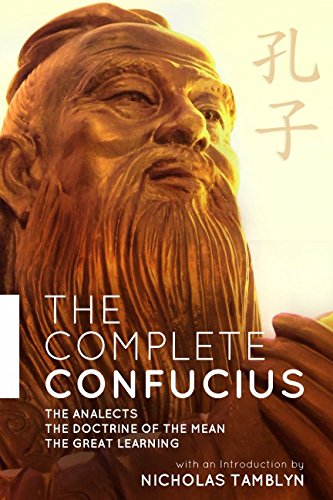
An honest stocking note from our editors: the biographies sit under our review-count floor for product cards, so they get names instead. Jonathan Clements’s compact Confucius: A Biography, Annping Chin’s The Authentic Confucius: A Life of Thought and Politics, and Michael Schuman’s Confucius: And the World He Created are all worth seeking out by title if you want the life behind the lines.
His Travel Philosophy: Be Findable, Then Go
Confucius never wrote a travel philosophy; he had a travel policy. It sits in Book IV of the Analects, and it is the least romantic line in the genre: “While his parents are alive, the son may not go abroad to a distance. If he does go abroad, he must have a fixed place to which he goes.” Travel, in other words, is a relationship with the people you leave, not just the places you reach. Tell someone where you are going. Be findable. Every embassy registration form and every worried parental text message is a footnote to that sentence.
The deeper position is that the journey was never the point; the work was. He did not leave Lu to find himself, he left to find an employer, and he kept the same job description through fourteen years of rejection. That puts him surprisingly close to Pico Iyer, the modern master of the argument that stillness beats movement, and to Ralph Waldo Emerson, who warned that travelling is a fool’s paradise for anyone expecting geography to fix character. Confucius would have endorsed the warning and boarded the cart anyway, because duty, unlike wanderlust, does not check the weather.
And yet the Analects is quietly full of movement: friends arriving from distant quarters, lessons taken from any two strangers walking beside you, the wise drawn to water and the virtuous to hills. The counter-position belongs to Robert Louis Stevenson, who declared he travelled not to go anywhere, but to go. Confucius travelled precisely to go somewhere, failed to arrive for fourteen straight years, and turned the failure into the most quoted book in East Asia. Somewhere between the two positions is your next trip, honestly declared to your mother.
Memorable Confucius Quotes by Theme
Arrivals and the Road
Is it not delightful to have friends coming from distant quarters?
— Confucius Analects, Book I (James Legge translation, 1861) The opening passage of the Analects. The most influential book in East Asian history begins with the pleasure of an arrival, which is as strong a travel endorsement as the ancient world ever printed.
While his parents are alive, the son may not go abroad to a distance. If he does go abroad, he must have a fixed place to which he goes.
— Confucius Analects, Book IV (James Legge translation, 1861) The genuine Confucius travel rule, and the least romantic one in the genre: go if you must, but be findable. Twenty-five centuries before roaming plans, this was the itinerary-sharing policy.
Mountains, Rivers and Walking Companions
The wise find pleasure in water; the virtuous find pleasure in hills.
— Confucius Analects, Book VI (James Legge translation, 1861) The ancestor of every landscape preference quiz: are you a coast person or a mountain person? Confucius filed the question under character, not holiday planning, which is why it has lasted.
When I walk along with two others, they may serve me as my teachers. I will select their good qualities and follow them, their bad qualities and avoid them.
— Confucius Analects, Book VII (James Legge translation, 1861) The walking quote, and quietly the best argument for group travel ever made: any road with two strangers on it is a classroom, including the lessons in what not to do.
The prosecution of learning may be compared to what may happen in raising a mound. If there want but one basket of earth to complete the work, and I stop, the stopping is my own work.
— Confucius Analects, Book IX (James Legge translation, 1861) The authentic kernel behind the poster favourite "It does not matter how slowly you go as long as you do not stop." The real version is sharper: it does matter, and whose fault the stopping is gets named.
The Lines He Never Said
Wherever you go, go with all your heart.
— Attributed to Confucius (no source exists) Appears in no translation of the Analects or any other early Confucian text The most shared "Confucius travel quote" on the internet, and it is untraceable: not in Legge, not in Lau, not in Chin, not in Slingerland. No quote site that carries it cites a book or chapter. A lovely sentiment wearing a borrowed name.
A journey of a thousand miles begins with a single step.
— Attributed to Confucius (it is Lao Tzu) Tao Te Ching, chapter 64, by Lao Tzu, routinely credited to Confucius on poster and quote sites Real quote, wrong sage. The line belongs to Lao Tzu's Tao Te Ching, chapter 64, yet it circulates under Confucius's portrait across the poster economy, including on page one of Google for this exact search. Different book, different philosophy, different man.
A sourcing note, because this page exists to be the accurate one and our editorial standards demand receipts: alongside the two fakes flagged above, “It does not matter how slowly you go as long as you do not stop” has no Analects source in that wording; its authentic kernel is the raising-the-mound passage from Book IX quoted above, which says something sharper about whose fault stopping is. “Roads were made for journeys, not destinations” is untraceable in any translation, and “No matter where you go, there you are” is best known from a 1984 science-fiction comedy, which has not stopped travel groups pinning it on a sage who died 2,500 years earlier. One note for checkers: we cite the Legge translation of 1861, and some modern editions shift chapter numbers by one or two. The pattern is the one we document for the famous misattributed Mark Twain sailing quote: the bigger the name, the stickier the fake. The difference here is that the verified Analects lines, checkable against Legge on Project Gutenberg, have outlasted every poster that misquotes them. The same poster economy treats Lao Tzu and Henry David Thoreau the same way, which is why both are next in our sourcing queue.
For the full canon in context, browse the 100 best travel quotes mega-pillar, where the distant-quarters line holds down the wisdom end.
Other Voices in Travel Wisdom
Frequently Asked Questions about Confucius
What did Confucius say about travel?
His verified travel lines come from the Analects in the Legge translation: the opening passage, “Is it not delightful to have friends coming from distant quarters?” (Book I), and the practical rule, “While his parents are alive, the son may not go abroad to a distance. If he does go abroad, he must have a fixed place to which he goes” (Book IV). He backed them with about fourteen years of travel through the feudal states of eastern China.
Did Confucius say "wherever you go, go with all your heart"?
No. The line appears in no translation of the Analects or any other early Confucian text, and no source that carries it cites a book or chapter. It became a “Confucius quote” through repetition on posters and quote sites, not through anything he said.
Did Confucius say "a journey of a thousand miles begins with a single step"?
No. That line is from chapter 64 of the Tao Te Ching, attributed to Lao Tzu, the founding text of Taoism. It is routinely credited to Confucius on poster and quote sites, but it belongs to a different book, a different philosophy and a different man.
How much did Confucius actually travel?
A great deal for his era. After losing his position in Lu around 497 BC, he spent roughly fourteen years travelling the feudal states of eastern China, including Wei, Song, Chen, Cai and Chu, seeking a ruler who would adopt his ideas. The road nearly killed him more than once: he was detained at Kuang after being mistaken for an outlaw, escaped an assassination attempt in Song, and nearly starved between Chen and Cai before returning to Lu around 484 BC.
What is the best translation of the Analects to start with?
Start with D.C. Lau’s Penguin Classics translation, the standard inexpensive edition most quote checks run against. Annping Chin’s Penguin Classics Deluxe translation is the most readable modern version with excellent notes, and Edward Slingerland’s Hackett edition adds the traditional Chinese commentaries for readers who want the deep dive.
Confucius’s Lasting Legacy for Travellers
Confucius died believing he had failed; no ruler ever governed by his ideas in his lifetime. The students he dragged through Kuang, Song and the Chen-Cai famine wrote down what he had said, and within three centuries the failed consultant had become the official philosophy of the Chinese state, a position he held, with interruptions, into the twentieth century. His temple complex at Qufu is now a UNESCO World Heritage site and one of China’s great pilgrimage destinations, which is its own punchline: the man who said sons should not travel far while their parents live became the reason millions of people get on trains. More sourced voices are waiting in our author bio library, and our editorial team explains how every line on this site earns its place.